
A multi-state US employer posts an engineering role with a salary range built on market data from two years ago and a loose internal equity check. The posting triggers a non-compliance penalty in three states, and a current employee files an information request under a fresh transparency law. The HR team learns the hard way that the old model of running compensation planning in one system and scrambling for equity analytics in a spreadsheet is obsolete.
The operational gap between traditional compensation planning and mandatory pay equity analytics has snapped shut. Fourteen US states now have active pay transparency laws, and the EU Pay Transparency Directive's June 2026 transposition deadline is forcing global organizations to rethink their entire compensation tech stack from a compliance posture. These regulations demand auditable pay gap analysis, defensible remediation workflows, and on-demand employee reporting, none of which legacy compensation planning tools were built to deliver.
A new software category has emerged to close that gap: unified platforms that merge compensation planning with embedded pay transparency analytics. They exist, they are production-ready, and forward-leaning HR teams are adopting them right now.
What this means for compensation and rewards leaders evaluating software in 2026:
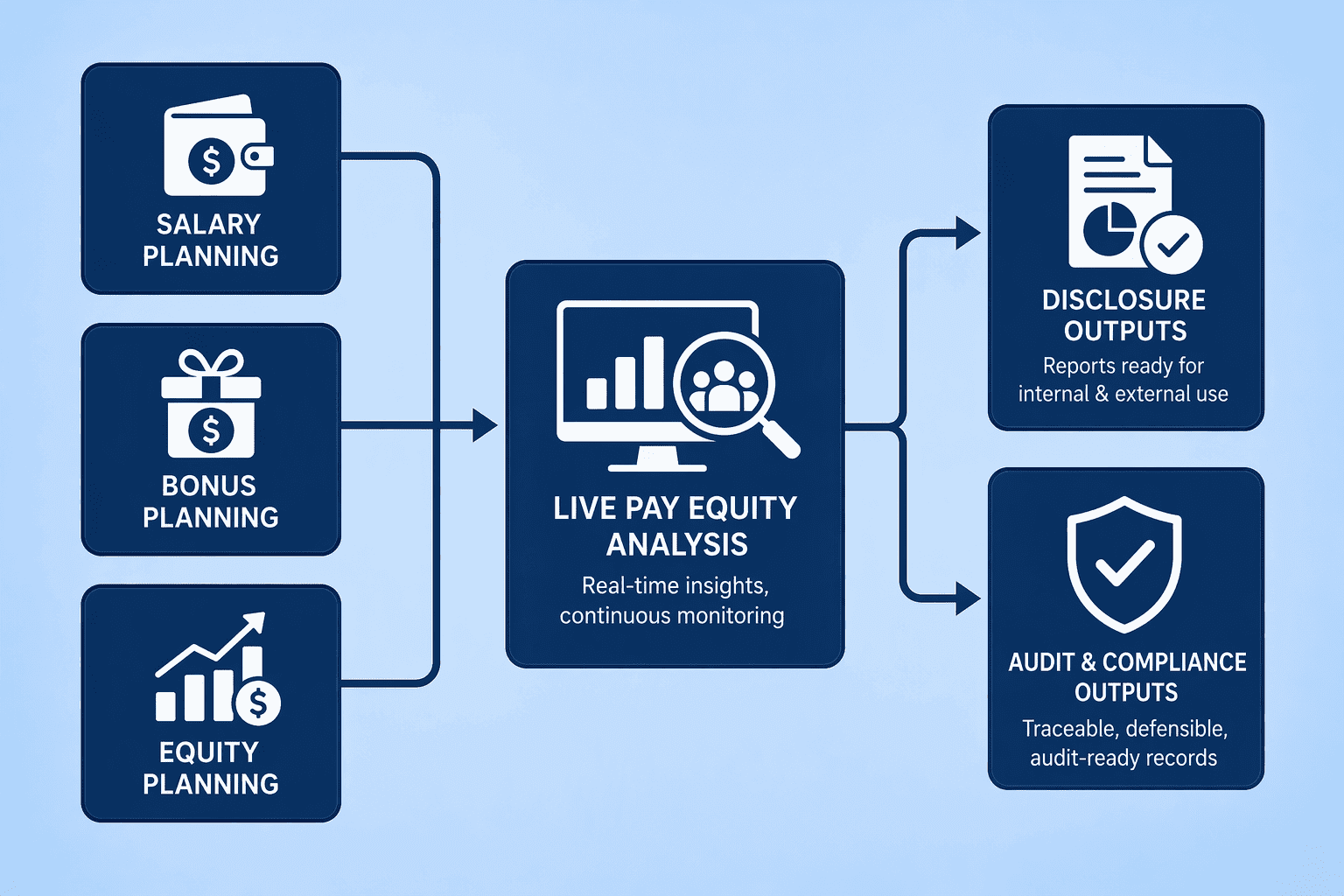
You are looking at a single system that runs your salary, bonus, and equity cycles and simultaneously proves your pay is fair. That is the operational definition of unified compensation and pay transparency software. It moves beyond static spreadsheets and annual survey files by connecting your compensation planning engine directly to a live pay equity analysis module.
This is not a standard HCM suite with a transparency report tacked on. A unified platform ingests your employee data, market benchmarks, and job architecture to do two things at once: model merit increases and budget allocations, then run a regression-based pay gap analysis against the same dataset. The output is a remediation plan with a dollar figure attached, not a standalone consultant's PDF.
Consider the regulatory landscape driving adoption. 14 US states now enforce active pay transparency laws, with Massachusetts requiring salary range disclosure for any employer with 25 or more employees and New Jersey mandating it for shops with just 10 or more. Simultaneously, the EU Pay Transparency Directive’s member-state transposition deadline lands in June 2026, triggering pay gap reporting obligations that phase in through and beyond 2026.
A unified tool lets you generate a defensible salary range, publish it, and audit the underlying pay equity data from one interface. What separates a genuine unified platform from a legacy planning module is the remediation workflow. Traditional planning software stops at budget distribution; you still export data to a consultant for a pay gap study.
A unified system like Semos Cloud’s Total Rewards Hub includes scenario modeling with full remediation cost visibility and structured approval chains with audit trails. Every adjustment to close a gap is tracked, attributable, and reportable. The manager experience is another dividing line.
Because 37% of US organizations report that managers cannot explain their own compensation programs, a unified platform equips front-line leaders with an AI-powered team view and on-demand transparency statements. When an employee asks, "Why is my range this?"
the manager pulls a consistent, system-generated answer rather than improvising. Unified compensation and transparency software, then, is a closed loop: you plan pay, check it for gaps, fix what is broken, and communicate the outcome, all without leaving the platform.
The US now operates under a patchwork of 14 state-level pay transparency laws, each with its own thresholds, disclosure requirements, and penalty structures. Massachusetts enforces salary range disclosure for employers with 25 or more employees, while New Jersey mandates pay range and benefits disclosure for employers with just 10 or more employees. What started as a coastal compliance concern is now a national operational reality.
Layered on top of that: the EU Pay Transparency Directive's June 2026 transposition deadline. Any US company with EU employees faces pay gap reporting obligations and employee right-to-information requirements that phase in through and beyond 2026. Key obligations under the Directive include pay gap reporting and responding to employee information requests, and those obligations demand an analytical backbone most point-solution compensation tools lack. The operational consequence is blunt: if your compensation planning software cannot produce defensible, regression-backed pay equity reports on demand, you are running compliance on borrowed time.
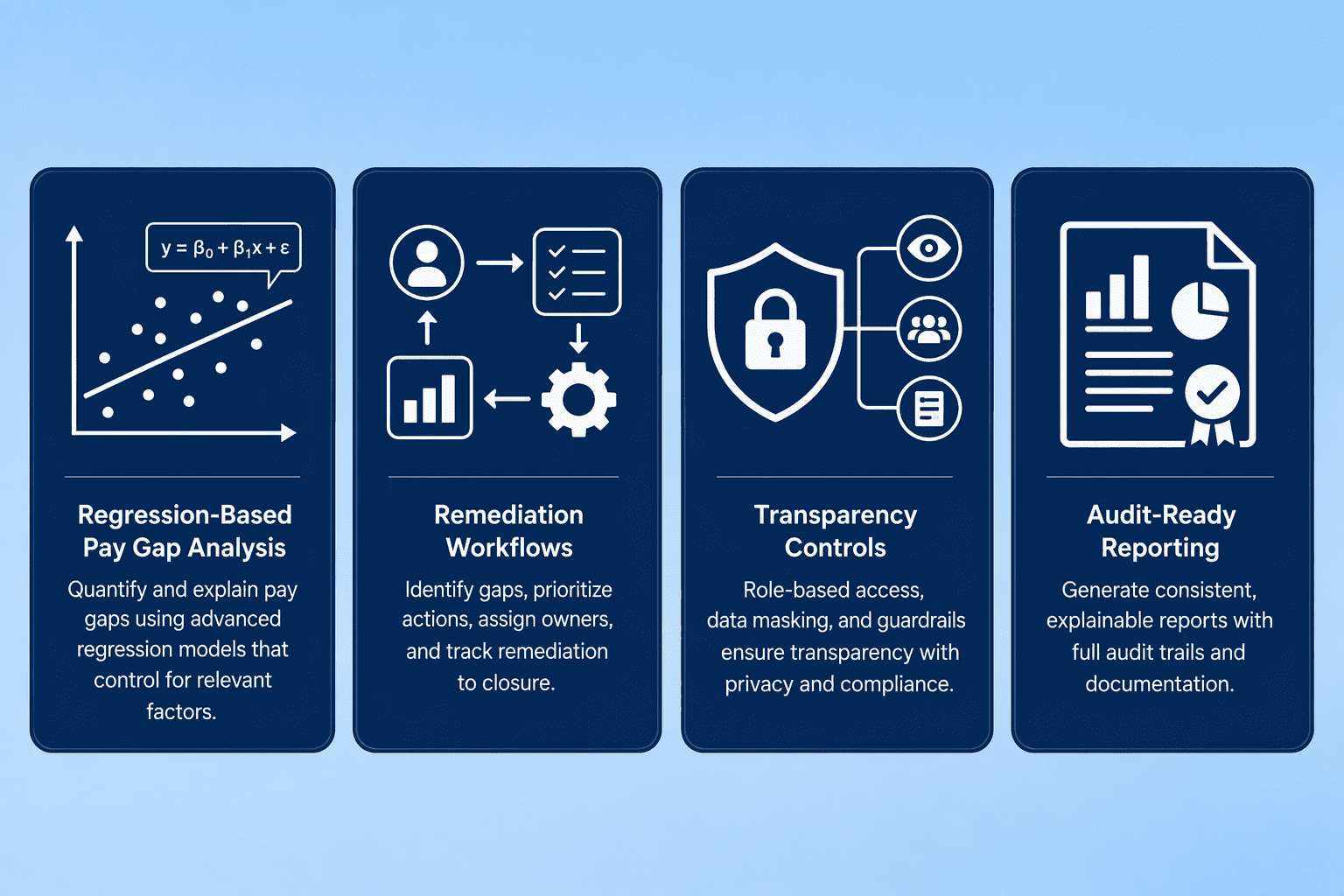
Four capabilities separate a genuine unified compensation-and-transparency platform from a compensation planning tool with a dashboard labeled "equity."
CompUp entered the market in 2019 with a compensation-centric architecture rather than bolting pay transparency onto an HCM suite. The platform's observable feature set, verified against its own product documentation and a 4.9 G2 rating, maps onto three of the four unified-platform pillars.
|---|---|---|
| Compensation planning cycles | Merit, bonus, and equity planning with budget controls and structured approvals | Product positioning and feature pages list Compensation Management as a core offering |
| Pay equity analytics | Pay structure analysis and parity detection at the organization level | Purpose stated as "eliminating pay disparity"; confirmed by real-time comp data access across industries |
| Transparency statements | Personalized Total Rewards Statements generated at appraisal close | Documented feature: automated generation of individualized Total Rewards Statements |
| Manager-enablement tools | People Analytics and Workforce Planning modules provide visibility layers | Modules listed: People Analytics, Workforce Planning, Attrition Analysis |
| HRIS integrations | Pre-built connectors to BambooHR, Lattice, Darwinbox, and Workable | Confirmed integration list; no SAP or Workday integration confirmed in source material |
What the source material does not fully resolve is the depth of regression methodology underpinning CompUp's pay gap analysis and whether the platform provides the full remediation workflow with audit trails described in pillar two. For US mid-market buyers running compensation on BambooHR or Workable, CompUp's integration footprint and $3 per-employee-per-year starting price make it a practical contender. But IT teams in Workday or SAP shops will need to validate integration depth directly.
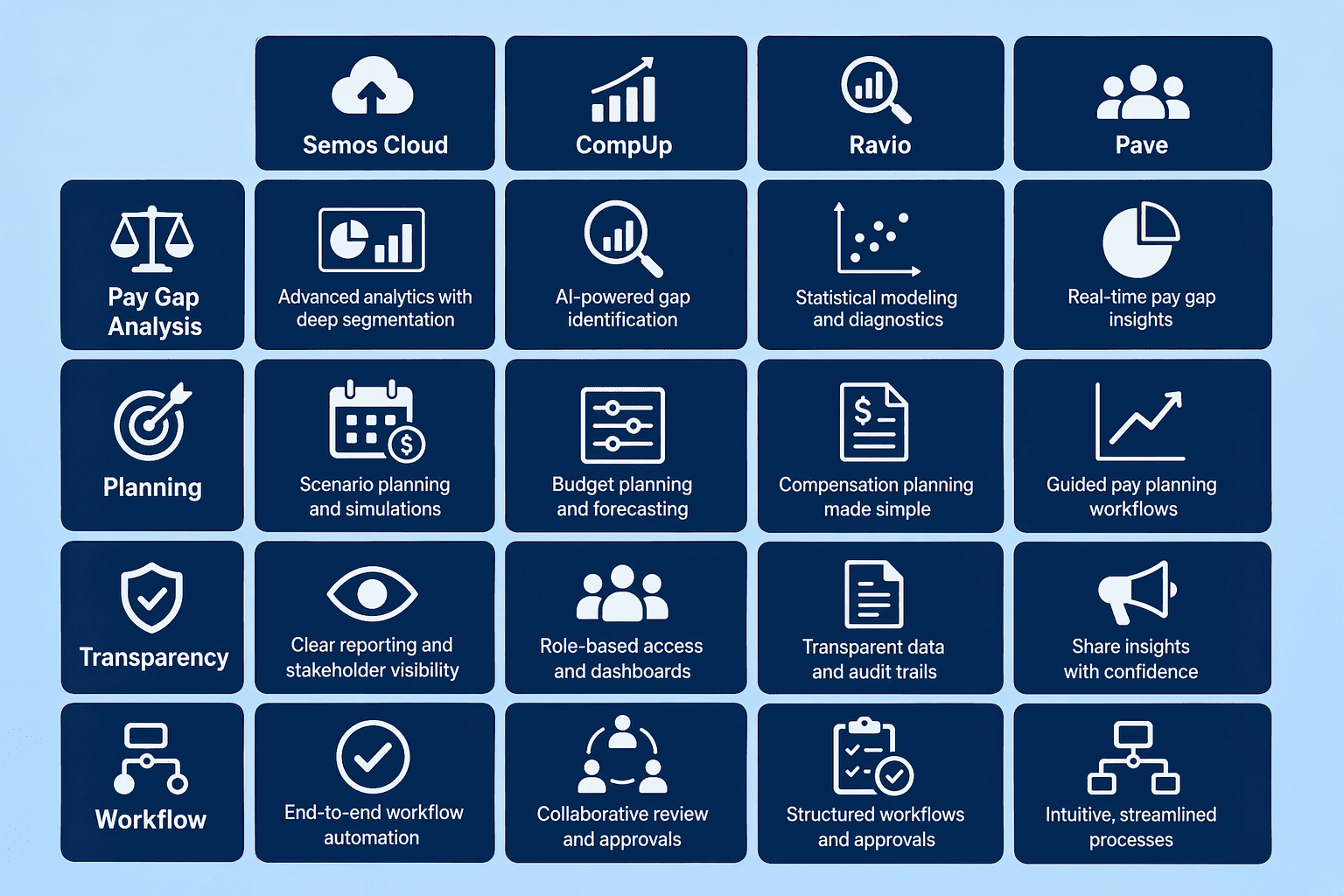
Three other platforms illustrate the range of what's available in the unified compensation-and-transparency category. Stacking each against the same pillar framework surfaces real trade-offs.
| Feature | Semos Cloud Total Rewards Hub | CompUp | Ravio | Pave |
|---|---|---|---|---|
| Pay gap analysis method | Regression-based with scenario modeling and remediation cost visibility | Parity analysis tied to compensation structures; regression depth not fully detailed in sources | Compensation benchmarking and pay equity analysis embedded in strategic planning workflow | Compensation analysis tools with market data and pay equity check; regression depth not detailed in blog sources |
| Remediation workflows | Integrated business-rule workflows with full audit trail | Not explicitly detailed in verified sources | Framed as part of strategic planning; specific audit-trail depth not confirmed | Not framed as a transparency-remediation engine in the sourced material |
| Transparency statements | Automated, on-demand employee reports | Personalized Total Rewards Statements at appraisal close | Not a prominently listed feature in the sourcing | Not a prominently listed feature in the sourcing |
| Manager tools | AI compensation assistant plus Manager Team View for pay conversations | People Analytics and Workforce Planning visibility layers | Compensation planning platform approach; dedicated manager pay-communication tools not highlighted | Comp analysis tools focus is analyst/comp-team-facing; manager enablement not detailed in source |
| HRIS integrations | SAP SuccessFactors, Workday, Oracle HCM | BambooHR, Lattice, Darwinbox, Workable | Not detailed in the source excerpt | Not detailed in the blog source excerpt |
| ESOP support | Not detailed in sourcing | ESOP management is a named platform capability | Not detailed | Not detailed |
| Ideal company size | Mid-market to enterprise, global employers with multi-jurisdiction compliance needs | 100-plus employee organizations across 140-plus countries; mid-market core | Companies running strategic compensation planning cycles | Companies building compensation programs with real-time market data |
The clearest dividing line is HRIS integration depth. Semos Cloud targets the enterprise SAP/Workday/Oracle install base, while CompUp aligns with the mid-market BambooHR and Darwinbox ecosystems. Ravio and Pave approach the problem from the comp strategy analyst's perspective rather than the compliance-operational layer Semos Cloud and CompUp represent.
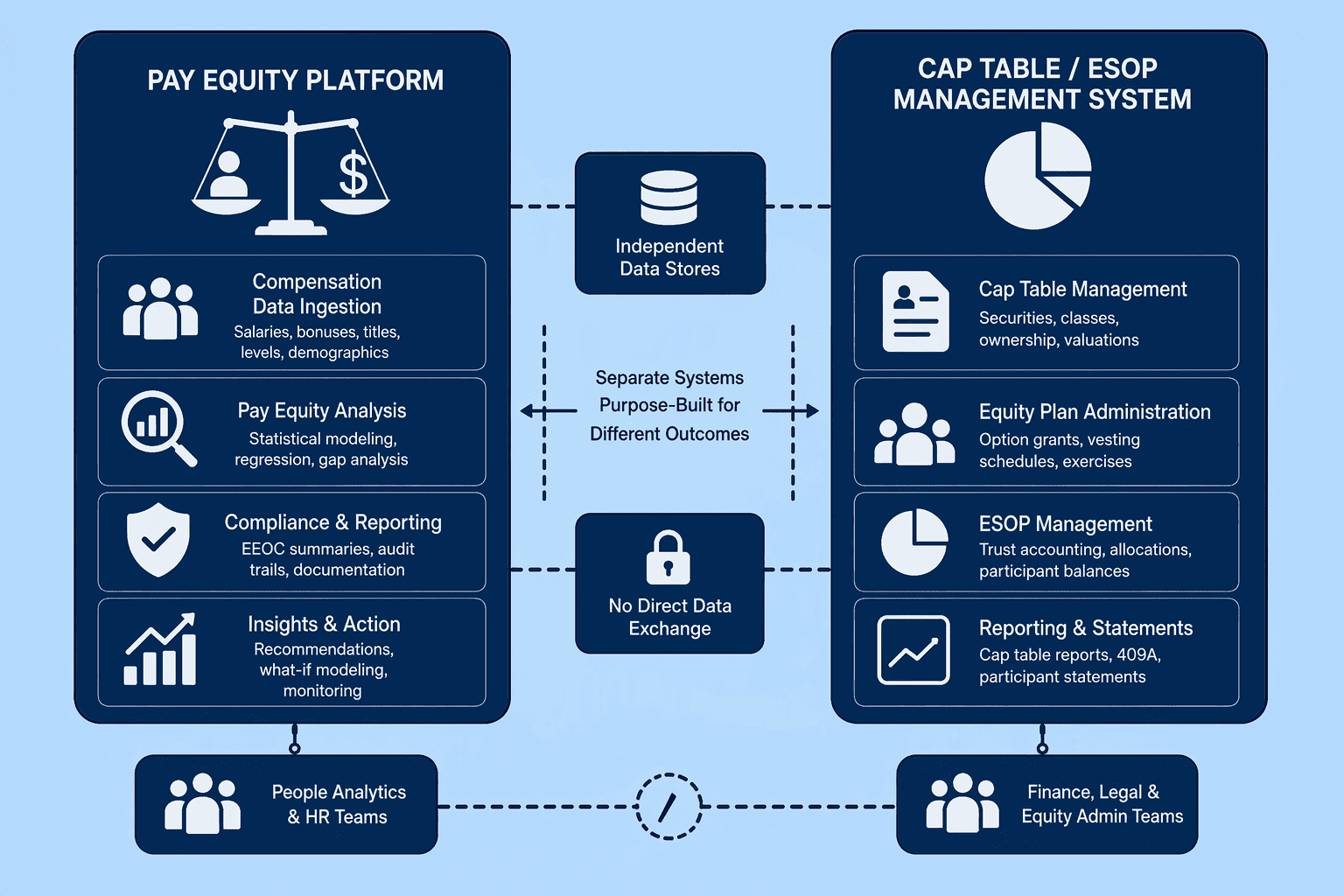
Most unified compensation-and-transparency platforms do not natively handle full ESOP administration. The architecture that makes a platform excellent at regression-based pay gap analysis (normalizing payroll data across departments, geographies, and tenure bands) is different from the architecture required to manage cap tables, exercise windows, vesting schedules, and 409A valuations. Cap-table management lives in a separate software category. The tools that excel there (Carta, Pulley) do not claim to be pay transparency platforms.
CompUp is a notable exception because its platform DNA includes ESOP management alongside compensation planning. The company offers a platform designed for implementing and managing ESOPs, and its founding team built the product to bridge equity grants and traditional pay structures in a single system. This is the ecosystem pattern you are looking for: an ESOP-aware compensation planning layer that can model total rewards inclusive of equity, while a dedicated cap-table platform handles the legal and securities-compliance machinery.
What a unified tool *should* do is ingest equity grant data, calculate total compensation inclusive of projected equity value, and run pay equity analyses that treat equity as a compensable component alongside base and bonus. If a platform cannot surface whether equity grants are distributed equitably by gender or race, it does not matter that it processes merit cycles beautifully. The analytical question is not whether the software administers the ESOP. It is whether the software models equity distribution through a transparency lens.
For the US mid-market buyer running 100 to 500 employees with an active ESOP, the realistic stack in 2026 pairs a compensation-and-transparency platform (CompUp, Semos Cloud, or a similarly architected tool) with a dedicated cap-table vendor. Evaluate the integration between the two, not whether one displaces the other.
Here are the six dimensions mid-market buyers should build their RFP scorecards around, ordered from must-verify to nice-to-confirm:
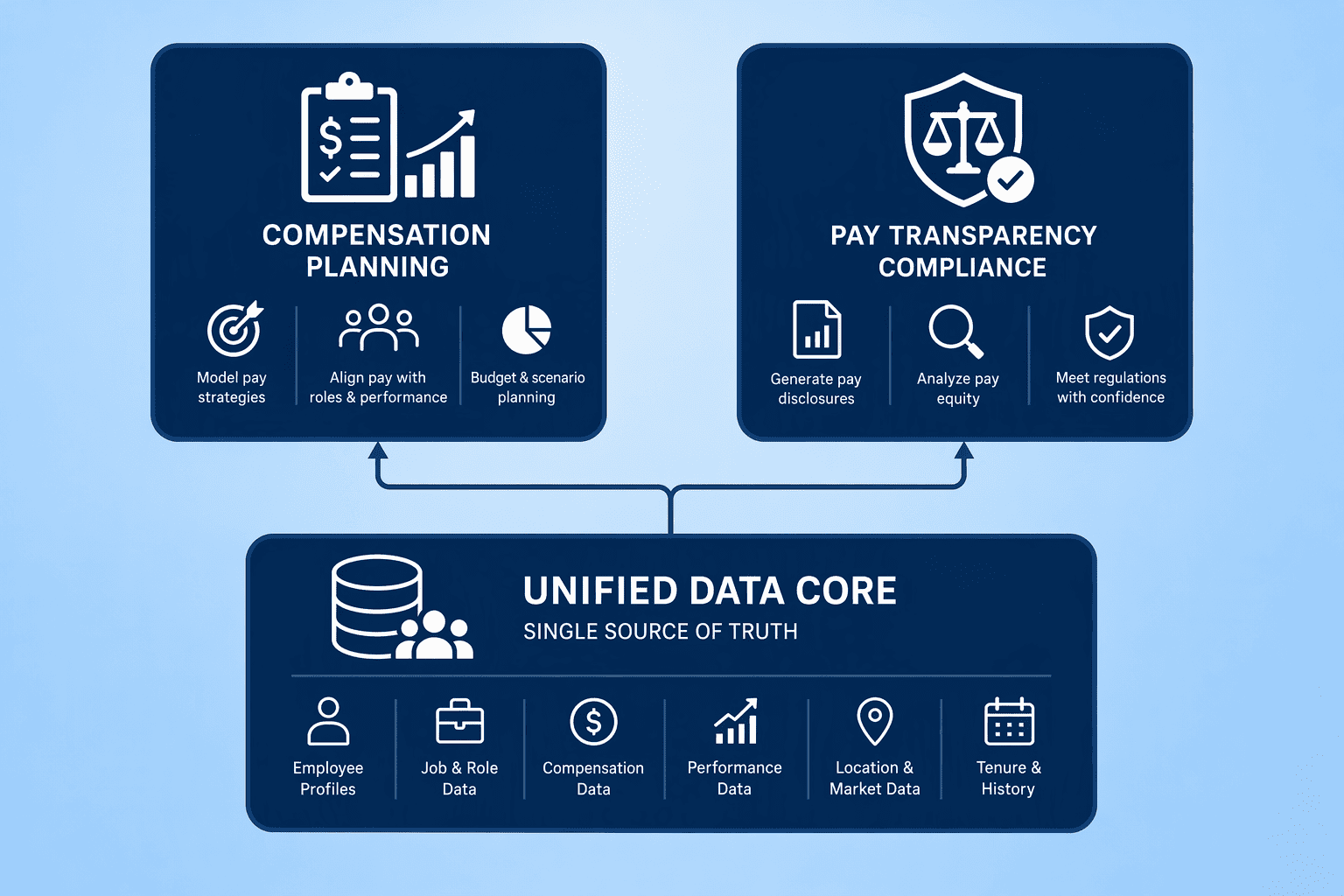
Unified compensation and transparency software runs compensation planning and pay transparency compliance on the same data core instead of patching together separate tools. It handles merit cycles, bonus allocation, and equity grants while simultaneously surfacing pay gaps by gender, race, and geography with the regression analysis and audit trail a regulator or employee can request at any time.
Contrast that with the status quo. Traditional compensation planning software is purpose-built for budget modeling, approval workflows, and communicating salary and bonus decisions, but it treats pay equity as a separate analysis you run offline. Compensation management software centralizes pay data, employee performance, and compensation history to inform fair and consistent pay decisions, and it rarely bakes in the transparency obligations now landing on HR desks. A unified platform does. It answers the five core questions compensation planning software addresses (market positioning, role structures, salary bands, risk detection, and budget allocation) while keeping pay gap analysis and remediation modeling ready for the moment someone asks.
Compensation planning and pay transparency compliance now run on the same calendar. If your 2026 cycle treats them as separate projects, you are already behind.
Fourteen US state laws are active, the June 2026 EU transposition deadline has passed, and employees know they can request salary range data. A standalone compliance audit done once a year won't hold up when a manager needs to justify an offer band in real time.
The software to unify this exists. Current platforms combine regression analysis, remediation tracking, transparency statements, and manager-ready dashboards. Two things matter when evaluating them: how deep the statistical engine actually goes, and whether the tool fits your existing HRIS without a six-month integration project.
Equity modeling deserves a hard look. Some vendors run genuine multivariate models. Others wrap a dashboard around spreadsheet math. Ask for a walkthrough of the regression output before you sign.
For a US HR team operating under the current patchwork of state rules, the practical step is to stop maintaining separate systems for comp planning and pay equity. Run them on one platform. Get ahead of the moment when a regulator, or an employee, asks a question you need data to answer. If you're weighing options, CompUp is worth a closer look.
Compensation planning software is a purpose-built platform for modeling, approving, and communicating salary, bonus, and equity decisions. Integrated pay transparency analytics layers regression-based pay gap analysis, remediation workflows, and automated employee disclosure statements onto the same data core, so compliance reporting runs on live compensation data rather than separate offline analysis.
Fourteen US states now enforce pay transparency laws with varying disclosure thresholds, and the EU Pay Transparency Directive's June 2026 transposition deadline adds extraterritorial obligations for global employers. These laws demand auditable pay equity analysis and on-demand employee reporting that traditional comp planning tools were never designed to produce.
Four pillars define a genuine unified platform:
CompUp weaves compensation planning, ESOP management, and pay equity analysis into a single platform with personalized Total Rewards Statements at appraisal close and pre-built integrations to BambooHR, Lattice, Darwinbox, and Workable. Its $3 per-employee-per-year starting point targets mid-market buyers, though SAP and Workday integrations are not confirmed in available sourcing.
Fourteen states enforce pay transparency laws with employer thresholds ranging from 10 employees (New Jersey) to 25 or more (Massachusetts). Remote roles are explicitly in scope if performable from a pay-transparency state regardless of HQ location. Washington introduced a temporary cure period, while other states impose direct penalties for non-compliant postings.
Most unified comp-plus-transparency platforms do not natively administer cap tables. CompUp is a notable exception with ESOP management built alongside compensation planning. For most buyers, the practical stack pairs a transparency-capable compensation platform with a dedicated cap-table tool like Carta, evaluated on integration rather than all-in-one claims.
Community Manager (Marketing)
As a Community Manager, I’m passionate about fostering collaboration and knowledge sharing among professionals in compensation management and total rewards. I develop engaging content that simplifies complex topics, empowering others to excel and aim to drive collective growth through insight and connection.
Revolutionizing Pay Strategies: Don't Miss Our Latest Blogs on Compensation Benchmarking