
Your finance team submits the quarterly forecast using a headcount model locked in January. By October, your engineering attrition has spiked 12% because the market for senior architects moved, and your static salary bands did not. The reconciliation meeting that follows uncovers a half-million-dollar budget variance that no one saw coming. This is the cost of disconnected workforce planning.
The gap between isolated headcount spreadsheets and real-time compensation intelligence has become a critical financial risk for organizations in 2026. When labor costs, which are often the largest expense lines on a company's Profit and Loss statement, are modeled on stale data, budget overruns are no longer a surprise. They are a structural inevitability.
Workforce planning platforms with built-in salary benchmarking close this gap directly. These systems fold headcount forecasting, pay bands, equity grants, and market data into a single dynamic model that stays current as conditions change. The operational result is measurable.
Organizations that centralize their compensation and workforce logic into an integrated platform report cutting their workforce budgeting time by 50%. That time savings translates into capacity redirected toward solving the retention and margin risks that disconnected spreadsheets actively hide. This article maps the 2026 landscape of integrated platforms, the features that create hard-dollar returns, and the architectural demands you use to separate a real command center from something that simply moves data between two systems.
The 2026 market has converged around a small group of platforms that treat compensation not as a post-planning input but as the engine of workforce strategy. Here are the non-negotiable findings:
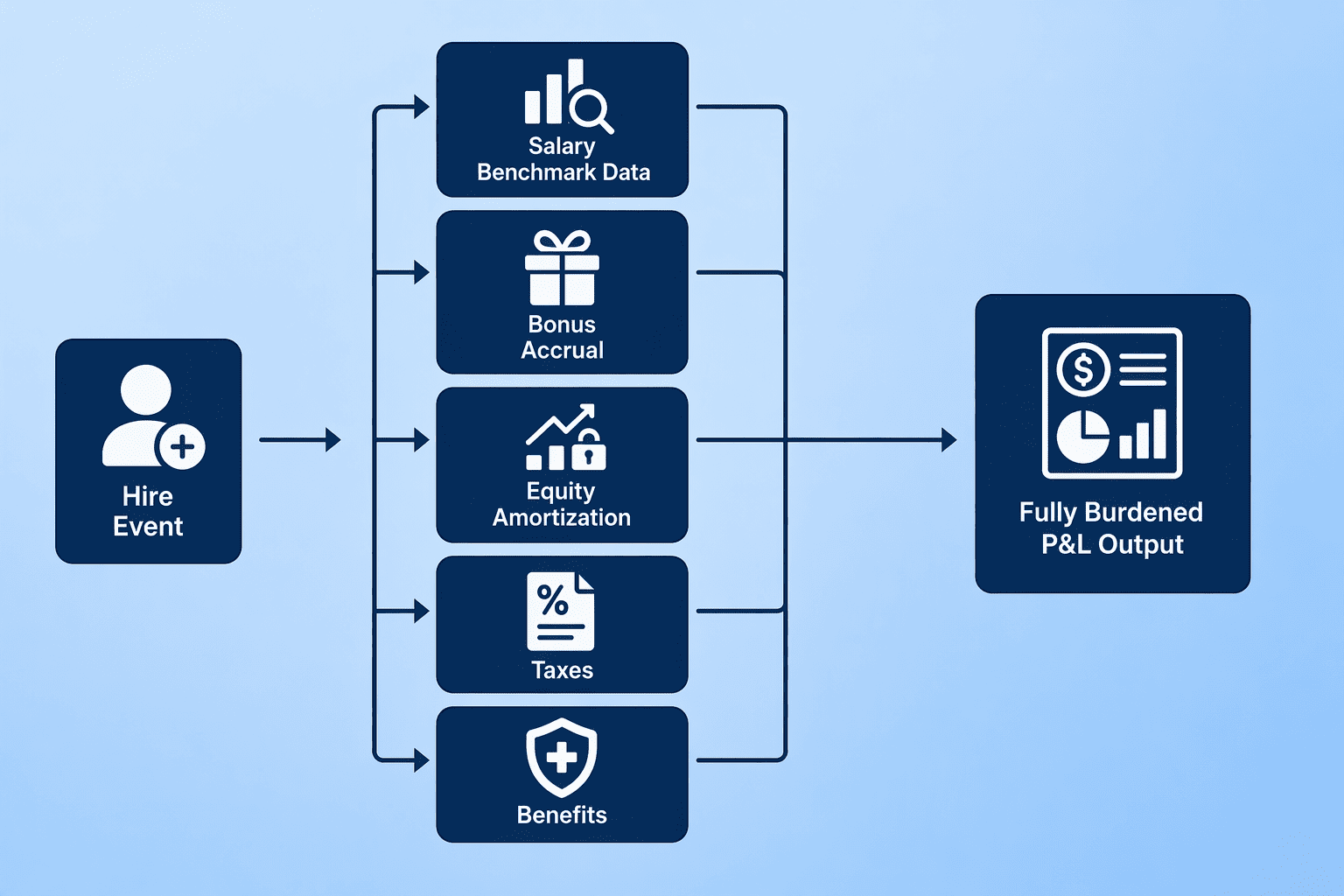
A modern workforce planning platform with built-in salary benchmarking is a single source of truth where every material cost of employment moves in lockstep with the financial model.
In these systems, a hire triggers an immediate, automated calculation that factors in base salary against an external market reference, variable bonus accrual based on a driver formula, equity amortization, employer-side taxes, and location-specific benefits loading. The output is a fully burdened P&L entry that updates the general ledger forecast in real time. This is the command center logic that separates a modern planning tool from the annual HR-driven headcount exercise of the past.
The distinction from legacy processes is structural. Traditional workforce planning relied on a periodic, siloed loop: HR collected headcount requests and applied salary bands that had been set months earlier using static survey data. Finance then rebuilt those inputs, often manually, inside separate budgeting software, stripping out the compensation assumptions along the way. When market salaries shifted mid-cycle, the model was blind to the variance until it showed up as an attrition spike or an overspend.
An integrated command center removes that latency entirely. It treats headcount decisions, market pay rates, internal equity ratios, and benefit costs as one continuous dataset. A geographic pay differential is not a footnote; it is a driver that automatically adjusts the financial model. For example, an organization might set Minneapolis as its baseline at 100% of the salary midpoint, while a New York hire automatically triggers a 135% differential and a Sioux Falls hire calculates at 85% of that midpoint. These location rules, combined with live market benchmarks, then feed directly into the scenario model, letting the organization test what hiring 20 engineers in a premium market will do to unit economics before a single offer letter goes out.
Evaluating a platform requires moving beyond feature lists and testing for the modeling depth that creates financial certainty. A competent 2026 platform must embed these three native capabilities:
- Driver-based pay logic: The system ties headcount assignment to operational drivers such as sales volume trends and customer KPI objectives, so a headcount increase is a calculated output of your revenue model rather than a typed assumption. Compensation planning layers on top: Anaplan lets you model salary, merit, bonus, and equity within the same environment while incorporating compensation benchmarks and external data, when you adjust a merit pool assumption, the quarterly margin impact flows through automatically.
- Scenario analysis capability tied to compensation decisions: You need to model a 4% merit increase against a 6% increase for critical roles, factor in equity refresh grants due in Q3, and compare both paths against a hiring-freeze alternative. Anaplan's scenario planning solutions are purpose-built for these decisions, giving leadership a real-time financial impact readout before locking any pay decision. Meanwhile, platforms like Planful's Workforce Pro add granular variance diagnostics, a Headcount Rollforward that tracks workforce movement across regions, locations, and departments with real-time visibility, and a Variance Bridge that breaks down salary spend variances by key drivers such as promotions and merit increases so finance understands why the forecast shifted.
- Live cost visibility, not batch reporting: A modern platform shows your total burn rate by team, location, and project, updated the moment a compensation change is modeled. Without this, you manage the largest P&L cost line on quarterly latency that the market punishes.
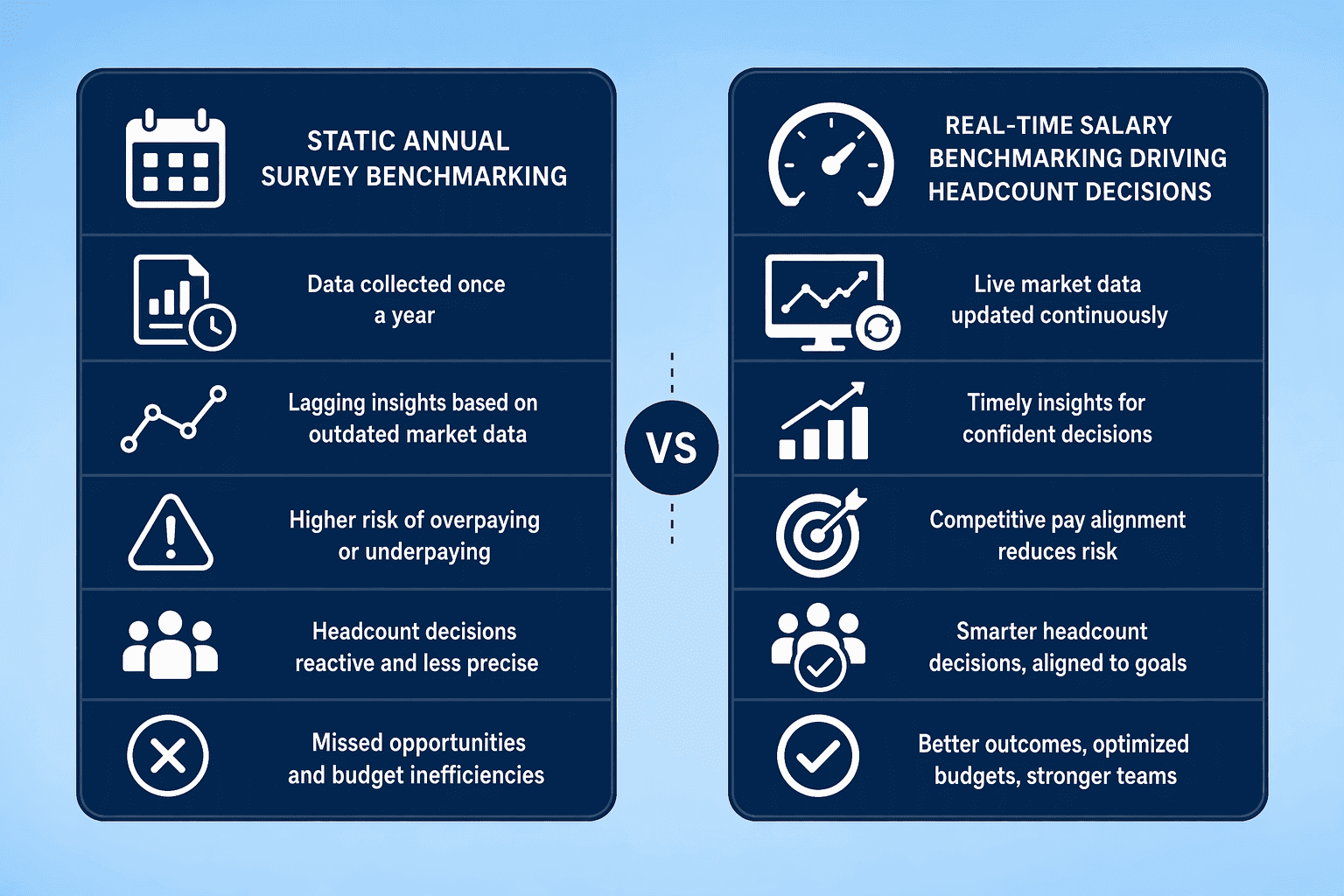
The market for talent operates on continuous pricing. Your workforce model cannot operate on an annual survey that was stale by the time it was published. Below, the table contrasts the decision-making reality of the old approach against an integrated alternative that draws on current data.
| Decision Dimension | Static Survey-Driven Planning | Integrated Real-Time Benchmarking |
|---|---|---|
| Data latency | Annual or bi-annual batch updates; data is 6 to 12 months old at time of decision | Streaming, always-on market data that reflects current clearing prices |
| Replacement vs. retention modeling | Manual lookup against an outdated midpoint; blind to recent market shifts | Automated gap analysis flags flight risks based on real-time pay positioning relative to current market offers |
| Offer precision | Recruiters operate on a band set 8 months ago; offers lose candidates or overspend on non-critical roles | Hiring managers adjust offers instantly to current market clearing rates within pre-set guardrails, preventing both overpayment and failed searches |
| Build vs. buy analysis | Finance models internal development cost but cannot accurately price the external hire alternative at today's market rate | Platforms incorporate compensation benchmarks and external data into models, enabling apples-to-apples cost comparison of internal development against immediate market hire |
The platforms that lead the 2026 market have converged on a single operating principle: compensation is a core financial variable that workforce planning exists to model. Workday consolidates its Adaptive Planning engine with skills and sentiment data from Peakon, giving organizations a continuous, unified view of workforce cost, capacity, and flight risk in one tenant. SAP SuccessFields counters with the most thorough suite architecture, linking its fieldglass contingent workforce data with employee central compensation modules for full total-cost visibility across both permanent and extended labor.
Anaplan differentiates on pure modeling firepower. Its platform handles high-complexity scenario modeling that connects workforce costs to supply chain and revenue models, which matters for organizations where labor cost drives margin directly. Farseer enters as a specialist that centralizes salary, bonus, tax, and benefits logic into a workflow that mirrors the P&L, automatically routing every compensation assumption to the correct general ledger line.
For organizations without the appetite or budget for a full enterprise suite, specialist platforms like CompUp offer an alternative entry point. CompUp joins compensation benchmarking, pay equity analysis, and workforce planning in a unified SaaS model at a lower implementation threshold.
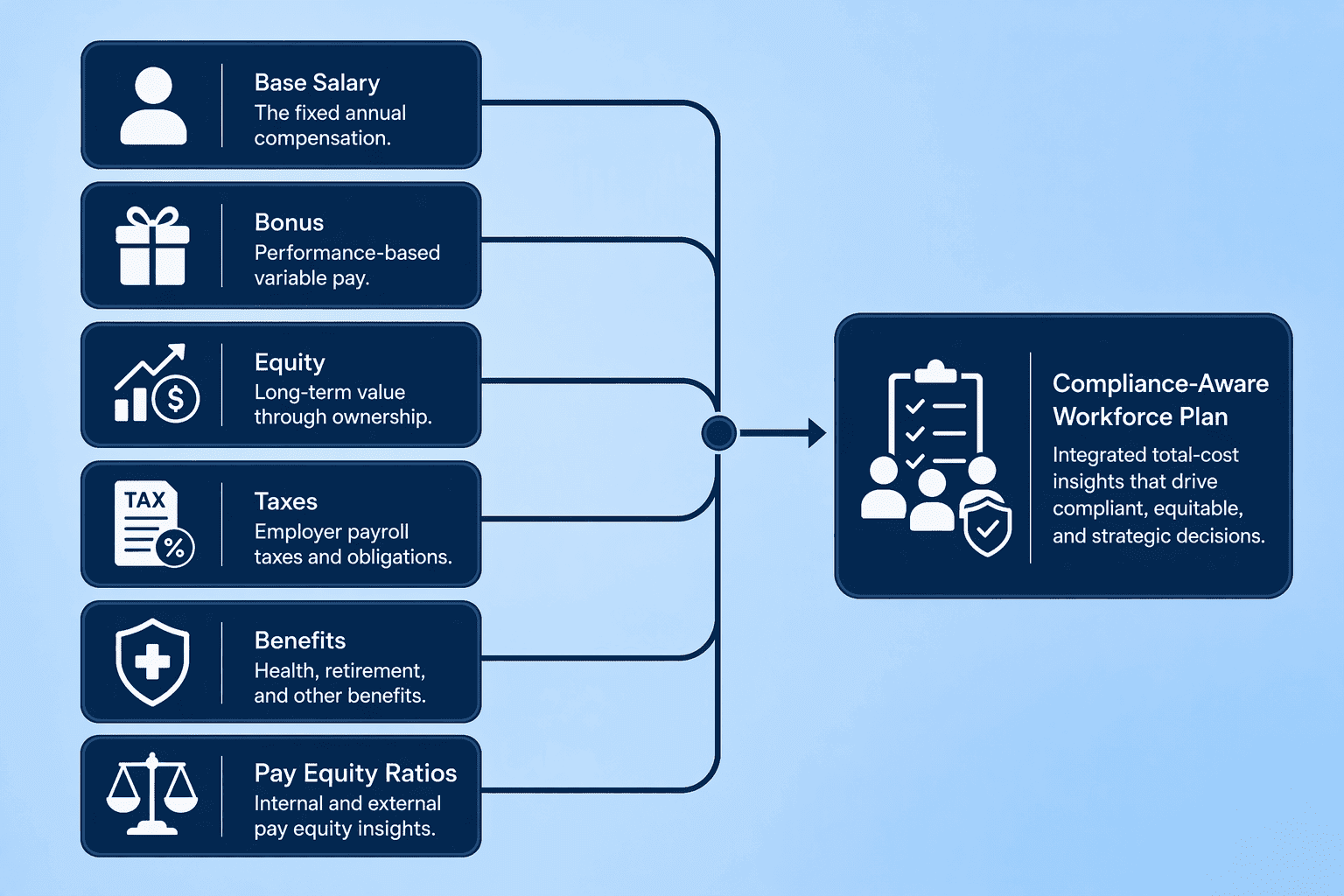
Total workforce cost is never just salary. An integrated platform models every component of the cost stack and layers equity ratios on top before a single comp decision reaches an employee. The table below maps the modeling dimensions that turn a headcount forecast into a compliance-aware total rewards plan.
| Planning Dimension | What It Models | Why It Matters |
|---|---|---|
| Total employee cost loading | Base salary + variable bonus accrual + equity amortization + employer-side taxes + benefits + location differentials | Reveals true per-role P&L impact; a $150k salary hire in New York at a 135% location differential carries a materially different burdened cost than a Minneapolis hire at baseline |
| Pay equity scenario layering | Gender and ethnicity pay-gap ratios overlaid on proposed merit, promotion, and new-hire budgets | Simulates whether a 5% merit pool widens or closes existing pay gaps before money is committed; prevents compliance incidents that arise from after-the-fact analysis |
| Driver-based location rules | Automated geographic pay differentials tied to specific offices and remote-work states | Ensures every compensation change respects jurisdiction-specific tax, benefit, and market realities without manual adjustment |
Pricing falls broadly into two models: per-employee-per-month SaaS subscriptions and modular platform licensing where workforce planning and compensation benchmarking are sold as separate or bundled SKUs.
CompUp, for example, starts at $3 per employee per year, a pricing point purpose-built for organizations that want compensation intelligence and workforce planning without the per-seat burden of a full HCM suite.
The hard-ROI case sits in two line items. The first is a direct efficiency gain. An integrated platform that centralizes salary, bonus, tax, and benefits logic and lets updates automatically flow through to the P&L produces a 50% reduction in workforce budgeting time, cutting weeks of manual consolidation from every planning cycle.
The second is cost avoidance from market-informed offers. When managers can benchmark live market rates against current internal pay, they avoid the double cost of losing a critical hire to a lowball offer and then paying a premium to backfill under pressure. Merit increases tied to individual, team, divisional, and corporate performance objectives can act as an incentive with much more return for the company than an arbitrary annual pay increase, and an integrated platform turns that insight into a budgeted scenario rather than a philosophical position.
Technical implementation for a SaaS workforce planning platform typically runs 30 to 60 days, not quarters. The critical variable is not the software itself. It is the data readiness for a clean compensation baseline. Organizations that can bring cleansed salary, job architecture, and location data into the platform on Day 1 reach decision-ready modeling within that window. Those who must first standardize their compensation architecture during implementation will see extended timelines, but the platform becomes the forcing function for a hygiene exercise that the business needs anyway.
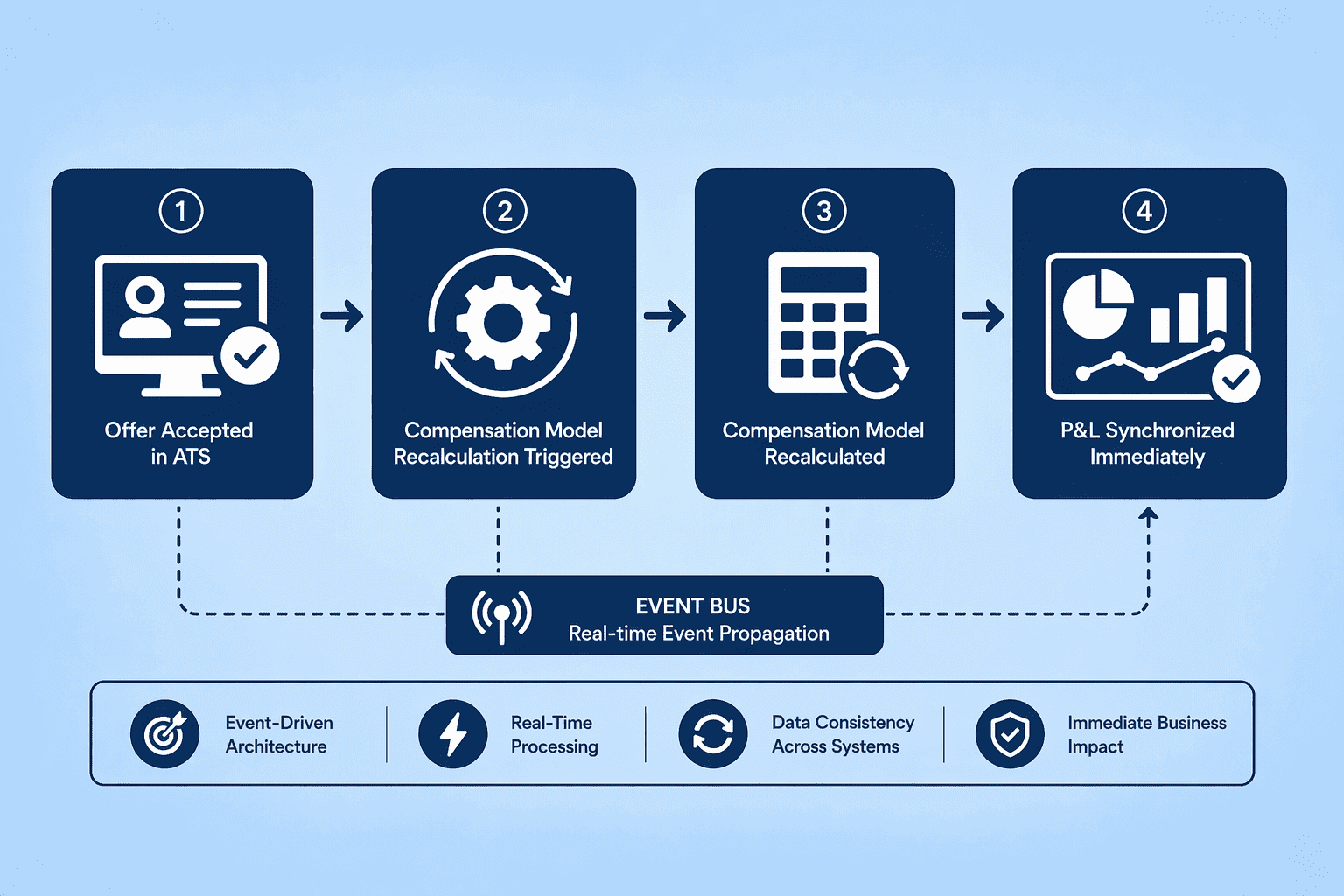
A platform that requires a monthly CSV upload to sync headcount with the general ledger is not a planning tool. It is a reporting tool with a planning label.
The architectural expectation for 2026 is zero-latency synchronization between HR records and the P&L. When a recruiter marks an offer as accepted in the applicant tracking system, the platform must immediately consume that event, run it against the loaded compensation model (salary + bonus formula + equity grant + tax engine + benefits table + location rule), and post the fully burdened cost to the correct cost center in the financial forecast. The budget available updates in real time. The hiring manager sees the remaining run-rate. Finance sees the margin impact.
This synchronization eliminates the month-end variance surprise, because actuals are flowing continuously, and the forecast is re-basing against live data instead of quarterly assumptions. The planning team moves from forensic variance analysis to dynamic re-forecasting. The hours once spent reconciling broken models shift to testing strategic alternatives. Farseer engineered this P&L-mirroring capability directly into its core architecture, treating every compensation input as a financial posting event rather than an HR data point. The platform manages workforce cost, not merely reporting on it.
The integration label on a vendor's website means nothing until you test for directionality. Here are the three levels of technical reality, ordered from surface to substance:
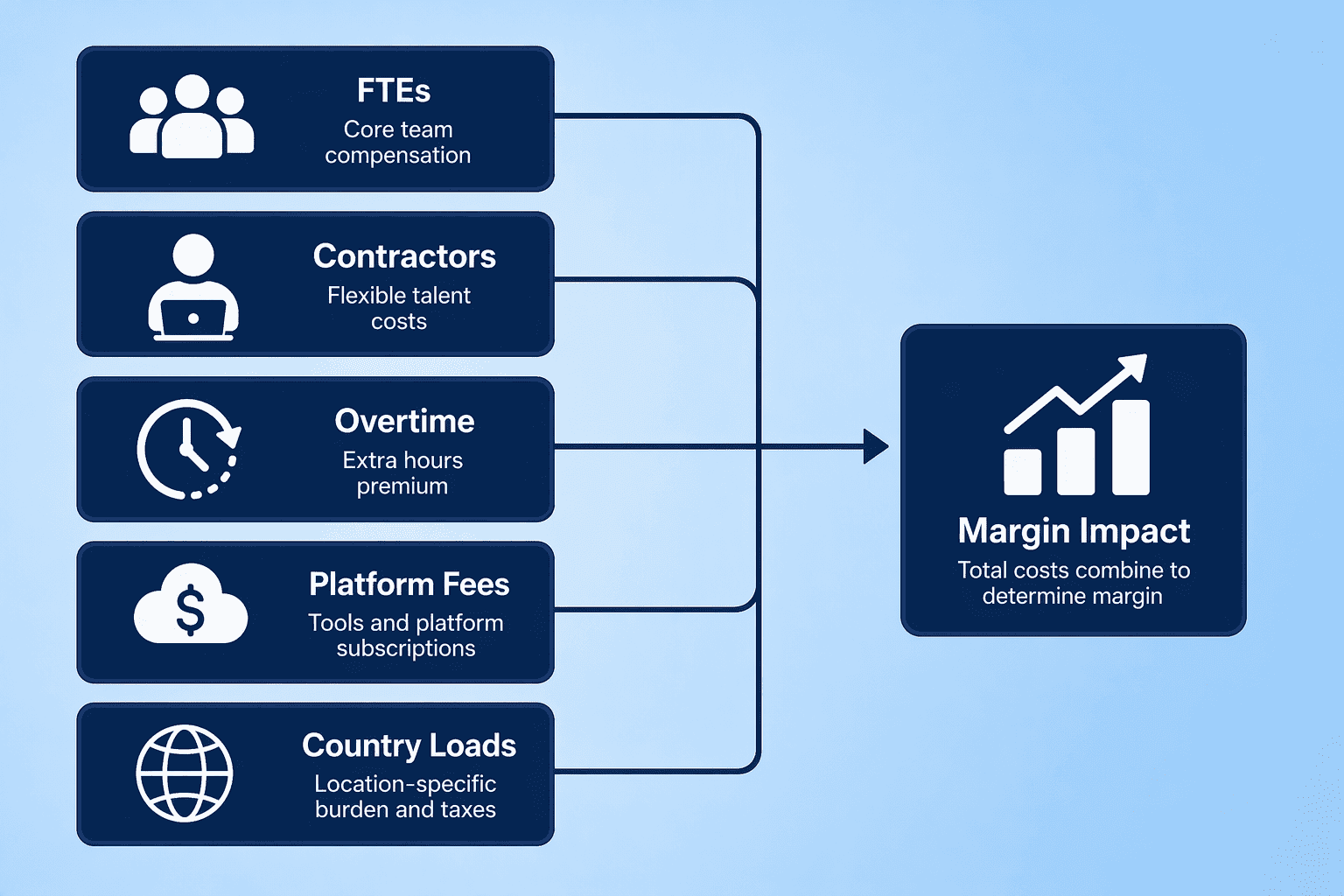
The workforce has evolved well beyond full-time employees. Your planning platform must model the cost and margin impact of every labor channel in a single view, because your P&L does not give you separate statements for FTEs and contractors.
Modeling the extended workforce requires factoring in load rates that go well beyond a daily rate. A contractor sourced through a platform like Deel carries platform fees, statutory benefit costs in the country of engagement, currency risk, and potential co-employment classification risks that introduce legal cost exposure. An integrated planning model must load these variables into the cost stack automatically, so a $500 daily rate surfaces its true $680 fully burdened cost before it hits an approval workflow. The same logic applies to overtime modeling. Running a scenario where a project team moves from 40 to 50 hours per week to hit a deadline must calculate the downstream impact on bonus pools, the risk of burnout attrition requiring replacement hires, and the margin erosion on the project the overtime is meant to save.
Advanced cost protection means attaching labor costs directly to revenue-generating activities using driver-based logic. When you model a new client implementation that requires three dedicated engineers, you load their fully burdened cost (salary, benefits, equity, training overhead) directly against that project's expected revenue and watch the gross margin percentage recalculate in real time. This is the operational level where workforce planning shifts from a cost-control exercise into a margin-protection capability, using the same Anaplan scenario planning engine that lets you test whether that implementation can support the proposed staffing cost before you commit to it.
This is the planning level that separates operators who report on labor costs from those who manage business performance through labor investment.
Workforce planning in 2026 is inseparable from real-time compensation intelligence. The platforms that lead the market have collapsed the silo between headcount modeling and pay benchmarking, creating a unified command center where every operational decision about people flows through the financial model automatically.
The competitive edge has shifted. It no longer sits in accurately reporting last quarter's headcount variance. It sits in predictive agility: the ability to model a market-driven offer, a geographic expansion, or a pay equity adjustment and see its margin impact before committing the company to the cost.
Choose a platform that treats compensation data as live financial infrastructure. Your planning becomes a forward-looking competitive capability rather than a backward-looking reconciliation event. If you're weighing options, CompUp is worth a closer look.
It is a unified software system that combines headcount forecasting, compensation modeling, and real-time external market data in one model. Instead of separate spreadsheets for headcount and static salary surveys, the platform automatically calculates the fully burdened cost of every hire and pay change against live market benchmarks.
Non-negotiable features include the following capabilities:
It replaces stale, periodic survey data with current market clearing prices, letting you model replacement versus retention costs instantly, adjust offers to competitive rates, and flag flight risks based on real-time pay gaps. Decisions shift from historical guesswork to current market reality.
Workday, SAP SuccessFactors, and Anaplan lead the enterprise category. Farseer specializes in P&L-mirroring and automated compensation flow-through. For organizations seeking a compensation-specialized alternative without a full HCM suite, CompUp unifies salary benchmarking, pay equity analysis, and workforce planning.
Layer total rewards components, including salary, bonus, equity, benefits, and taxes, into your headcount model. Then apply pay-equity ratios by gender and ethnicity to every scenario, so you can test whether a proposed merit increase narrows or widens existing pay gaps before money is allocated.
Pricing spans per-employee SaaS subscriptions and modular licensing. CompUp starts at $3 per employee per year. The ROI is driven by a 50% reduction in budgeting cycle time and hard cost avoidance from attrition prevented by market-informed pay decisions. Technical implementation typically runs 30 to 60 days for SaaS platforms.
Community Manager (Marketing)
As a Community Manager, I’m passionate about fostering collaboration and knowledge sharing among professionals in compensation management and total rewards. I develop engaging content that simplifies complex topics, empowering others to excel and aim to drive collective growth through insight and connection.
Revolutionizing Pay Strategies: Don't Miss Our Latest Blogs on Compensation Benchmarking