
Your compensation review cycle just wrapped, and a manager is already deflecting a direct report's question about why their salary sits where it does. The data exists somewhere in your HCM, but it is not contextualized, not auditable, and certainly not ready for a real-time conversation. This is the precise failure point that 37% of U.S. organizations identify as their biggest pay transparency hurdle: managers who cannot explain the numbers.
The pressure to solve this is no longer theoretical. With fourteen US states enforcing active pay transparency laws and the EU Pay Transparency Directive reaching its transposition deadline in June 2026, static annual benchmarking reports are a compliance liability. The market has responded with a distinct split: specialized operational platforms that transform pay equity analysis into governed action, and real-time analytics APIs that supply the fresh market data those platforms consume. Semos Cloud occupies the first camp by embedding remediation workflows directly into SAP SuccessFactors, Workday, and Oracle HCM. Inop AI powers the second by delivering verified compensation benchmarks through a developer-friendly API.
This article dissects both categories. We will examine how continuous analytics closes the gap between a pay philosophy on paper and an auditable employee experience, and why bridging the manager communication chasm is the determining factor for transparency success in 2026.
The compensation technology market has split into tools that operationalize internal equity and APIs that deliver external market benchmarks. For rewards leaders, the distinction matters more than ever.
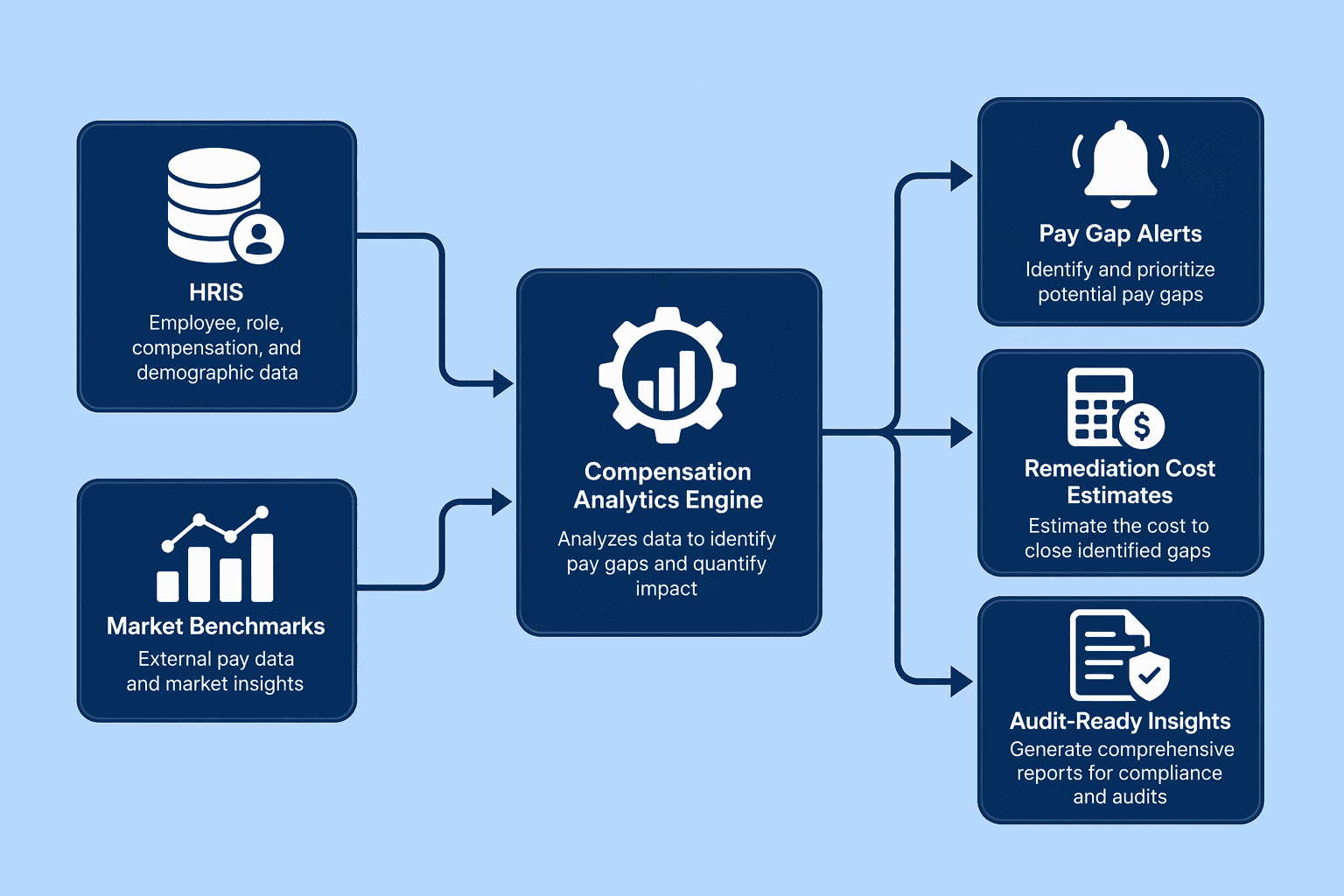
Real-time compensation analytics platforms continuously ingest internal HRIS data and external market signals to surface pay gaps, model remediation costs, and push contextual insights to decision-makers. The annual salary survey PDF that sits in a shared drive for 11 months gets replaced. These tools treat compensation data as a live operational layer feeding manager conversations and compliance audits simultaneously.
Within this category, the focus diverges sharply. Semos Cloud integrates directly with SAP SuccessFactors, Workday, and Oracle HCM to run regression-based gap analyses on your actual workforce. It generates remediation proposals with business rule safeguards and routes them through structured approval workflows. The output is a governed action chain. CompUp, as a compensation-specialized platform, takes a parallel approach by ingesting real-time industry-specific compensation data to benchmark markets and manage pay equity in one unified environment, generating personalized Total Rewards Statements at the close of appraisal cycles.
Inop AI operates from the opposite direction. Its Compensation Analytics API aggregates compensation data from verified job postings, user-reported salaries, government labor statistics, and professional networking platforms. It exposes three endpoints, General Compensation Insights, Location Comparison, and Company Benchmarking, each returning min, max, median, 25th percentile, and 75th percentile values for base salary, total compensation, bonus, and equity.
The operational platforms solve for internal governance. The APIs solve for external truth. A mature compensation strategy in 2026 connects both.
A pay transparency policy posted on the intranet is not transparency. It is a statement of intent.
Real transparency becomes operational when an employee can see their own compensation, understand exactly where it sits against peer and market ranges, and receive that information in a format that confirms compliance with applicable pay range disclosure laws. Semos Cloud makes this concrete through individual pay transparency statements that surface salary positioning, peer range context, and a compliance confirmation layer. The statement is not a static PDF export. It is an auditable artifact generated by the same engine that runs the organization's pay equity analysis.
This matters because the legal environment now demands it. Fourteen U.S. states require active pay range disclosure, and the EU Directive's June 2026 transposition deadline extends similar obligations across member states. A platform that cannot produce individual-level documentation on demand leaves organizations exposed to exactly the kind of ad hoc, inconsistent explanation that regulators and plaintiffs scrutinize.
But the real transparency failure point is not the employee statement. It is the manager conversation. When 37% of organizations admit their managers cannot explain compensation, every transparency investment made upstream, regression analysis, market benchmarking, remediation modeling, collapses at the moment of delivery. The tools that solve this equip managers with team-level dashboards that surface the same contextual data the analyst sees, translated into a narrative a manager can actually use. Without that last mile, the analytics are theoretical.
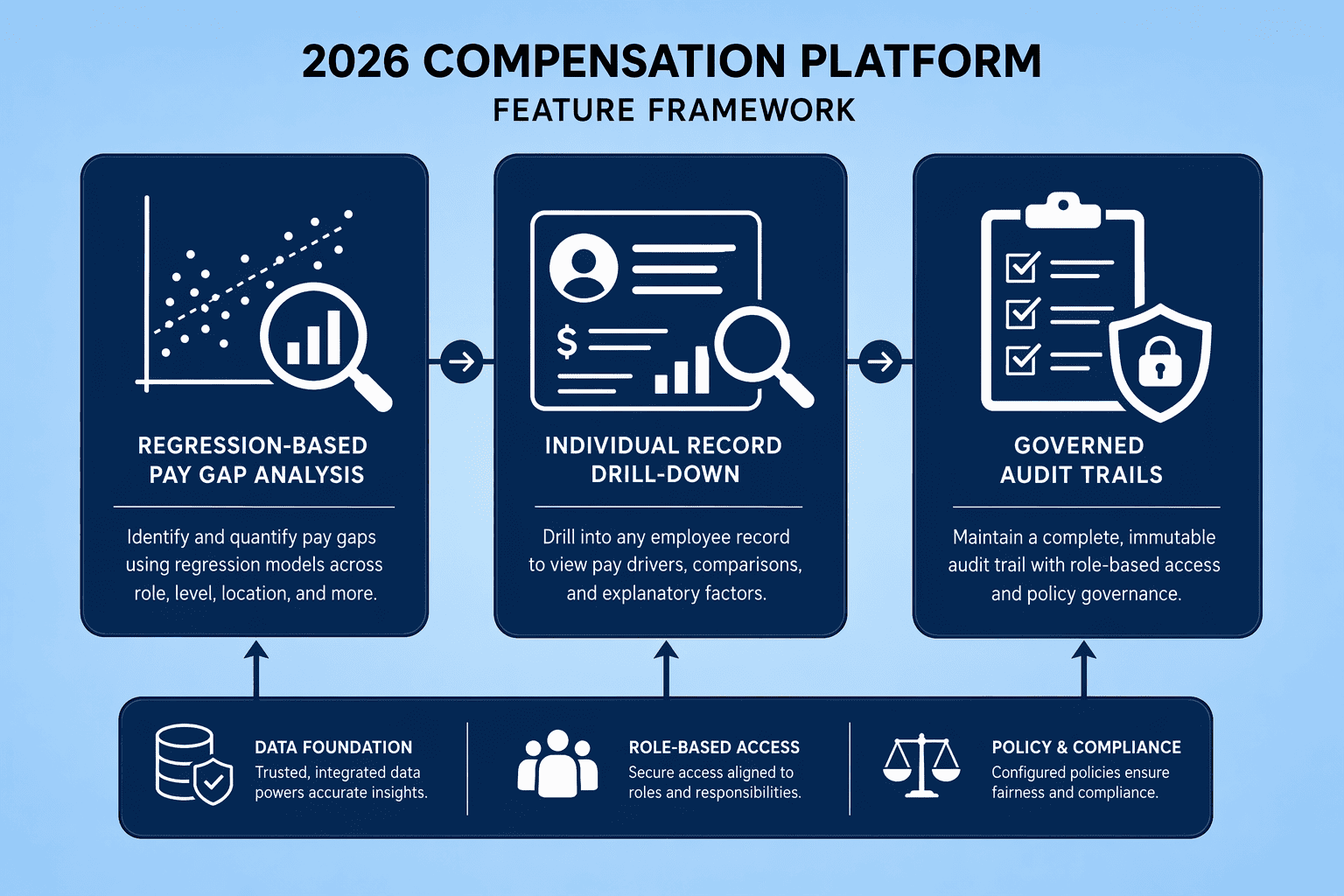
A genuine compensation analytics platform does more than display comparative salary figures. Here are the non-negotiable capabilities that separate governed, audit-ready tools from dashboard dressing:
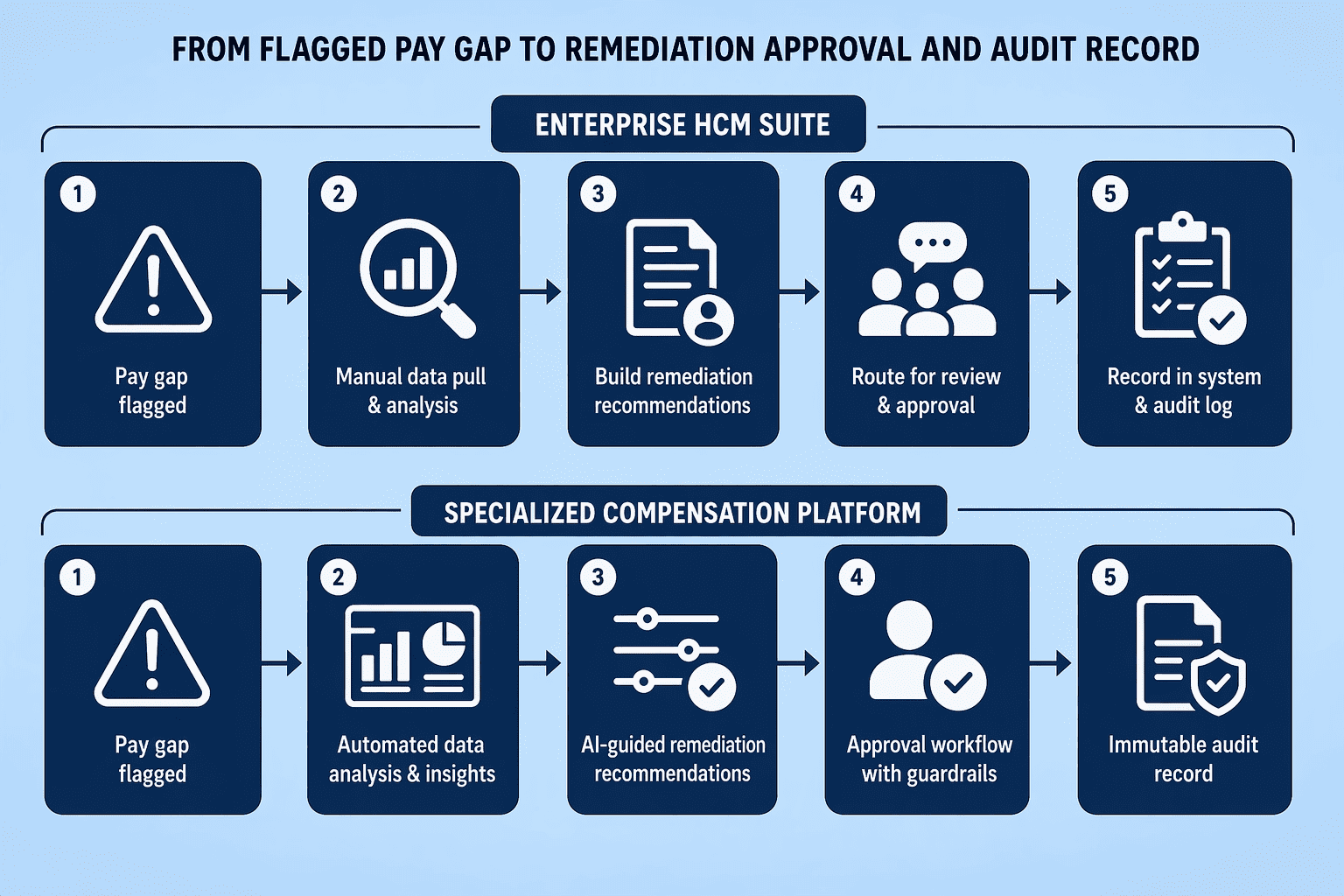
Your enterprise HCM suite can display compensation data. Workday, SAP SuccessFactors, and Oracle HCM all surface pay ranges and compa-ratios. Out of the box, they stop short of a governed workflow that carries you from a regression-flagged gap through a remediation proposal, multi-stage approval, and an audit-ready record. The typical workaround is an export to Excel, manual analysis, and a parallel approval chain that lives outside the system holding the data.
A specialized platform like Semos Cloud closes that fracture. The gap analysis produces a remediation proposal. The proposal routes through a structured approval chain with business-rule safeguards. The signed-off action generates an auditable record tied back to the statistical model. That sequence is the difference between having compensation data and having a defensible compensation process.
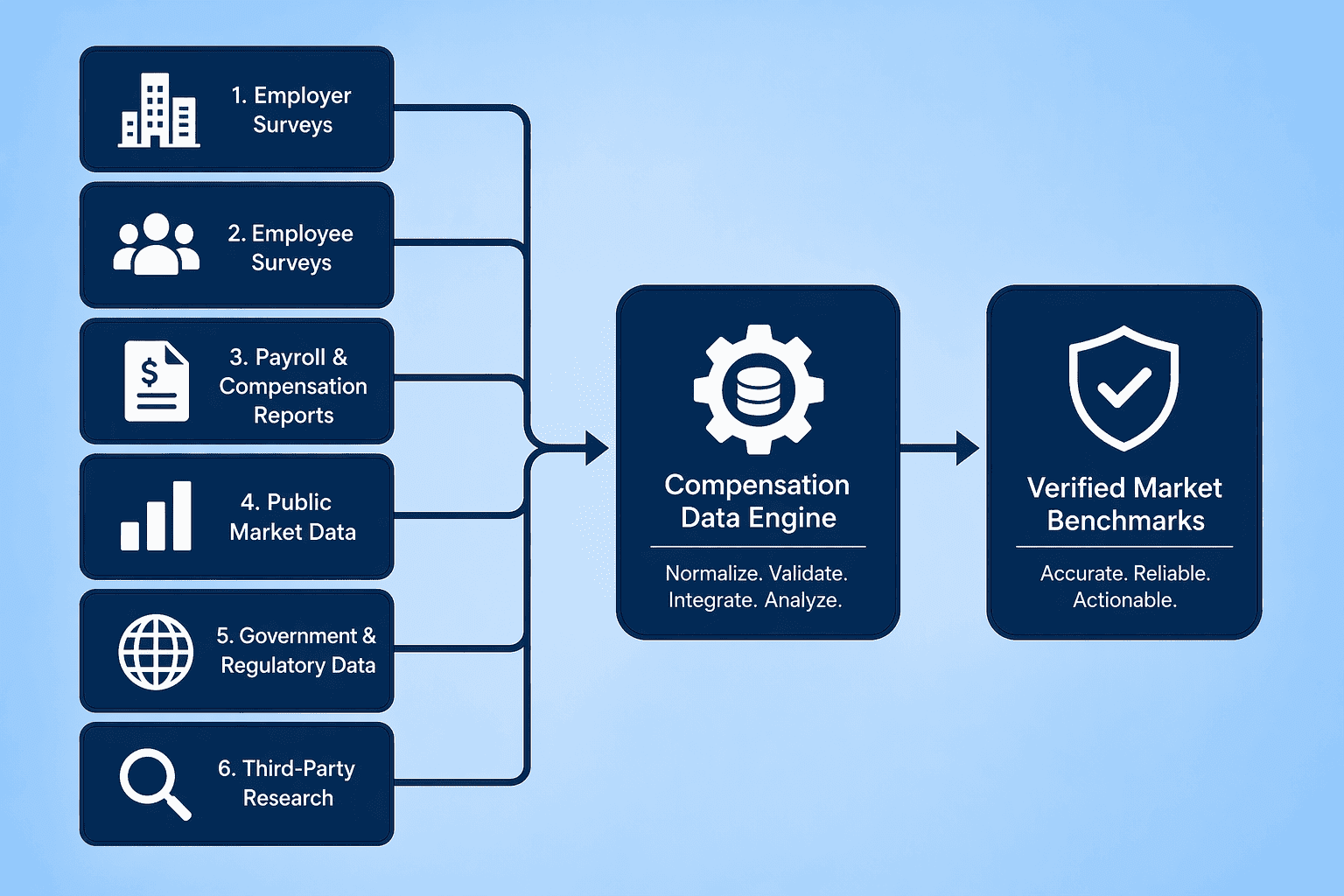
Every market benchmark is only as credible as its sourcing methodology. Inop AI's Compensation Analytics API pulls compensation data from six distinct source categories:
This multi-source aggregation provides a fresher signal than an annual survey whose data was collected nine months before publication.
The API exposes three endpoints, General Compensation Insights, Compensation Location Comparison, and Compensation Company Benchmark Tool, all supporting granular filters for location, industry, company size, job level, experience level, skills, compensation type, currency, time range, company type, and employment type. A query can return the 25th, median, and 75th percentile base salary for a Senior Software Engineer at a Series C SaaS company in Austin, with bonus and equity broken out separately. CompUp operates a parallel real-time data ingestion model, providing industry-specific compensation data that flows directly into its benchmarking and pay equity analysis modules. The global salary benchmarking software market that both inhabit is projected to grow at a 14.4% CAGR from 2026 to 2033, reflecting the accelerating shift away from static survey data.
Your analytics engine can be perfect and the transparency initiative will still fail if the frontline manager dodges the conversation. The dimensions that determine success extend beyond the data pipeline into manager enablement, jurisdictional complexity, and total rewards narrative.
| Capability | What It Addresses | Operational Tool Example |
|---|---|---|
| Manager team views with contextual data | The 37% manager readiness gap: equips managers with peer range positioning and remediation context so they can explain pay decisions | Semos Cloud's manager dashboards within the Total Rewards Hub |
| Multi-state pay range compliance | Fourteen active U.S. state laws with different disclosure thresholds, plus the EU Directive's June 2026 deadline | Semos Cloud's jurisdiction-aware transparency statements |
| Total rewards communication layer | The candidate who evaluates base, bonus, equity, and benefits as one package | CompUp's personalized Total Rewards Statements generated at appraisal close |
| Guided manager conversation support | The script and guardrails that prevent a well-intentioned manager from making a legally problematic admission during a comp discussion | Embedded within Semos Cloud's manager-facing modules |
A platform that treats compensation transparency as a compliance checkbox produces the employee statement and stops. A platform that treats it as an operational layer produces the statement, equips the manager, and generates the audit log proving the conversation happened correctly.
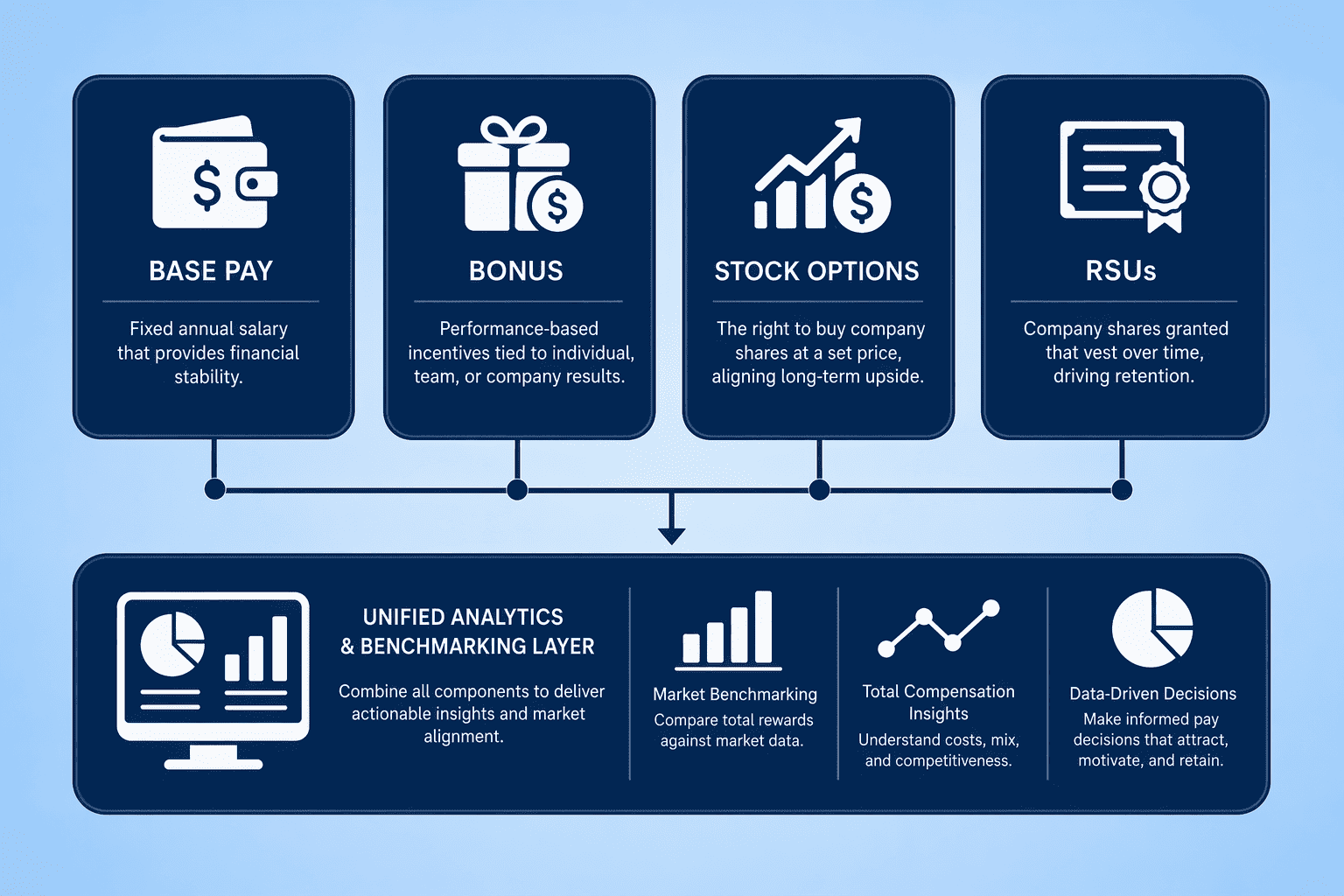
A platform that stops at base salary and bonus analysis addresses only part of the compensation picture. Candidates evaluating an offer, and employees assessing their total package, weigh equity components, stock options, RSUs, and equity plan structures alongside cash compensation.
Inop AI's API returns equity compensation data alongside base and bonus figures, which means the market benchmarking layer can already supply the external comparator. The internal operational layer needs the same integration. A rewards team that runs regression analysis on base pay but manages equity in a separate spreadsheet cannot produce a unified Total Rewards Statement or model the full cost of closing a pay gap that includes long-term incentives.
The practical fix connects a purpose-built equity administration tool like CompUp's ESOP management module into a compensation platform that already ingests and governs base and bonus data. The result is a single source of truth feeding both the analytics engine and the employee-facing transparency layer. A generalist HCM module lacks the structured approval workflows that make this integration work, and purpose-built tools add the audit trails, vesting schedules, and grant-date governance that prevent equity from becoming a disconnected silo.
Real-time compensation analytics in 2026 splits into two categories that serve different but complementary functions. Operational platforms, Semos Cloud being the most architecturally complete example, embed governance from regression analysis through audited remediation. Market data APIs, led by Inop AI, supply the verified external benchmarks that make internal analysis defensible.
Most organizations don't need to pick one and discard the other. The urgent priority is closing the manager communication gap that sinks transparency initiatives regardless of how sophisticated the analytics engine is. Start there, then build out the data and governance layers that make every compensation conversation consistent, compliant, and grounded in real numbers. If you're weighing options, CompUp is worth a closer look.
The market divides into several categories of specialized solutions:
They generate individual pay transparency statements showing an employee’s salary against peer and market ranges with a compliance confirmation layer. Critically, they equip managers with team-level dashboards and contextual data, addressing the fact that 37% of U.S. organizations cite managerial inability to explain pay as their top transparency obstacle.
Non-negotiable features in a compensation analytics platform include:
An HCM suite displays compensation data and basic compa-ratios but stops there. A specialized platform like Semos Cloud adds the governed workflow: gap detection triggers a remediation proposal, routes it through an approval chain, and generates audit-ready documentation. The HCM provides raw data; the specialized platform provides a defensible, closed-loop process.
Leading platforms like Inop AI aggregate compensation data from verified job postings, user-reported salaries, government labor statistics, market research surveys, and professional networking platforms. This multi-source approach produces fresher, more granular benchmarks than traditional annual salary surveys and supports filtering by job level, industry, location, and company size.
Pricing varies widely by category. The three main models are:
Community Manager (Marketing)
As a Community Manager, I’m passionate about fostering collaboration and knowledge sharing among professionals in compensation management and total rewards. I develop engaging content that simplifies complex topics, empowering others to excel and aim to drive collective growth through insight and connection.
Revolutionizing Pay Strategies: Don't Miss Our Latest Blogs on Compensation Benchmarking