
The UK public sector alone carries a wage bill of £260 billion for its 6.2 million employees, according to National Audit Office data for 2024-25. That staggering sum buys capability, or it buys misalignment and stagnation. Every organization, public or private, sits on the same knife-edge.
Your product roadmap depends on a critical specialist you have not hired yet. Your expansion into a new region stalls because local talent pools are dry. These are not recruitment problems.
They are workforce planning failures, and they cost you directly. Despite the existential stakes, recent research from Deloitte reveals that only 29% of CHROs are confident in their strategic workforce planning capabilities. This is the crisis of confidence that defines modern people strategy.
The antidote is not another spreadsheet. It is a fundamental, AI-driven shift from static annual headcount exercises to continuous workforce shaping. This is the definitive guide to that transformation.
Here is what you need to know before diving into the operational details:
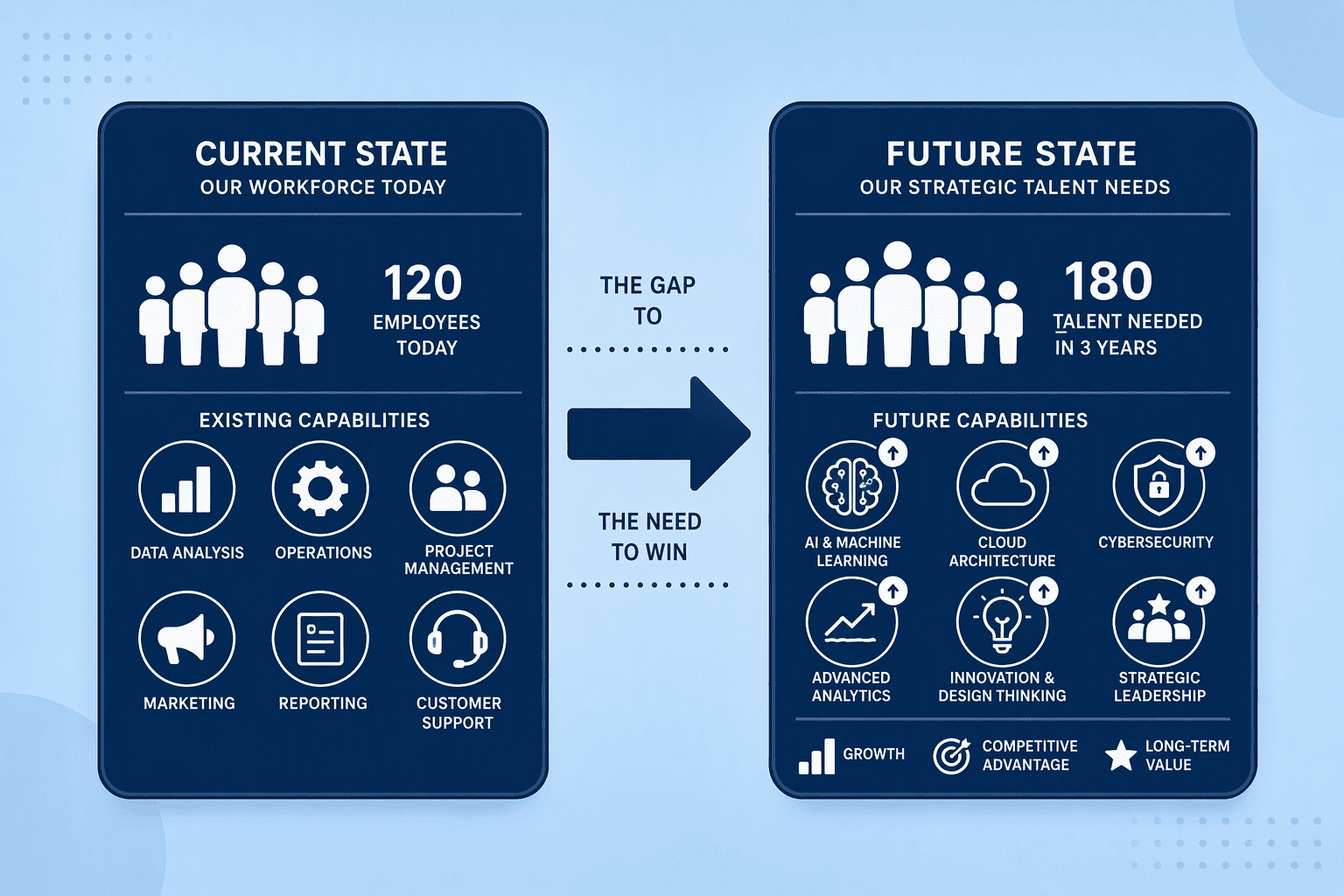
Workforce planning is the systematic process for identifying and addressing the gaps between your workforce of today and the human capital needs of tomorrow. It is the analytical engine that synchronizes an organization's talent pipeline with its strategic vision, so broad business goals don't drift out of reach because the right skills are missing. The Office of Personnel Management frames the core challenge around a foundational principle: having the right people, with the right skills, in the right place, at the right time. That is a logistics problem of massive scale, demanding a rigorous method to define what 'right' means for your specific roadmap.
Think of it as balancing your labour supply against demand. According to the CIPD, workforce planning is the process of balancing labour supply (skills) against the demand (numbers needed). The 'hard' side is numerical: predicting exactly how many heads you need with specific competencies. The 'soft' or strategic side develops the framework to assess whether those competencies even exist in your talent pools. Both converge on a single goal: preventing the future from arriving before your workforce is ready to meet it.
The output is not abstract. A proper workforce plan produces a snapshot of reality and pressure: it identifies potential threats and opportunities to your agency's livelihood. It takes the vague anxiety about the labor market and converts it into actionable intelligence.
When this fails, strategy becomes fiction. You can design an ambitious product launch, but if a gap analysis reveals zero internal successors for the lead engineer who just resigned, that strategy stalls at the gate.
The most immediate reason this practice hits the boardroom is raw fiscal exposure. The National Audit Office data on the UK’s £260 billion public sector payroll is a stark reminder that an unplanned workforce is likely the single largest drain on any organization's balance sheet. When a government cannot map its headcount to its service delivery promises, it risks a catastrophic failure of public trust; for a private enterprise, the same misalignment between talent and strategic bets destroys competitive advantage. Without active planning, you cannot tell the difference between a key capability and embedded dead weight.
Strategic failure is a direct consequence of talent blindness. Strategic Workforce Planning translates long-term corporate strategy into execution plans by ensuring that the strategy is supported by the right workforce. If your annual report declares a pivot to AI-augmented services but your planning data shows zero projected hires in that vertical for the next 18 months, your strategy is already dead. It is a paper tiger, and your investors will eventually scent the gap between rhetoric and resource allocation.
The elephant in the C-suite is that leadership knows this is a weakness. That Deloitte figure, only 29% of CHROs feeling confident, signals a leadership vacuum. It means 71% of chief human resources officers are walking into budget meetings with more hope than evidence.
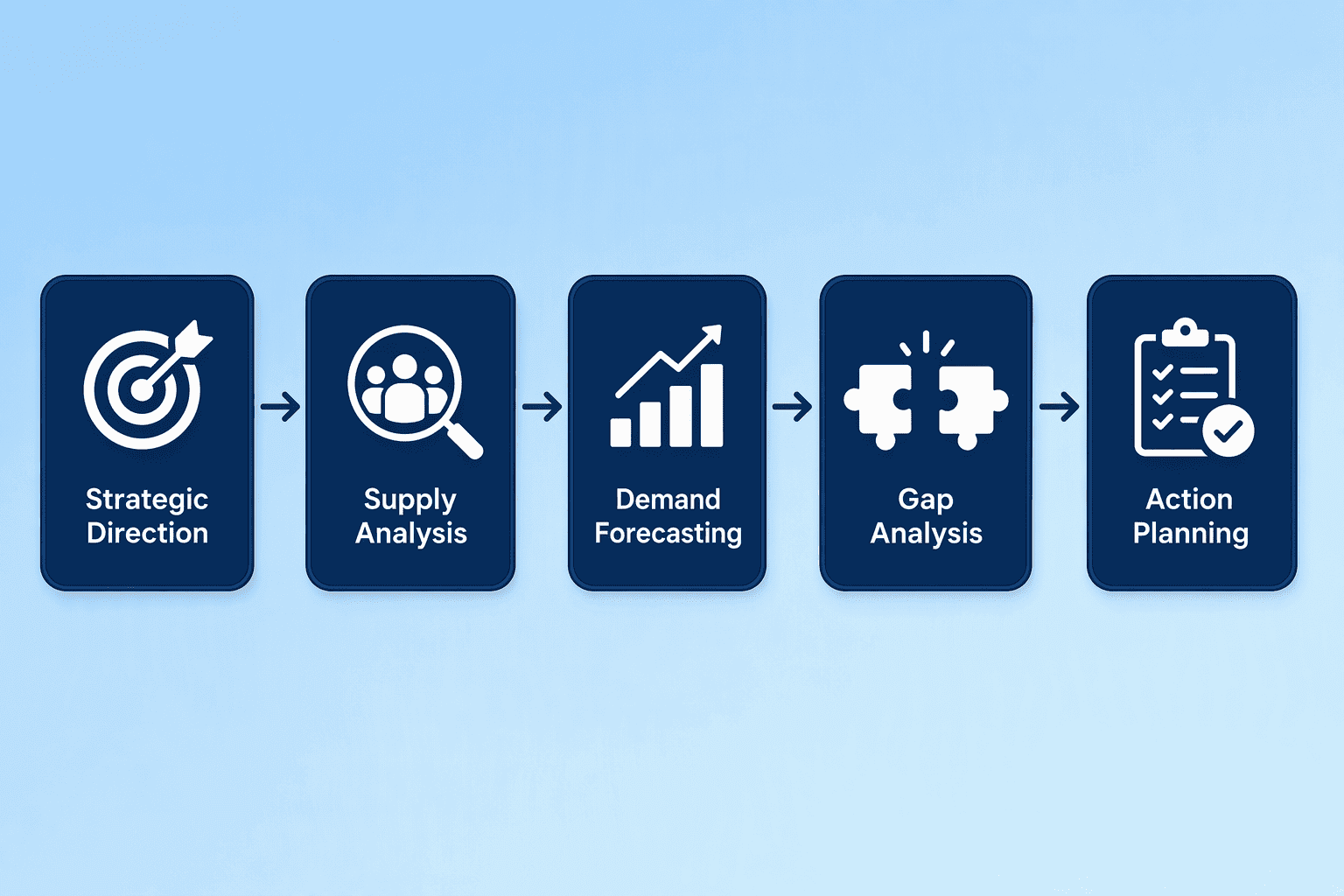
The U.S. Office of Personnel Management distills the entire discipline into a five-step workforce planning model that remains the gold standard for turning boardroom ambitions into operational reality. Here is how the cycle works:
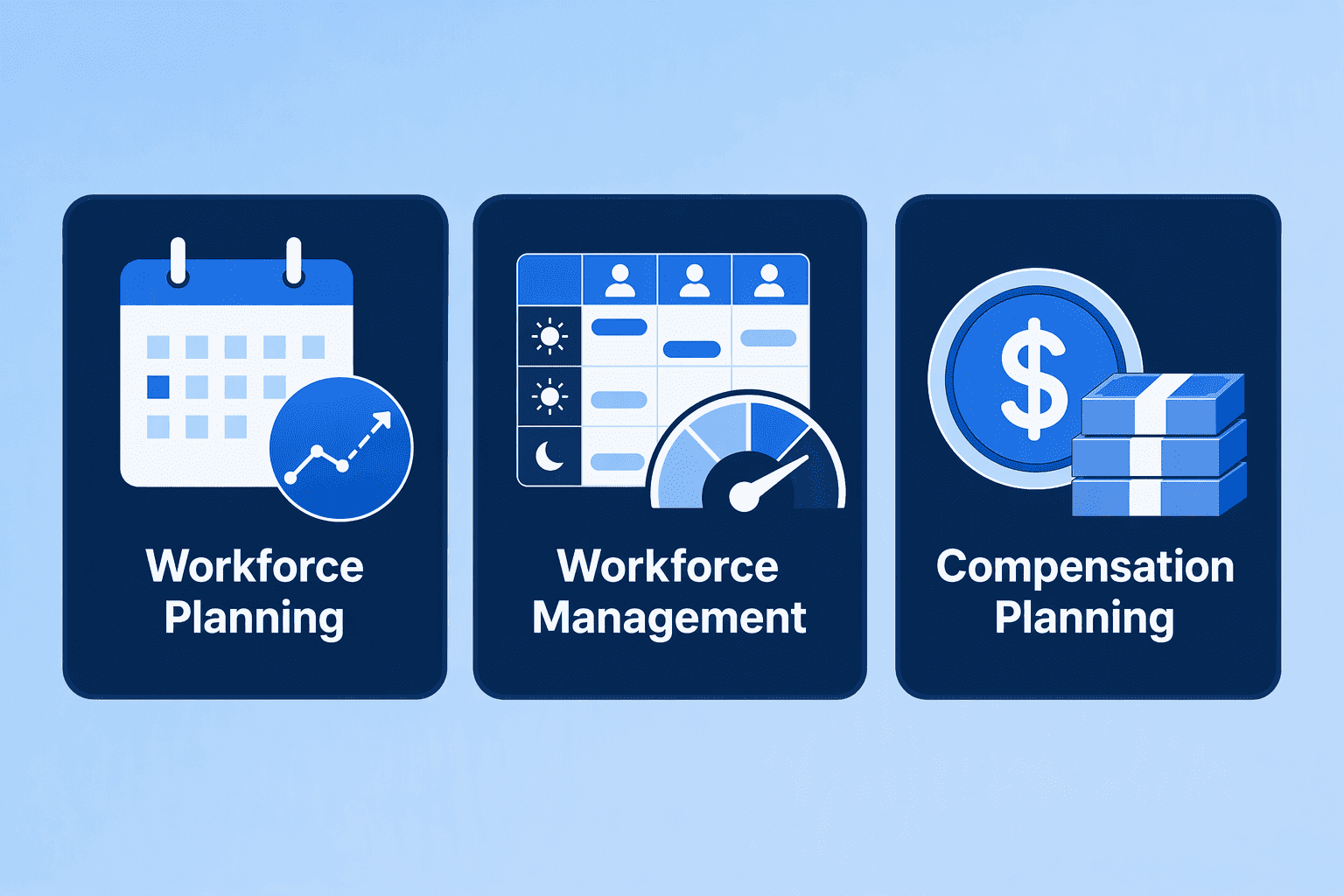
These three disciplines collide in budget meetings every quarter, but each answers a different question: one forecasts the workforce you will need, one runs the workforce you already have, and one sets the price for it all.
| Dimension | Workforce Planning | Workforce Management | Compensation Planning |
|---|---|---|---|
| Primary Focus | Strategic foresight on future headcount, skills, and cost | Operational execution of daily labor schedules and productivity | Structuring cash, equity, and benefits to attract and retain talent |
| Time Horizon | Long-term (quarters to years) | Short-term (weeks, days, shifts) | Cyclical (annual review cycles with multi-year vesting) |
| Core Question | What talent mix will we need to execute future strategy? | Are the right people in the right place at the right time today? | How do we price roles competitively without breaking the budget? |
| Key Output | A dynamic headcount model tied to revenue scenarios | Shift rosters, real-time adherence reports, and overtime tracking | Salary bands, merit matrices, and long-term incentive (LTI) grant guidelines |
| Typical Owner | FP&A or Strategic HR | Operations or frontline management | Total Rewards or HR Compensation |
| Data Dependency | Market growth forecasts, attrition assumptions, and skill gap analysis | Time-clock data, labor laws, and demand volume signals | Market salary surveys, internal equity audits, and cost-of-labor analytics |
Workforce planning is the long game. It ties headcount models directly to revenue scenarios and market growth forecasts so the company has the right skills when strategic bets pay off, not a scramble to backfill after the fact.
Workforce management runs the clock. Operations teams use time-clock data and demand signals to build shift rosters, track real-time adherence, and keep overtime spend from leaking through bad scheduling.
Compensation planning prices the work. Total rewards owners balance market salary surveys and internal equity audits against a hard budget number, producing salary bands and LTI grant guidelines that make the numbers competitive without making the P&L bleed.
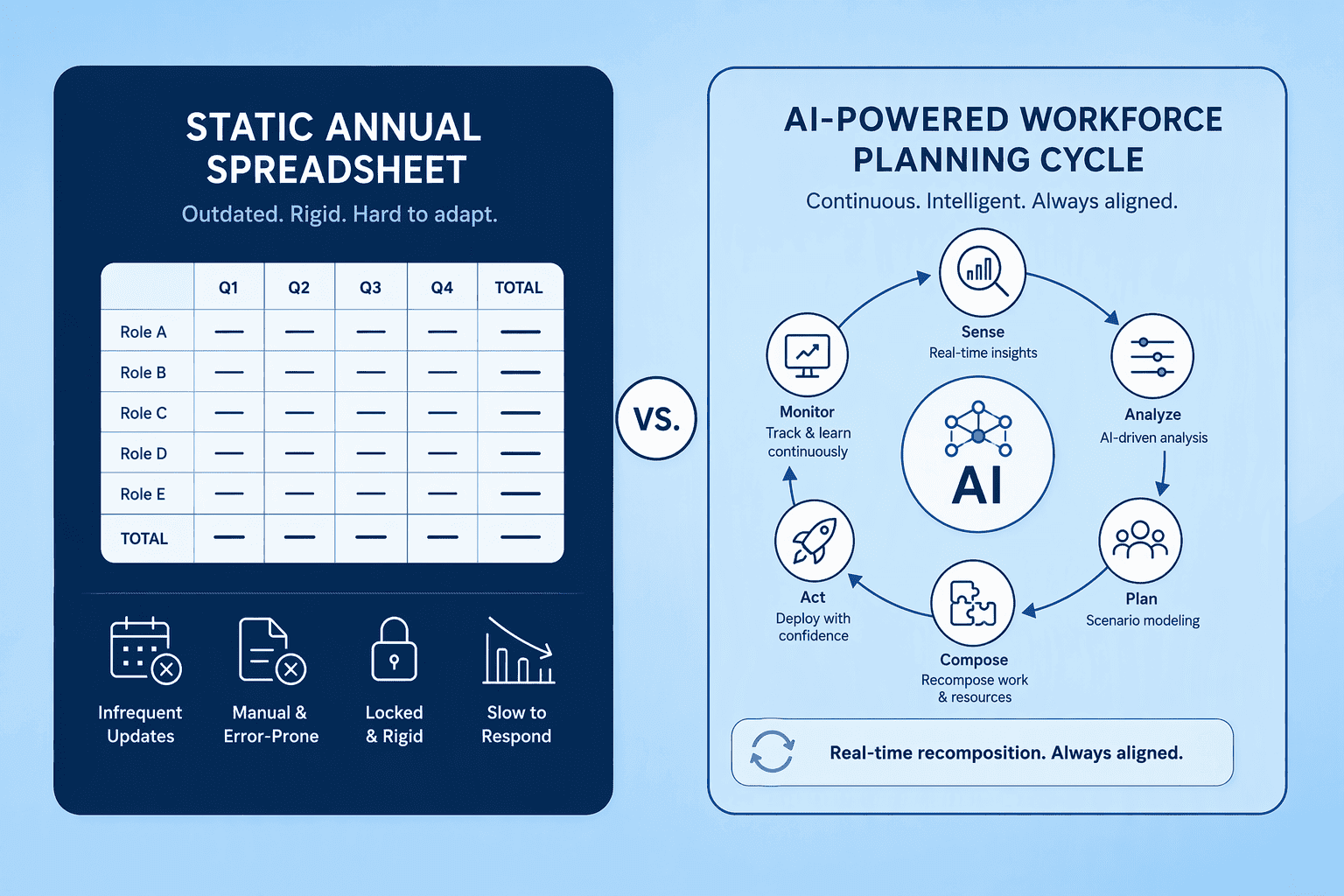
The 2026 competitive environment has finally killed the annual spreadsheet. Planning no longer happens in yearly isolation. Forbes Human Resources Council reports that planning now happens in quarters, not years.
Deloitte captures this shift through the concept of 'workforce shaping': a dynamic blend of human and AI capabilities that recomposes work in real time. This is a permanent state of organizational rebalancing. Static job architectures cannot keep up with a reality where AI systemically reshapes roles unevenly.
This requires a brutal re-evaluation of how work gets classified. Leaders must break jobs into work types: automation, augmentation, judgment and relationship. Only then can you redesign roles for a hybrid intelligence organization. The chief enemy of modern workforce planning is data siloing. If HR, finance, and operations do not share a single source of truth for headcount and capacity, you cannot plan with any speed.
Visibility has become the critical currency. HR needs real-time visibility into goals, skills, feedback and mobility to see precisely where talent is sitting idle, pinpoint where gaps are widening beneath the surface, and identify where a skilled employee can be redeployed internally before a critical business function grinds to a halt.
Under this model, the strategic planner stops counting chairs and starts governing capability mapping, tracking the internal readiness and retention of critical skill clusters before those clusters fracture.
Done right, the rewards are immediate and tangible. Effective planning reduces labour costs in favor of workforce flexibility, improves employee retention, and targets operational inefficiencies. The concrete payoff appears as faster time-to-productivity on new strategic projects and a demonstrable link between talent investment and revenue output. Beyond the balance sheet, you build a resilient system where leadership knows exactly who the critical players are and who the successors will be, insulating the business from sudden market shocks or the loss of tribal knowledge.
The major obstacles have deepened precisely because the data landscape has become more complex. Demographic shifts are hitting the labor supply harder than most operating models anticipate, and technology is not a silver bullet. Planners now struggle with a fragmented data reality: some units hold deep skill inventories while others run on gut instinct. The most damaging risk is falling back on simple headcount addition. Unless you treat planning as a governed capability loop, you will simply digitize bad assumptions, producing an expensive, AI-validated version of last year's mistakes.
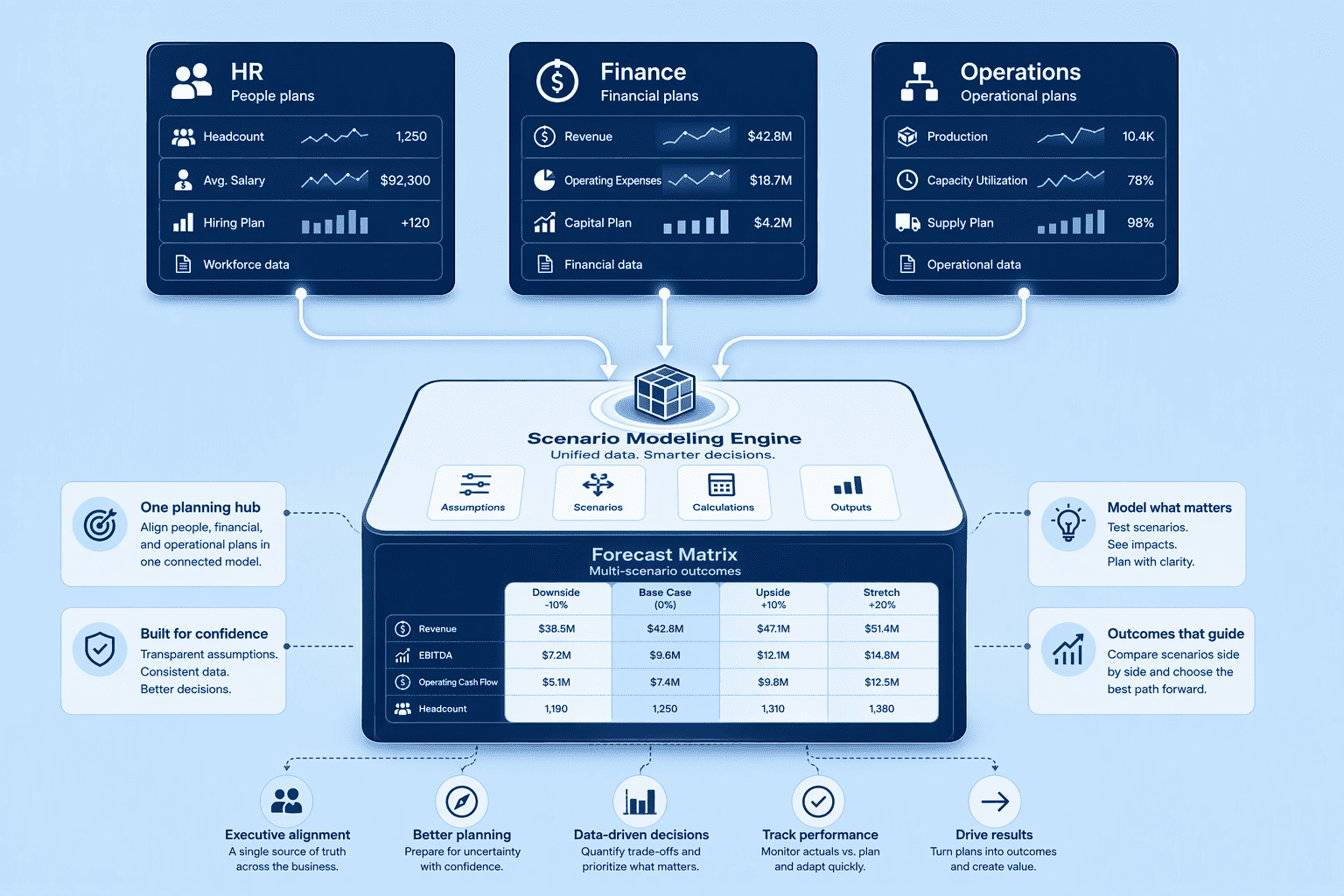
The manual spreadsheet buckles when it has to hold long-term strategy and next quarter's pivot in the same cell. Modern planning platforms solve this by pulling HR, finance, and operations data into one shared layer. Centralizing headcount numbers and salary allocations stops the spreadsheet war between FP&A and HRBPs before the first version-control email goes out.
Scenario modeling is the operational upgrade that matters most. Planners stop protecting a single linear forecast and start stress-testing several futures side by side. A tool like CompUp, for instance, lets teams run workforce supply-demand analysis and build what-if scenarios that model the financial weight of a targeted hiring spree in a new geography against a broad-based insourcing play. The budget negotiation shifts from a contest of opinions to a structured evaluation of assumptions.
These tools also sharpen the talent review. AI-powered solutions flag attrition risk clusters and spot where an internal move could close a skill gap faster than posting a new req.
CompUp connects headcount planning directly to workforce cost visibility. HR and finance partners model manpower budgets, track plan versus actuals, and run hiring and attrition scenarios at a granular level. Workforce cost decisions become transparent and readable for people well beyond the CHRO's office.
In a high-cost, high-speed 2026 environment, the axiom of having the right people in the right place at the right time depends on abandoning the annual spreadsheet. AI has accelerated the analytical steps OPM laid out into a continuous, skills-based discipline. The confidence gap C-suite leaders report shrinks when workforce planning stops being a passive headcount exercise and becomes the active engine of business strategy, aligning cost, capability, and purpose with precision. If you're weighing options, CompUp is worth a closer look.
Workforce planning is the systematic process of closing the gap between your current workforce and the human capital required to meet future strategic goals. It is important because an unplanned workforce drains financial resources and creates critical skill shortages that will stall your strategic execution in the near term.
The U.S. Office of Personnel Management defines a five-step model:
Workforce planning, workforce management, and compensation planning serve distinct purposes:
Key benefits, challenges, and risks of workforce planning include:
Modern software spans unified platforms like CompUp, enterprise suites like Workday Adaptive Planning and Oracle Cloud EPM, and specialized organizational design tools like Orgvue. These solutions support real-time scenario modeling, headcount cost visibility, and AI-driven skills and attrition analysis.
AI enables a shift from annual, static forecasting to continuous 'workforce shaping.' Planners now use AI to map work to skills rather than job titles, model complex what-if scenarios in real time, and predict attrition risk. This moves planning cycles from years to quarters.
Community Manager (Marketing)
As a Community Manager, I’m passionate about fostering collaboration and knowledge sharing among professionals in compensation management and total rewards. I develop engaging content that simplifies complex topics, empowering others to excel and aim to drive collective growth through insight and connection.
Revolutionizing Pay Strategies: Don't Miss Our Latest Blogs on Compensation Benchmarking