
Your product roadmap depends on a critical specialist you haven't hired yet, and the two internal candidates you were grooming just accepted offers elsewhere. That gap, between the business strategy you have committed to and the people you have available, is the problem workforce planning exists to solve.
For years, the discipline meant a headcount exercise: a spreadsheet reconciliation of vacancies, attrition, and budget. That approach breaks down in a market where skill requirements shift faster than recruitment cycles can respond. A 2026 Deloitte report notes the discipline is pivoting from headcount tracking to modeling skills, tasks, roles, and capacity.
An increasing number of HR and finance leaders are asking the same question: what combination of capabilities, costs, and contracts will get the strategy executed. The answer depends on skills forecasting and capacity modeling. This article explains what workforce planning is, walks through the authoritative framework from the U.S. Office of Personnel Management, and shows how organizations are closing the gap between knowing the discipline matters and actually executing it.
Before breaking down the framework and the trends, here are the core findings that define modern workforce planning:
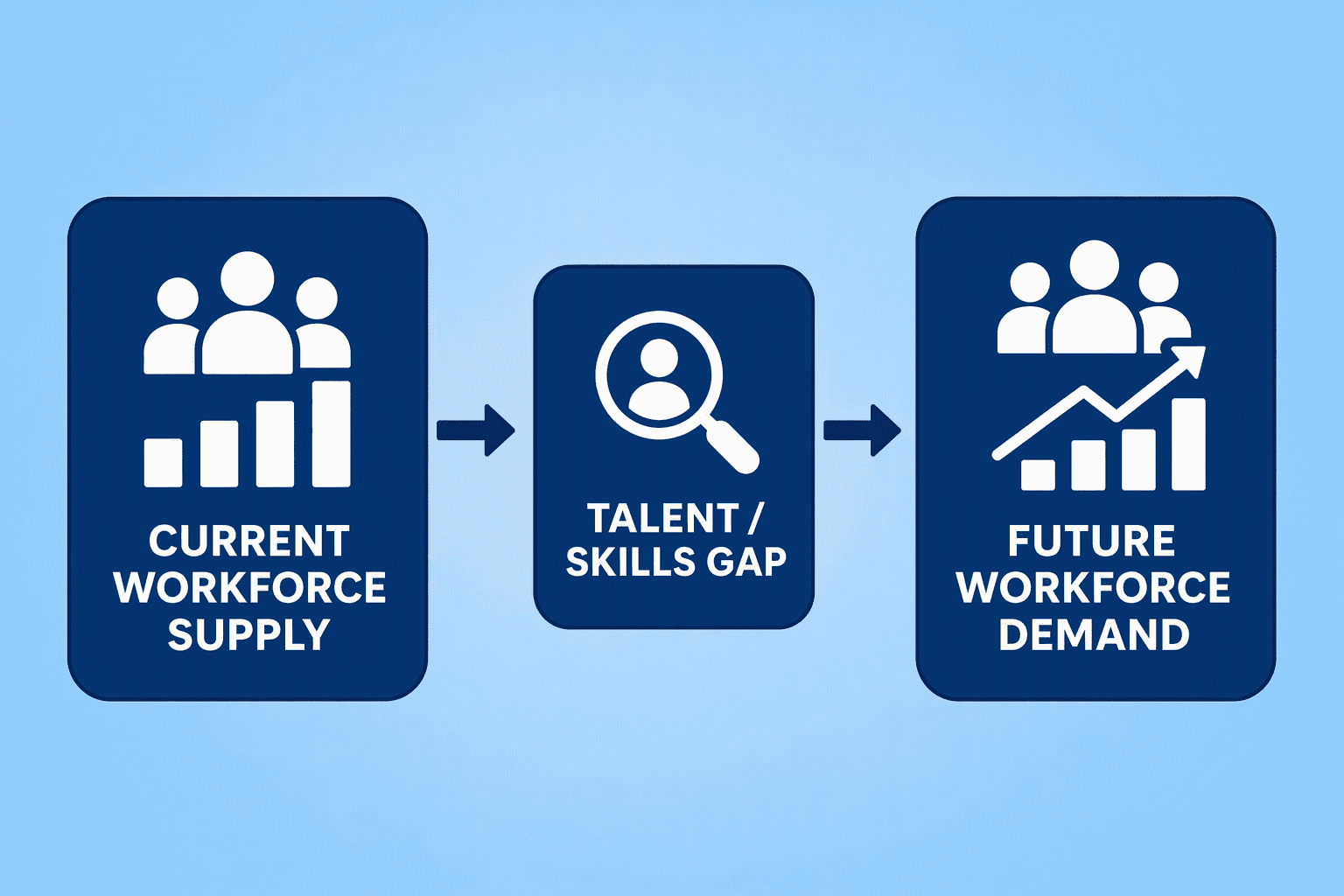
Before unpacking the process, it helps to anchor on the definition that federal agencies and HR practitioners actually use. It is systematic, measurable, and built around closing specific gaps.
The U.S. Office of Personnel Management provides a clean, repeatable framework that most successful planning efforts adapt. The model is a practical decision engine; every step forces a concrete choice.
| Step | Core Activity | What It Forces You to Answer |
|---|---|---|
| 1. Set Strategic Direction | Link the workforce planning process with organizational strategic plans, annual performance plans, and work activities required to execute goals. | Which business objectives will drive our staffing shape over the next 1, 3, and 5 years? |
| 2. Analyze Workforce and Identify Gaps | Determine what current workforce resources exist, specify the kinds of workers needed, and calculate the gap between supply and demand. | How large is the gap between the skills we have and the skills we need, and is it concentrated in specific functions? |
| 3. Develop the Action Plan | Translate the gap analysis into a structured plan that includes specific interventions: build, buy, borrow, or in some cases, automate. | What specific mix of hiring, contracting, reskilling, and technology will close the highest-priority gaps, and at what total cost? |
| 4. Implement the Action Plan | Execute the plan while managing stakeholder alignment, budget allocations, and operational timelines. | Who owns each item, and what triggers a reassessment if the business priorities shift? |
| 5. Monitor, Evaluate, and Revise | Establish feedback loops that track whether the actions are closing the targeted gaps and adjust the plan as new data arrives. | Are we tracking against the right metrics, and is the pace of gap closure sufficient? |
Most planning failures trace back to a single cause: skipping directly to hiring without first linking headcount to strategy. Step 1 sets your destination; Step 2 shows you how far you are from it. Treat those two steps as a single diagnostic unit. If you can't explain in one sentence which business objectives will reshape your staffing over the next three years, you are not ready to open a requisition.
Your action plan has to name hard choices about build, buy, and borrow. This is where you decide which critical roles to fill internally through reskilling and which to recruit externally, which to staff through contractors, and which parts of the work you can eliminate or automate entirely.
The difference between a plan that lives and one that sits in a drawer is Step 5. You need a feedback loop that compares actual gap closure against the targets you set in Step 2. The metric that matters is the rate at which your highest-priority capability shortages shrink, not just the number of filled and unfilled seats.
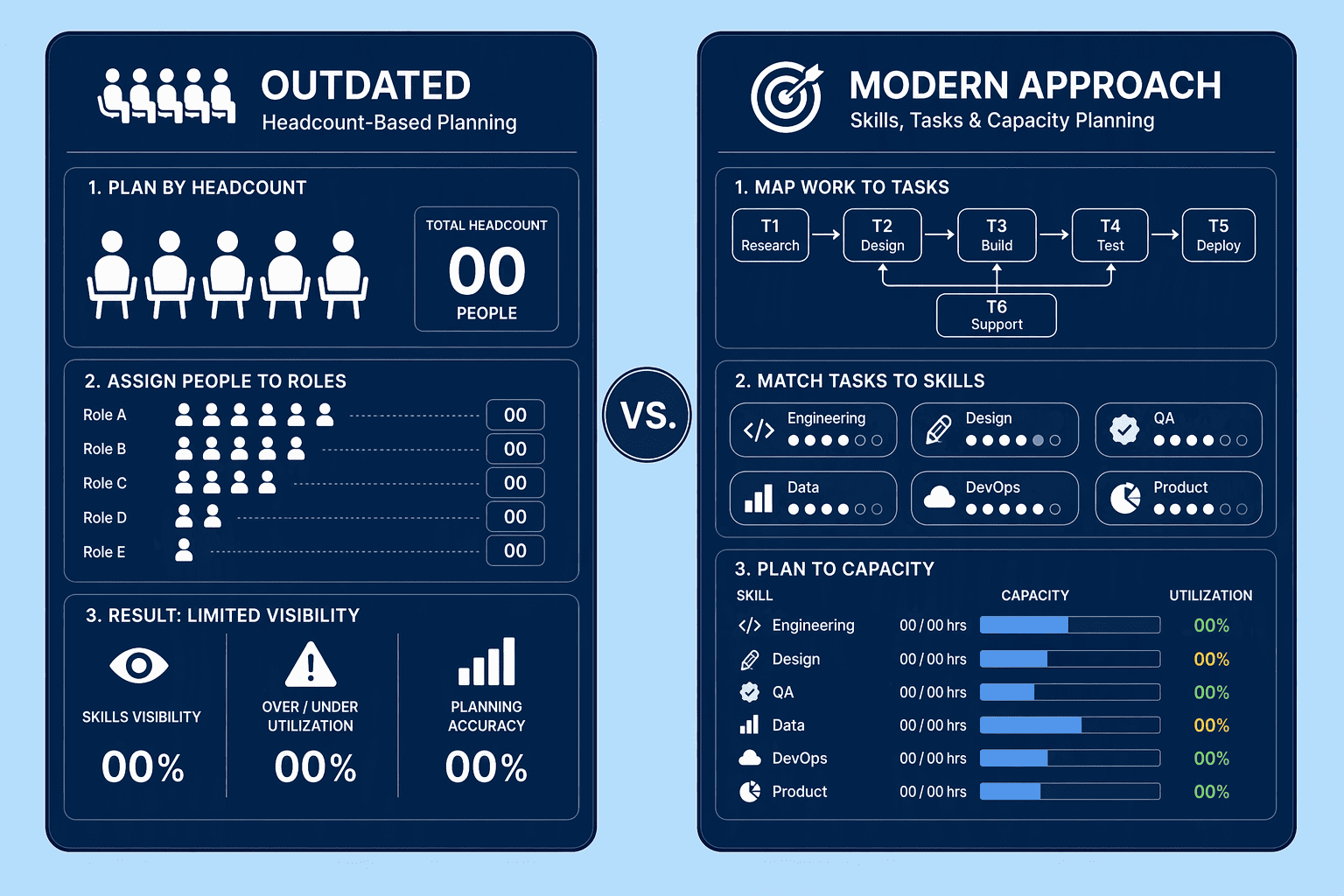
The traditional budgeting conversation starts and ends with headcount: number of approved positions, average cost per seat, and attrition assumptions. The 2026 Deloitte research confirms that effective teams are measuring tasks and capacity, not filled and unfilled seats.
Skills inventory and role design have become the hard currency. Organizations that cannot map the specific tasks required by a new product launch or market entry find themselves with fully funded headcount and stalled execution. Capacity modeling, when done right, tells you whether the people you have can absorb the work you are adding, and at what skill cost.
The most dangerous plan is the one that sits in a slide deck and never meets the budget. A properly executed workforce plan ties directly to operational outcomes.
- Cost control with precision: Workforce planning lets you reduce labor costs through deliberate deployment and flexibility. You skip the reactive hiring freezes and blanket layoffs altogether.
- Talent retention and resilience: Regular planning imposes a discipline: decisions answer to strategic needs, not to events or emotion. That predictability lowers the churn that follows poor staffing decisions.
- Quality and productivity gains: Getting the right skills into the right roles at the right time produces higher-quality outputs, stronger productivity, and measurable gains in employee retention.
- Risk mitigation across planning horizons: Macro strategic forecasts span 5-to-10 years. Shorter tactical and operational cadences surface exposure to single-point-of-failure roles and scarce skill dependencies before they become crises.
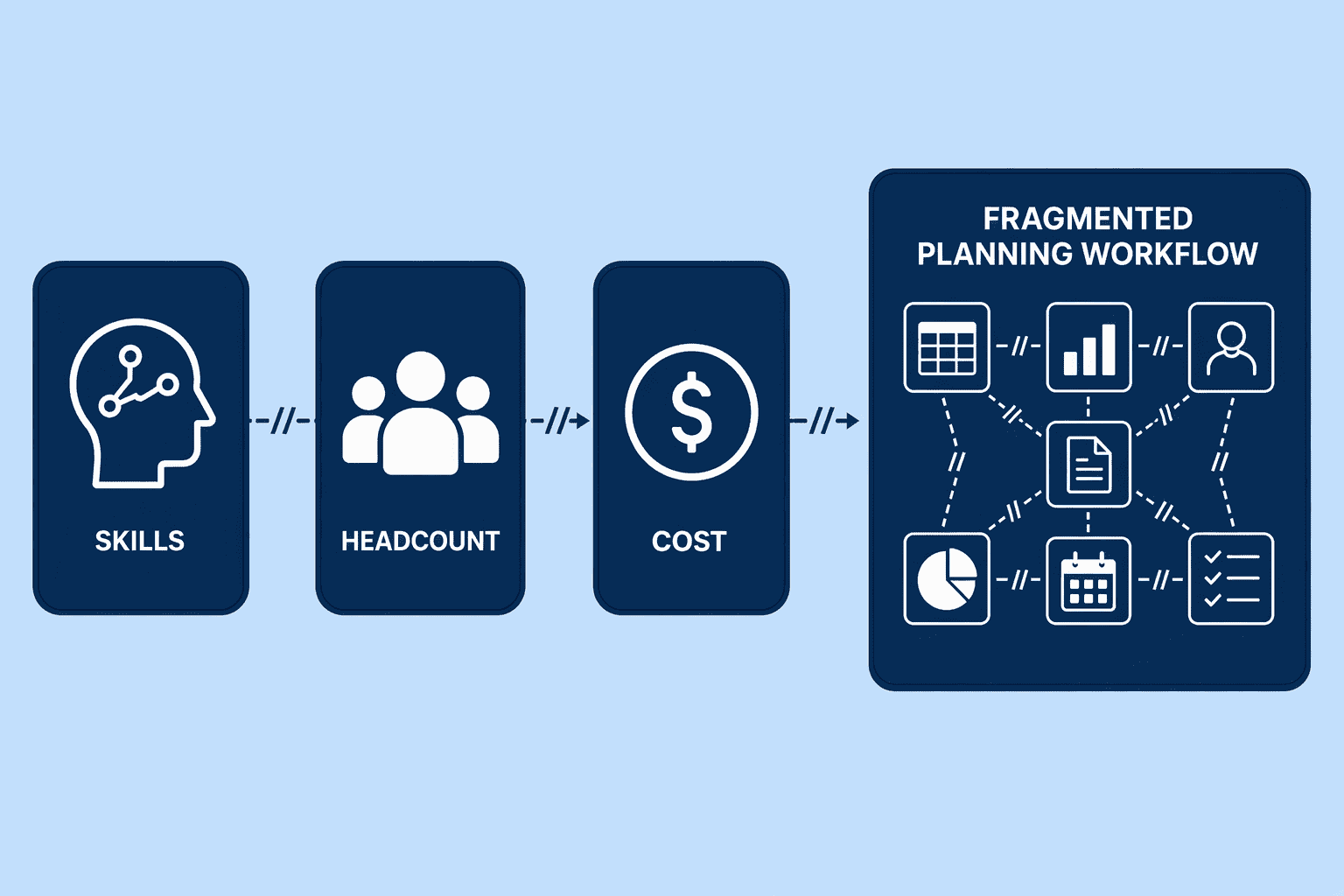
There is a statistic from the 2026 Deloitte report on workforce planning that HR leaders find uncomfortable but immediate: 88% of organizations say workforce planning is important, yet only 7% rate their own progress as meaningful. This is the orchestration gap. It comes from a shortfall in execution infrastructure, not ignorance of the process.
The gap typically opens at the data layer. Planning demands a unified view of skills, headcount, and cost; most organizations store those data sets in separate systems owned by different functions. HR tracks headcount in the HCM.
Finance manages labor cost in the ERP. Talent management holds skill data in disparate modules. Without integration, the model gets stale before it is complete.
A second failure pattern is the static plan. Teams produce a detailed workforce forecast once a year, present it to the board, and then lock it in a drawer until the next planning cycle. In a market where a critical postdoctoral pipeline can decline in applications, as the GAO observed in its analysis of NIST's workforce challenges, a static plan is a liability.
The organization that built the plan in January is often staring at a different business reality by March. Practitioners who report the greatest traction cite a few key success factors: they create cross-functional planning teams, scope the effort to a manageable set of critical roles rather than the entire organization, and use internal and external data with technology to automate parts of the analysis. If your current approach does not include those mechanics, the orchestration gap will persist.
The pitfall that surprises teams the most is the compensation blind spot. A workforce action plan that specifies hiring, redeployment, and upskilling without attaching realistic total-compensation cost scenarios has no purchase on the budget conversation. The plan reads like an HR document, not a business case.
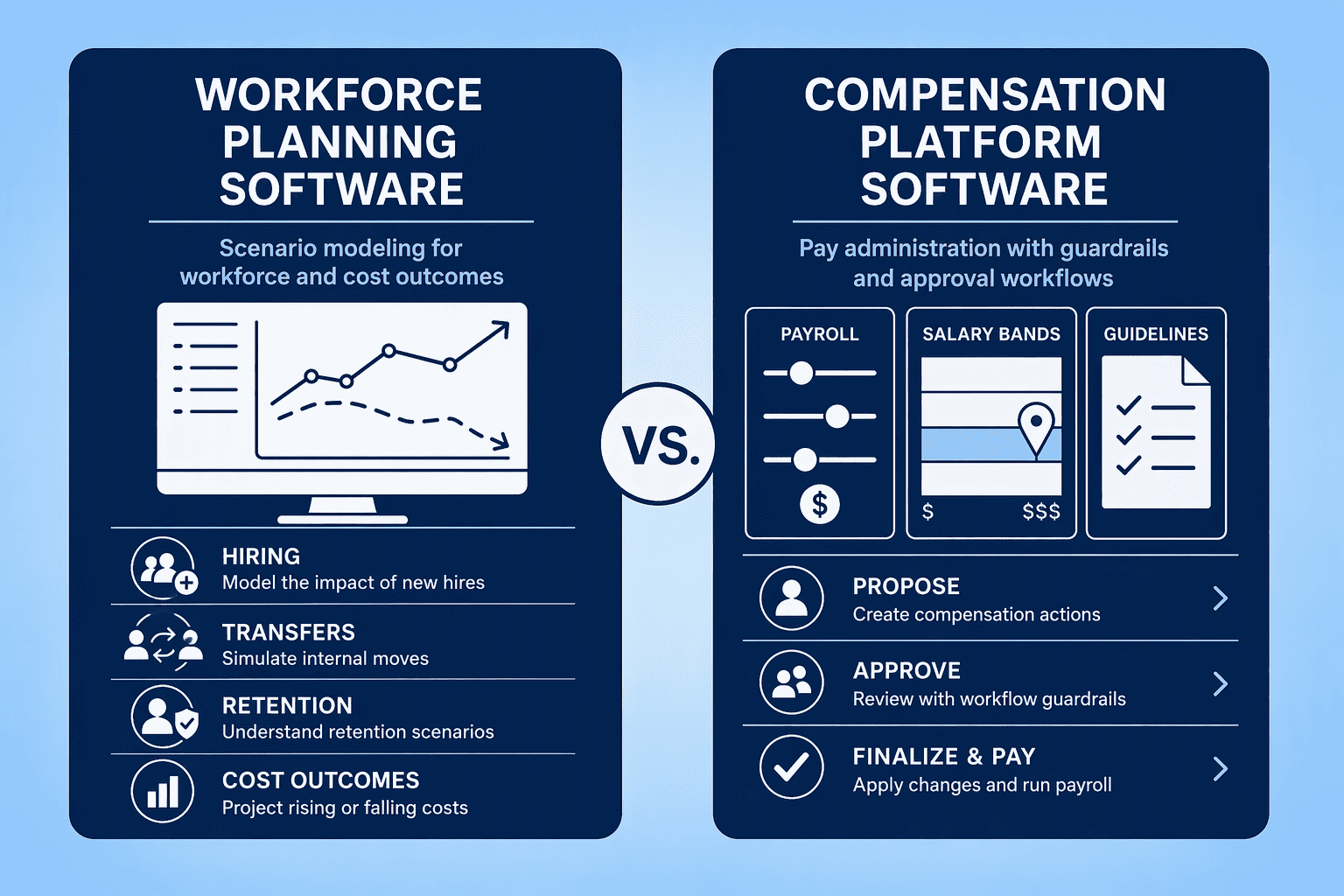
A specific confusion in the market makes the orchestration gap worse: the conflation of workforce planning platforms with compensation management software. They solve related but distinct problems.
Dedicated workforce planning software enables you to model hiring, transfers, and retention with driver-based assumptions and visualize the cost impact instantly. It typically handles scenario comparison, supply-demand modeling, and gap reporting at the strategic, programmatic, and operational levels. A compensation platform such as CompUp focuses on the cost and equity side of the equation: it centralizes base salary, bonuses, stock options, and benefits, applies formula-driven guidelines, and generates real-time budget simulation. That way the cost assumptions feeding the workforce plan are current, not estimated.
You need both a headcount model and a live compensation data source, but no single tool today covers strategic workforce modeling and detailed compensation cycle management end-to-end. Recognizing the difference helps buyers avoid the frustration of expecting one platform to do everything.
The moment you attach real cost data to a workforce action plan, it stops being an HR artifact and becomes a budget document.
When the OPM model calls for an action plan in step three, most organizations produce a list of hires, training investments, and contract conversions. That list without a cost line is incomplete. Integrating compensation data gives each hire a market-benchmarked salary band and projected equity. Each redeployment carries a retraining investment and a possible comp adjustment. Each long-term capacity gap gets stress-tested against different cost scenarios.
In practice, a tool like CompUp lets teams run those simulations in real time and see the immediate budget impact without rebuilding spreadsheets. The result is a workforce plan the CFO can engage with because it answers the question they care about most: what does closing this gap cost, and what do we get for it?
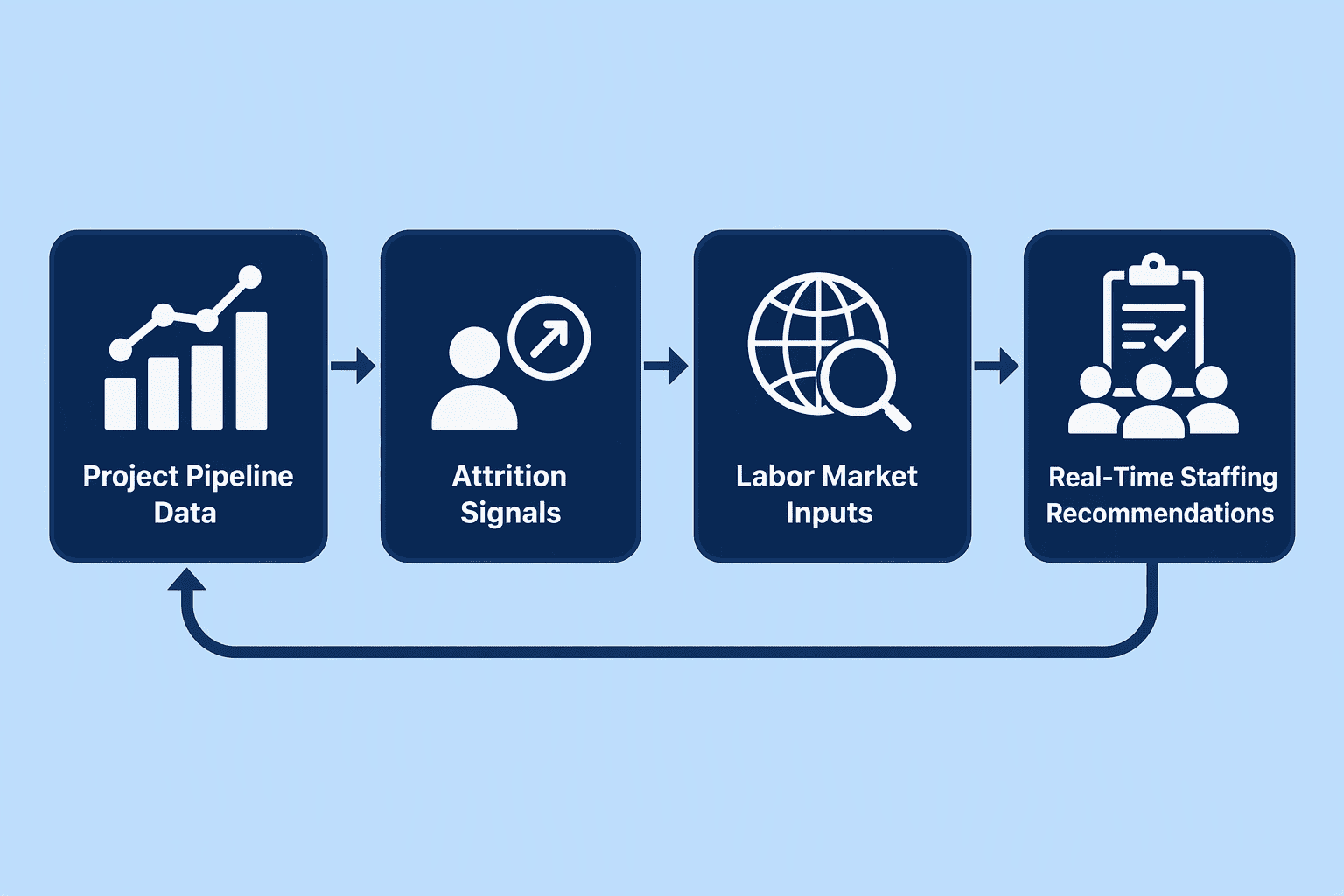
The workforce planning function is undergoing a material shift in 2026, driven by technology maturity and labor market pressure in the US. The annual plan is losing its relevance to a continuous planning cadence enabled by AI.
Deloitte's 2026 analysis frames the new norm: AI reads signals from project pipelines, attrition patterns, and external labor market data to recommend staffing adjustments in near real time. This goes beyond headcount forecasting. The technology generates continuous scenarios and infers skills. This is a structural change, not a feature upgrade. The organizations making good progress are those that have embedded AI-powered recommendations into a monthly or quarterly cadence rather than an annual cycle.
Compensation integration is also rising in importance. The old model treated total rewards as a downstream HR administration task. The emerging approach treats compensation data as a core input to workforce modeling, directly influencing decisions about where to build, buy, or borrow talent.
For US-based HR and Total Rewards leaders, the takeaway is specific. Strategic workforce planning has historically been stronger in European and government-sector environments with longer planning horizons. The US market is now accelerating adoption because the cost of skill gaps has become too visible to ignore. If your organization is still running planning as an annual headcount reconciliation, 2026 is the year to implement a lighter, more continuous model grounded in skills data and real-time compensation cost scenarios.
Workforce planning closes the gaps between your current workforce and the human capital you will need. The OPM's five-step framework remains the authoritative model, but it only delivers ROI when compensation cost modeling is part of the action plan. Organizations that combine continuous, skills-first planning with real-time compensation data will close the orchestration gap (88% say it is important, 7% execute it well). If your current process lacks that cost integration, that is the single capability to pursue. If you're weighing options, CompUp is worth a closer look. Book a free demo today.
Workforce planning is the systematic process for identifying and addressing the gaps between the workforce of today and the human capital needs of tomorrow. Its core components are a current-state workforce analysis, a future-requirements specification, a quantified gap analysis, and an integrated action plan to close those gaps.
Per the U.S. Office of Personnel Management, the five key steps are:
Strategic workforce planning reduces reactive labor costs, improves employee retention and productivity, and imposes discipline so staffing decisions align with strategic needs rather than short-term events or emotion. It also surfaces single-point-of-failure roles before they become crises.
The primary challenge is the orchestration gap: knowing the discipline matters but failing to execute. This stems from siloed data, static annual plans, and missing compensation cost integration. Successful teams overcome it by building cross-functional planning groups, scoping to critical roles first, and leveraging technology for continuous, data-backed analysis.
Workforce planning software models hiring, transfers, and retention with driver-based assumptions to forecast supply-demand gaps. Compensation platforms such as CompUp manage pay, bonuses, equity, and budget simulations. No single tool covers both exhaustively; the most strong operations pair them so workforce plans carry accurate cost data.
The critical trends in 2026 are the shift from annual plans to continuous, AI-enabled scenario planning and the pivot from headcount to skills, tasks, and capacity modeling. In the US market, adoption is accelerating as organizations tie compensation cost modeling directly into workforce plans to make them budget-ready.
Community Manager (Marketing)
As a Community Manager, I’m passionate about fostering collaboration and knowledge sharing among professionals in compensation management and total rewards. I develop engaging content that simplifies complex topics, empowering others to excel and aim to drive collective growth through insight and connection.
Revolutionizing Pay Strategies: Don't Miss Our Latest Blogs on Compensation Benchmarking