
Your board meeting is in three days. The compensation committee needs total rewards statements, pay-for-performance analytics, and a clear picture of budget alignment against your stated strategy. Two analysts are pulling data from three different systems into a shared spreadsheet, and the version history already shows sixteen conflicting copies.
A bad compensation report burns far more than time. It erodes boardroom credibility, invites scrutiny from audit committees, and leaves leadership making multi-million dollar pay decisions on data that is already stale. The stakes are too high for process heroics.
Dedicated compensation reporting software, purpose-built platforms that integrate directly with your HRIS, apply custom comp-cycle logic, and render board-ready outputs without IT intervention, has moved from a nice-to-have to the structural answer. Tools like Aeqium, COMPackage, and CompUp exist to eliminate the spreadsheet scramble and give leadership real-time visibility into how every dollar maps back to strategy. You get an audit-ready dataset that lives inside the system, updated continuously. No assembled slide deck can match that reliability.
What follows is a practical breakdown of the features that matter, the platforms that deliver them, and what you should expect to pay.
Before you evaluate vendors, here are the bottom-line findings every HR and rewards leader needs.
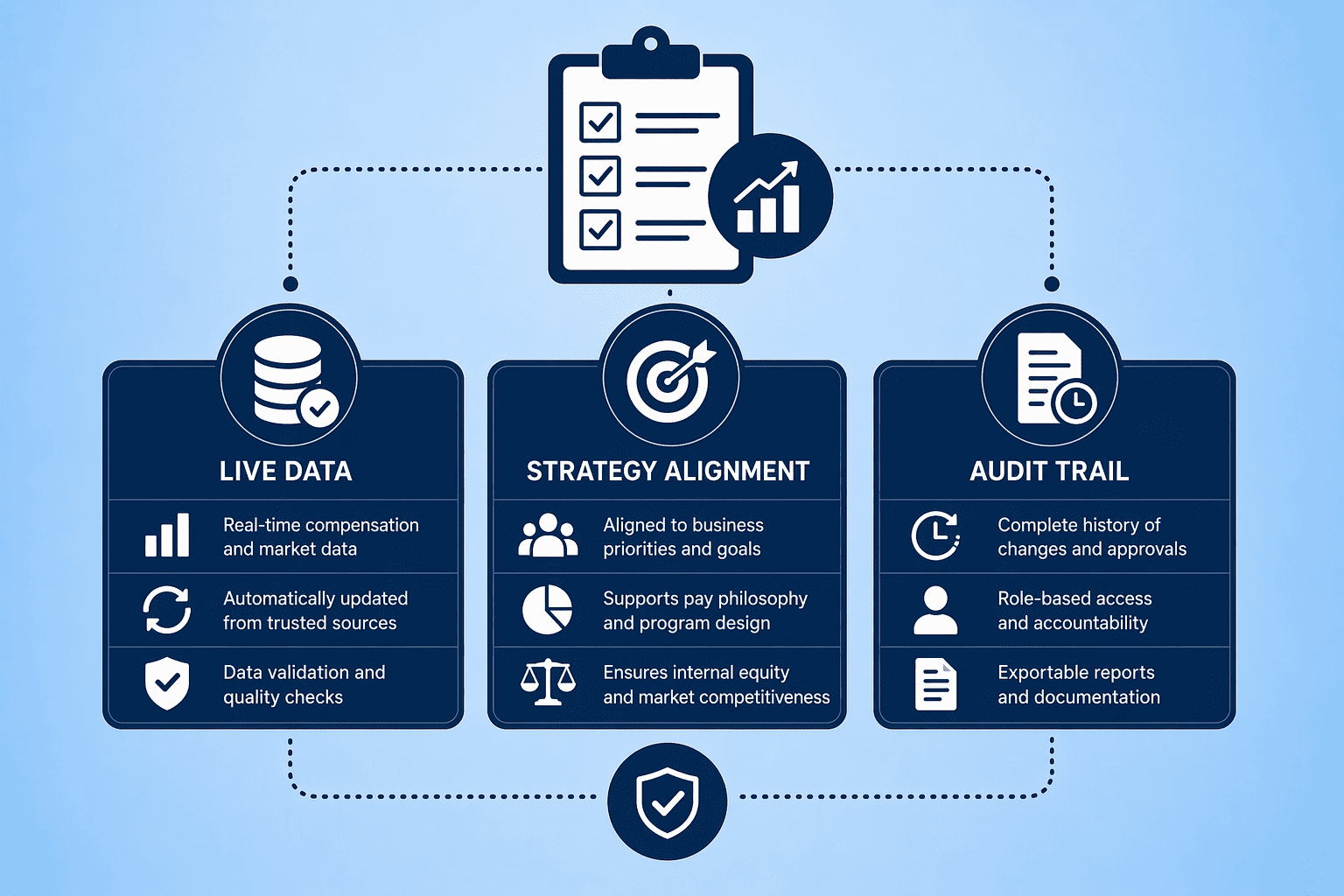
Boards do not need more data. They need decisions they can defend. A compensation report built for leadership must surface what is happening now, tie it to the strategy you approved, and leave an indisputable record of every adjustment. General board portals manage document packets and meeting minutes, but they stop short of the dynamic compensation analytics a comp committee requires.
Here is the checklist that separates dedicated compensation reporting software from a generic board-deck tool:
| Feature | Dedicated Compensation Reporting Software | General Board Meeting Software |
|---|---|---|
| Real-time budget alignment | Pre-built dashboards track spends against approved budgets as decisions happen | Static data exports updated manually before each meeting cycle |
| Custom pay-for-performance visualizations | Configurable reports map pay outcomes to performance ratings, identify inconsistencies, and track metrics that drive comp philosophy | Basic charting within presentation decks, no live data connection |
| Role-scoped, secure access | Granular permissions let the comp committee view equity details while a departmental reviewer sees only their unit; AICPA SOC 2 Type 2 certification backs the architecture | Broad board member access controls, rarely granular to the compensation record level |
| Immutable audit trail | Every adjustment, override, and approval is logged and traceable for audit committee review | Version history on shared files, not an embedded system-of-record audit log |
| Direct HRIS integration | Pulls live employee data on salary, bonuses, and equity without manual exports; Aeqium, for instance, connects directly to HRIS, ATS, and equity management systems | No native integration; relies on imported snapshots |
If a tool cannot show you real-time budget consumption against your cycle targets or scope compensation detail by role, it will fail at the boardroom door. That is the non-negotiable starting line.
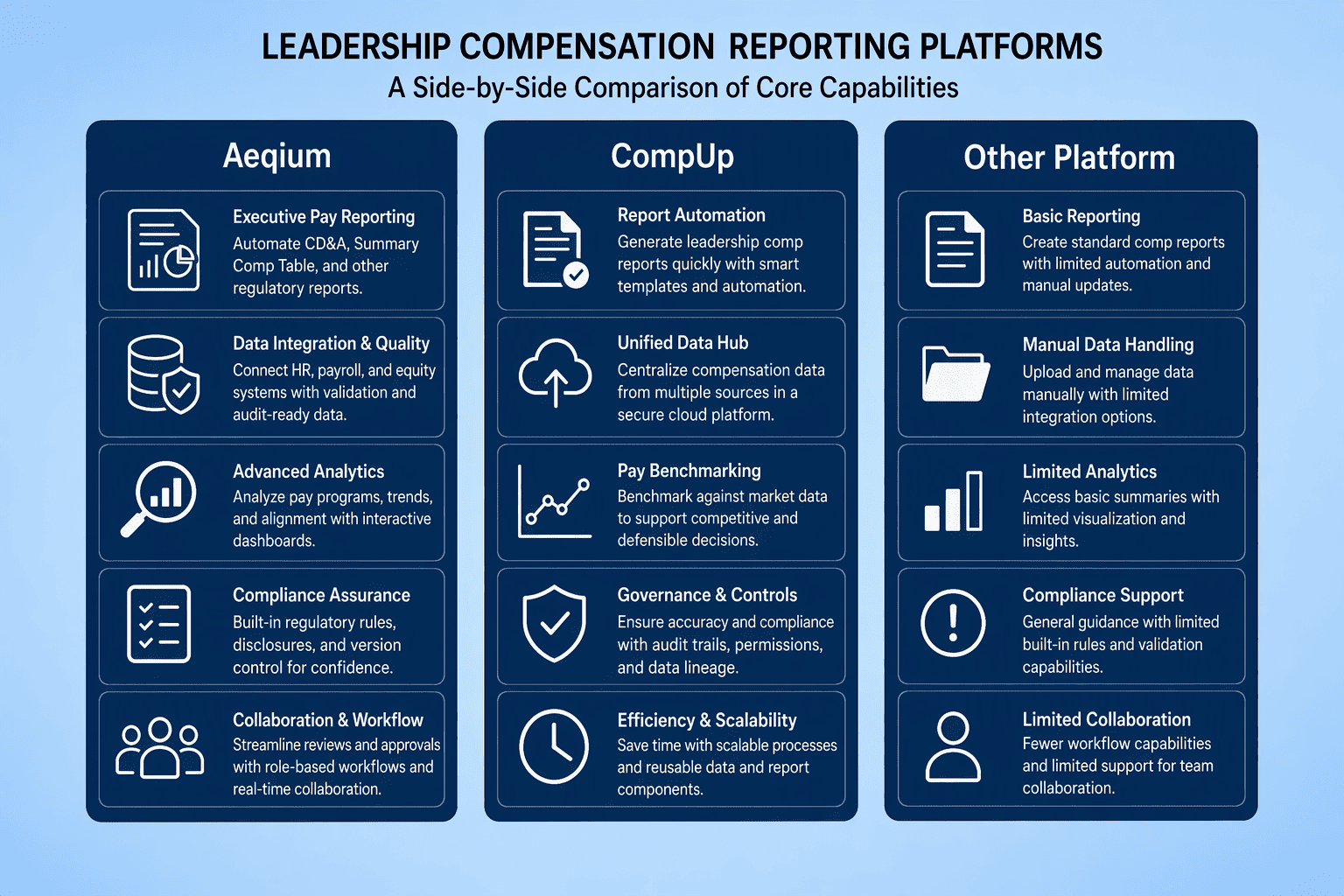
Three platforms repeatedly surface when compensation leaders look for software that goes beyond basic reporting and into the mechanics of running and analyzing a full compensation cycle. Each solves a different operational weight.
Aeqium is built for the compensation cycle itself. Comp teams model and execute any cycle with custom logic and approvals without waiting on IT. Its pre-built budget dashboards give leadership real-time visibility into how every decision maps to the approved allocation across regions, functions, and currencies.
Full onboarding takes four to six weeks. The trade-off is pricing opacity: Aeqium does not publish a rate card, so costs land in the custom enterprise bracket. COMPackage takes the opposite approach.
It focuses squarely on secure executive compensation reporting and total rewards statements at scale, with plans that start at roughly $495 per year for unlimited employee reporting in a large business plan. That pricing clarity makes it an accessible option for organizations that need standardized, defensible reports without building cycle logic from scratch.
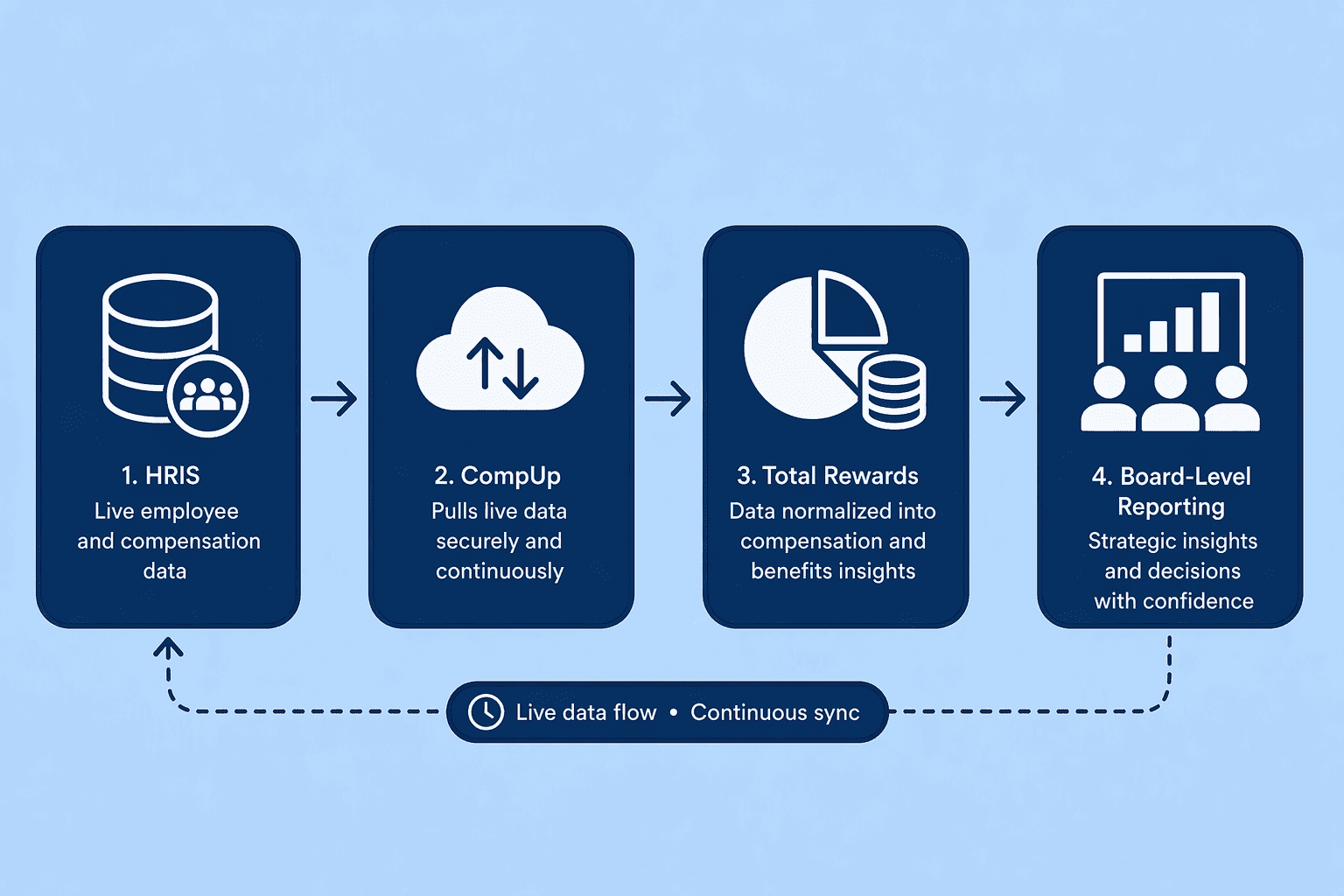
The leap from manual reporting to automation removes the points of failure between your HRIS and the board deck. CompUp, as a compensation-specialized platform, illustrates the practical workflow. That workflow follows an integration-led approach: the system pulls live data rather than pushing static files.
The operational value is straightforward: the data the board sees is the same data the comp team used to allocate pay, refreshed directly from the cycle that just closed.
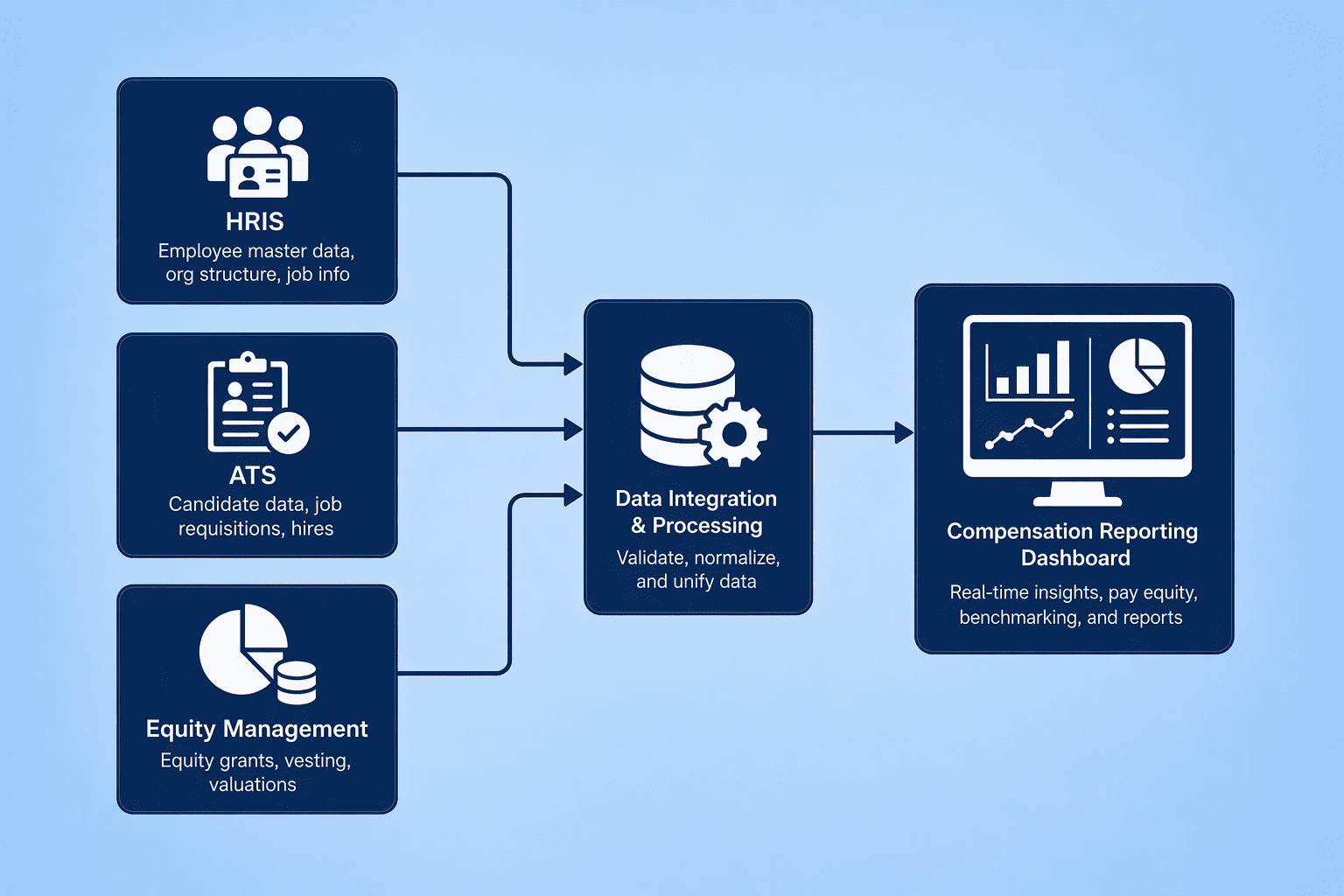
Every board-ready compensation report depends on one structural truth: the output is only as trustworthy as the data pipeline that feeds it. Manual exports break that pipeline at the first copy-paste.
Direct integration with your HRIS, ATS, and equity management systems removes the spreadsheets that introduce human error. When a compensation platform pulls live employee records, salary, bonus targets, equity grants, performance ratings, it produces a board report that reflects the organization as it exists right now. A file someone downloaded three weeks ago cannot do that.
Workday Compensation, for instance, provides dashboards and reports that give executives rich insights from real-time data, including a pay equity discovery board that surfaces gaps by gender, ethnicity, or other variables. That analysis becomes useless on a stale spreadsheet. Integration makes the earlier features in this article possible.
Role-scoped access pulls permissioning from the HRIS. Budget dashboards update as managers submit allocations.
Audit trails capture every change against a live record. Without that live connection, you are just formatting spreadsheets faster.
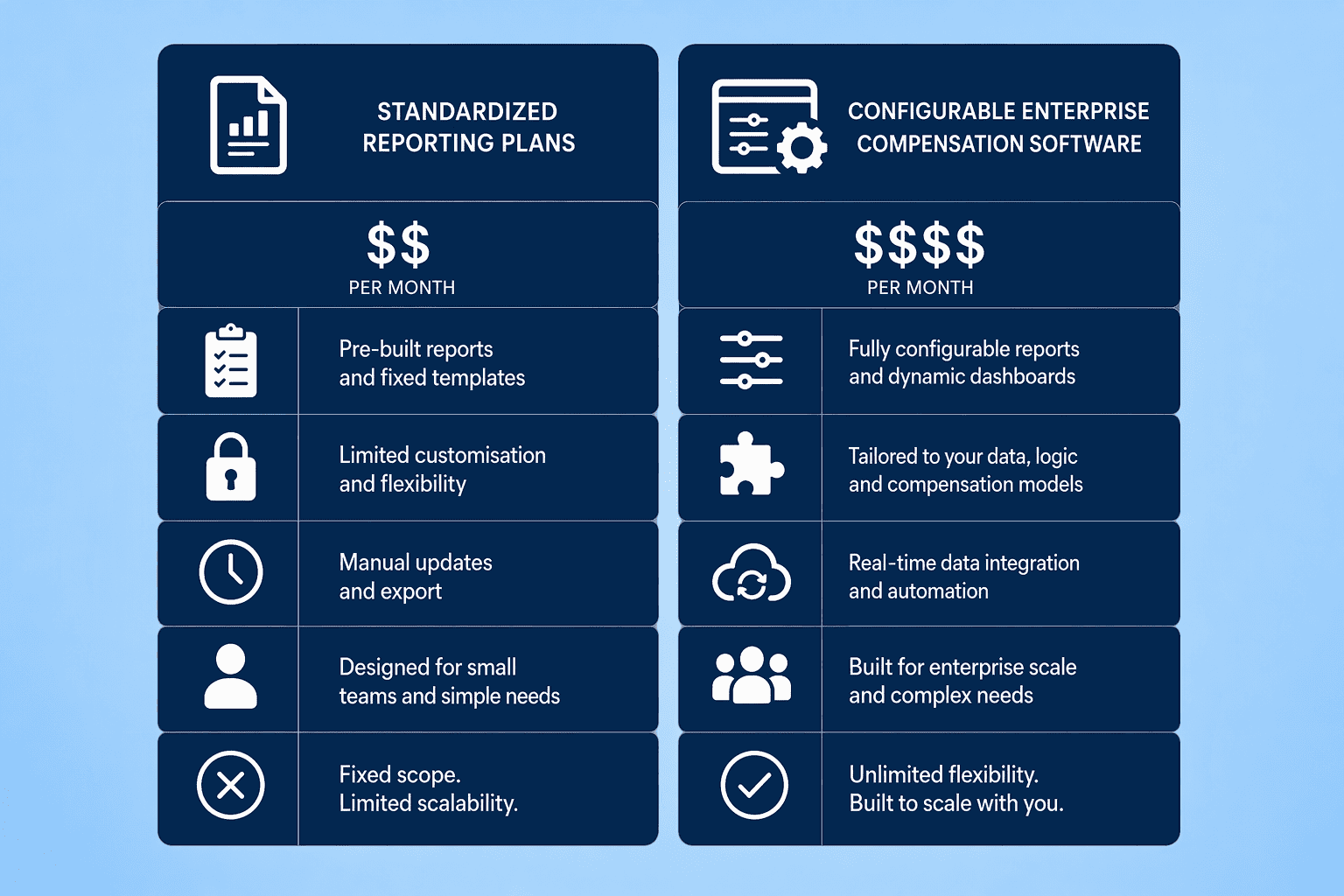
Pricing for compensation reporting software splits into two clear bands, and which band you land in depends almost entirely on whether you need standardized output or configurable cycle logic.
On the transparent end, COMPackage publishes a plan at roughly $495 per year for large businesses that covers unlimited employee reporting. That price point makes it practical for organizations that need defensible, repeatable reports without custom workflow build-out. It is an operating expense you can approve on a purchasing card.
The enterprise cycle platforms operate differently. Aeqium does not publish a rate card, which is itself a useful data point: pricing scales with employee headcount, cycle complexity, and the depth of integration required. Technical implementation takes only a few hours, but the onboarding that follows runs four to six weeks.
You are buying a system that becomes the operating core of your compensation function, and the cost reflects that. CompUp starts at $3 per employee per year for its compensation management platform, putting it in a distinctly accessible bracket while still offering total rewards statements, attrition analysis, and workforce planning. You can get a free demo to validate fit before committing budget.
Ask yourself what happens when a board member wants to trace a single number in your leadership compensation report. If your honest answer involves multiple spreadsheets and manual reconciliation, you already understand the business case for these tools better than any demo script could convey.
The software solves one concrete problem: it produces reports leadership trusts enough to defend. Aeqium automates the compensation cycle so modeling errors don't survive into final worksheets. COMPackage generates standardized executive statements at scale. CompUp connects pay structuring directly to board-ready analytics in a single system. Different approaches, same core outcome: a defensible audit trail that holds up when questions come.
Request a demo with actual employee records loaded. A vendor's polished dashboard changes character the moment real data flows through it. That one exercise will reveal more about fit than any features grid, and it costs you nothing but an hour. A good next step is seeing how CompUp puts this into practice.
A board-ready report must include the following elements:
Aeqium automates compensation cycles with deep analytics. COMPackage scales total rewards statements at a published price point. CompUp offers a unified platform covering total rewards, appraisal letters, and board-ready dashboards starting at $3 per employee per year.
Modern compensation platforms deliver these capabilities:
Costs split into two bands. COMPackage offers unlimited-employee reporting at roughly $495 per year. Configurable cycle platforms like Aeqium are custom-priced based on headcount and complexity. CompUp starts at $3 per employee per year for its platform.
Direct HRIS integration eliminates manual data exports and the errors they introduce. Live employee records feed budget dashboards and pay-for-performance analyses, ensuring the board sees current data, not a stale snapshot from a prior reporting period.
Community Manager (Marketing)
As a Community Manager, I’m passionate about fostering collaboration and knowledge sharing among professionals in compensation management and total rewards. I develop engaging content that simplifies complex topics, empowering others to excel and aim to drive collective growth through insight and connection.
Revolutionizing Pay Strategies: Don't Miss Our Latest Blogs on Compensation Benchmarking