
It’s Wednesday night and your star sales director has just emailed you version seven of the merit increase spreadsheet. You download the attachment and find a hard-coded number in cell F14 that wipes out a carefully planned departmental budget, putting you back to square one. This isn’t a single isolated mistake. It’s the systemic failure of a process built on the back of a tool that has a 89% chance of containing errors.
For compensation leaders and HR teams, the annual review cycle isn’t just a logistics exercise. It is a multi-week marathon of stress, manual data entry, and anxious late-night auditing that puts your credibility on the line. The source of this pain isn’t your people. It’s the broken foundation of manual spreadsheet handoffs. This article diagnoses exactly where your bottlenecks originate, quantifies the error tax you are paying, and maps a path to a three-day review cycle that eliminates the chaos.
The root cause of weeks-long compensation review cycles is the serial handoff of error-prone spreadsheets across managers, HR, and finance.
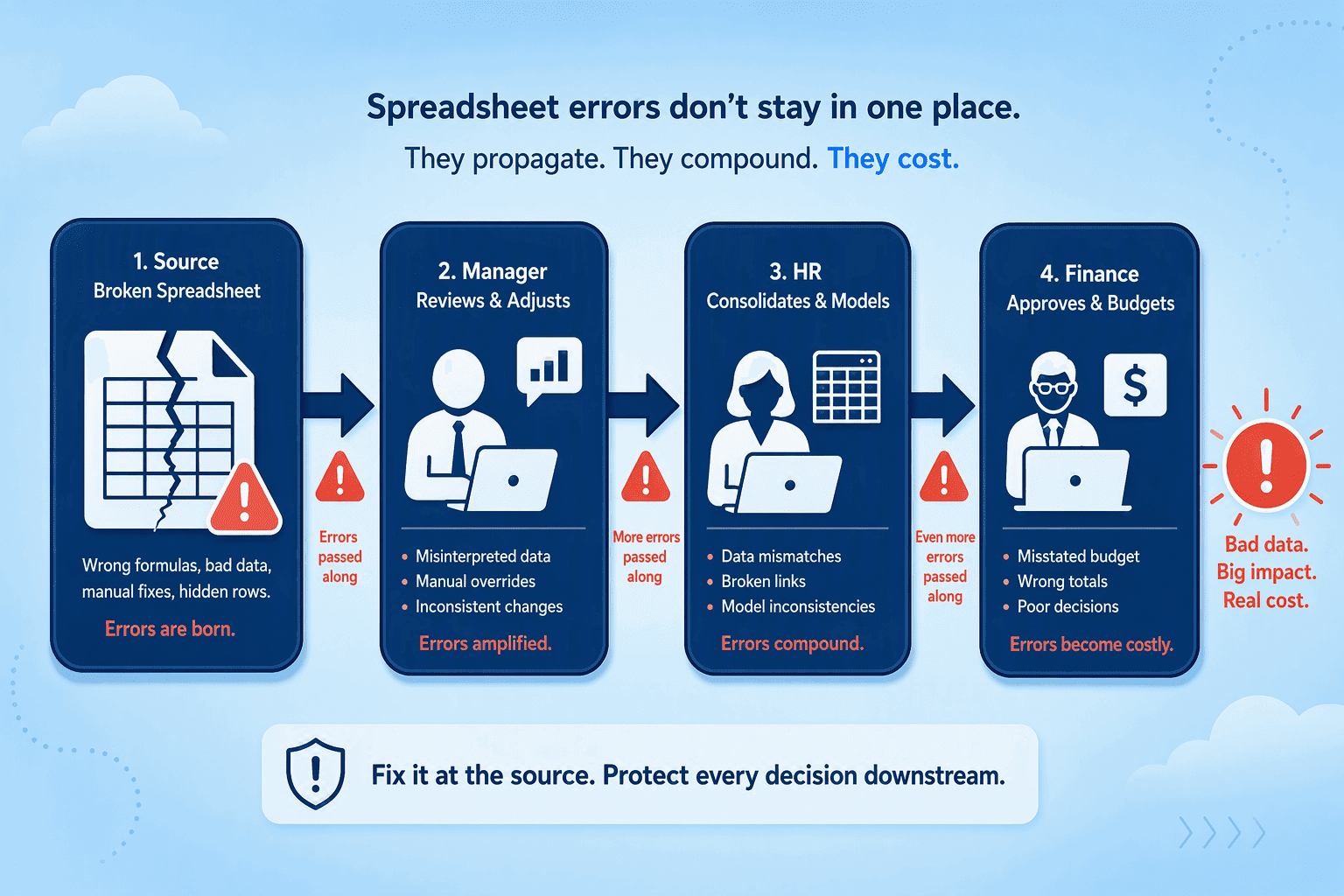
Manual spreadsheets are the single root cause of your compensation review delays. Research spanning decades is brutally clear on this point. Powell, Baker, and Lawson’s critical review of the spreadsheet literature identifies a staggering statistic: 89% of operational spreadsheets contain errors. When managers, HR business partners, and finance teams pass these files back and forth via email, they aren’t making progress. They are propagating mistakes that compound with every handoff.
What does this look like in practice? A manager adjusts a merit percentage but accidentally overwrites a fixed bonus amount. HR consolidates the file, unaware of the error.
Finance then allocates budget on a corrupted data set. The discovery triggers a rework loop that kills days of productivity. The process itself manufactures the friction that slows everything to a crawl.
The sequence of events is predictable, yet teams repeat it every cycle:
Each stage is a gate that cannot open until the previous one is perfectly closed. This dependency chain means that when a single manager misses a deadline, the entire compensation review cycle idles behind it.
The rework cost is quantifiable. In a study cited by Panko and Halverson, 11 of 17 observed spreadsheet errors involved mistakes in formulas. In a comp planning context, an error in a lookup or a broken cell reference is a financial discrepancy that freezes a merit increase or misallocates a bonus pool. Every hour spent manually reconciling these errors adds directly to the weeks-long timeline.
A survey of more than 200 compensation leaders reveals the scale of this operational drain: nearly two-thirds of organizations experienced at least one payout error in the past year. The bottleneck audit returns a clear verdict: the serial, sequential spreadsheet handoff is the engine of delay.
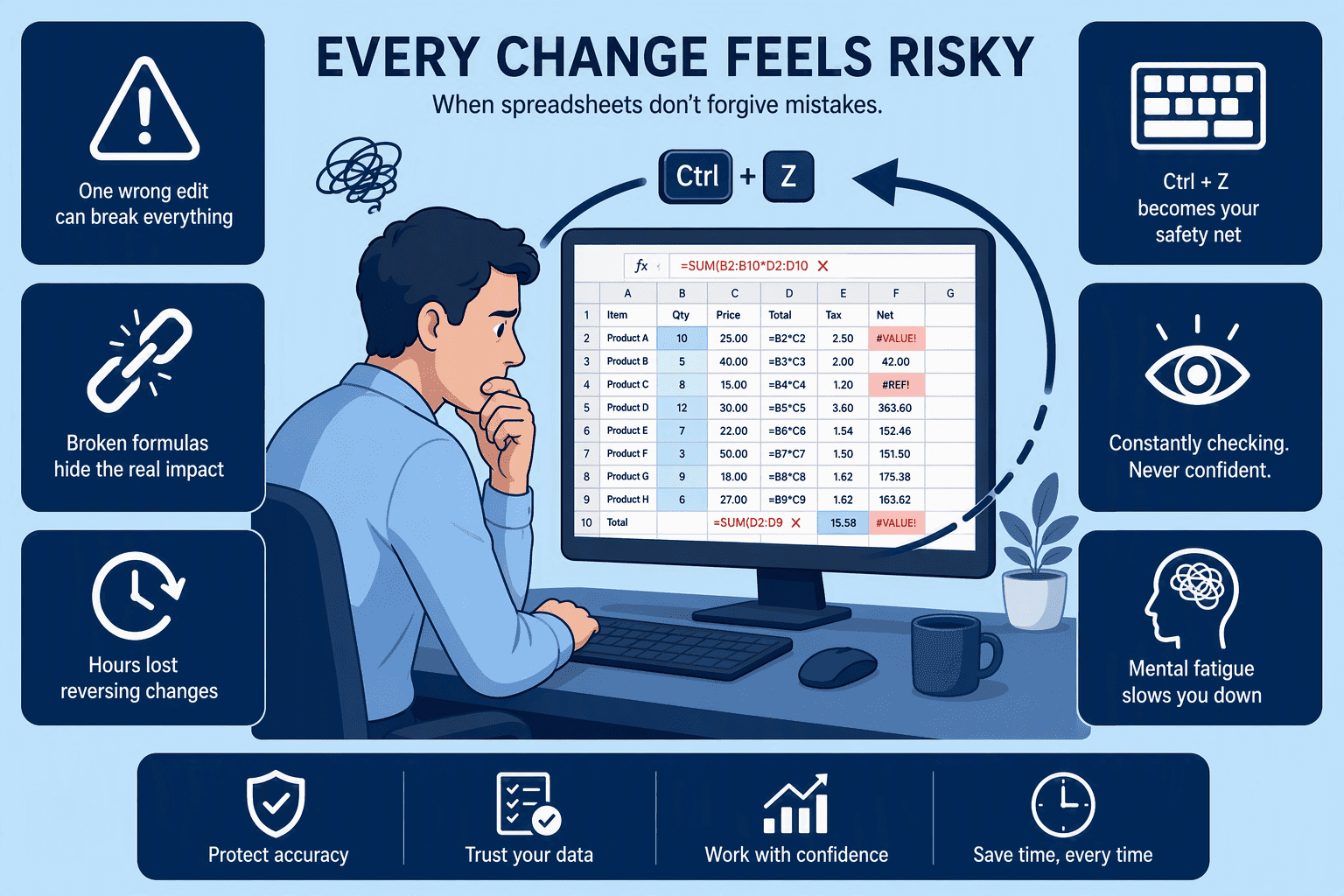
The cognitive load on managers during a manual cycle turns a professional task into a high-stakes auditing ordeal. The terror is specific: a fear of making an invisible mistake that affects someone's livelihood.
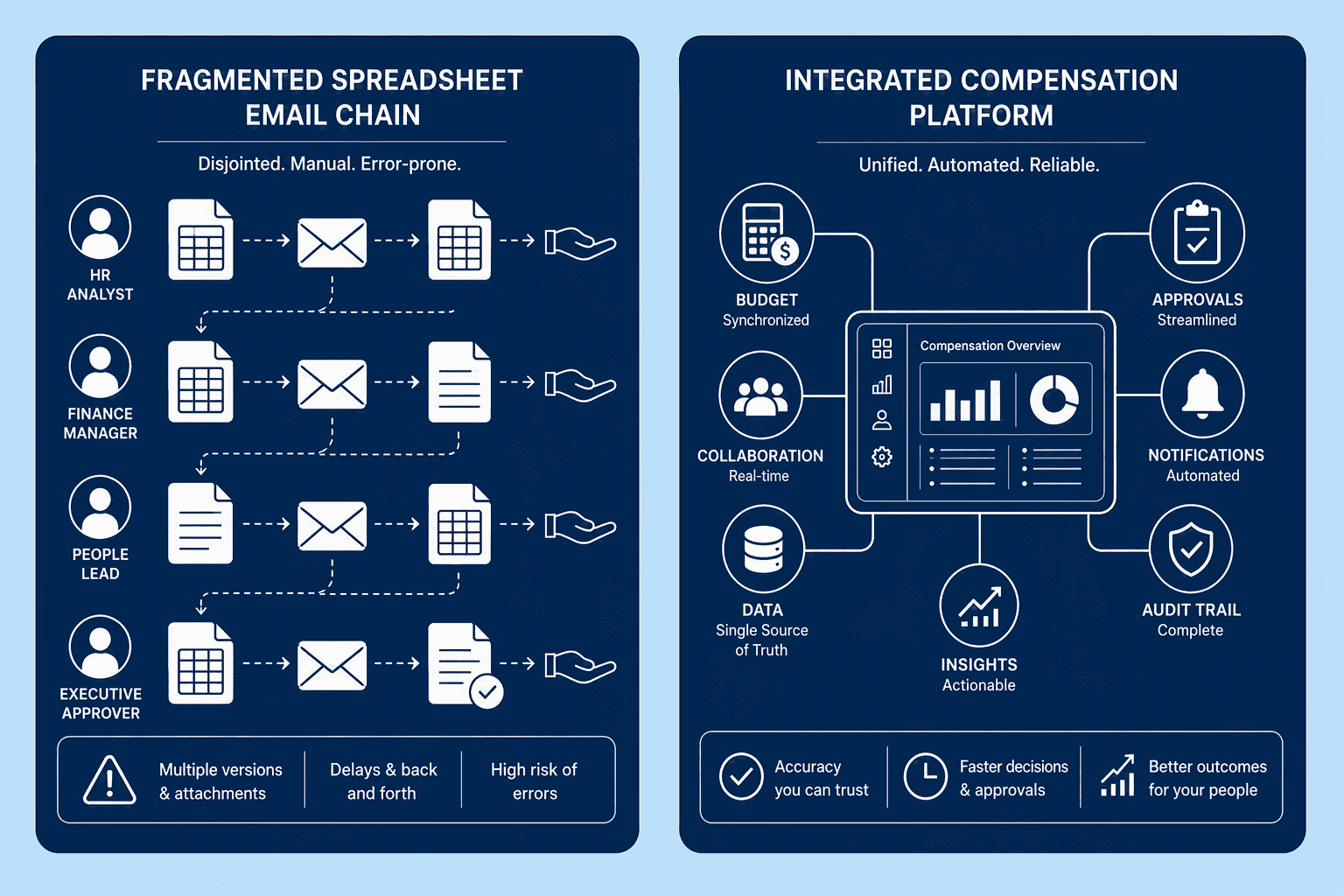
An integrated compensation platform dismantles the linear, person-to-person spreadsheet chain by providing a collaborative workspace with a single source of truth. It restructures the process into parallel, synchronized steps:
This structural change is what makes a targeted three-day cycle achievable. When you use a tool like CompUp, the system provides a centralized platform for managing base salary and bonuses with an automated audit trail. The bottleneck disappears because the work shifts from a sequential relay race to a parallel, synchronized process that protects data integrity at every step.
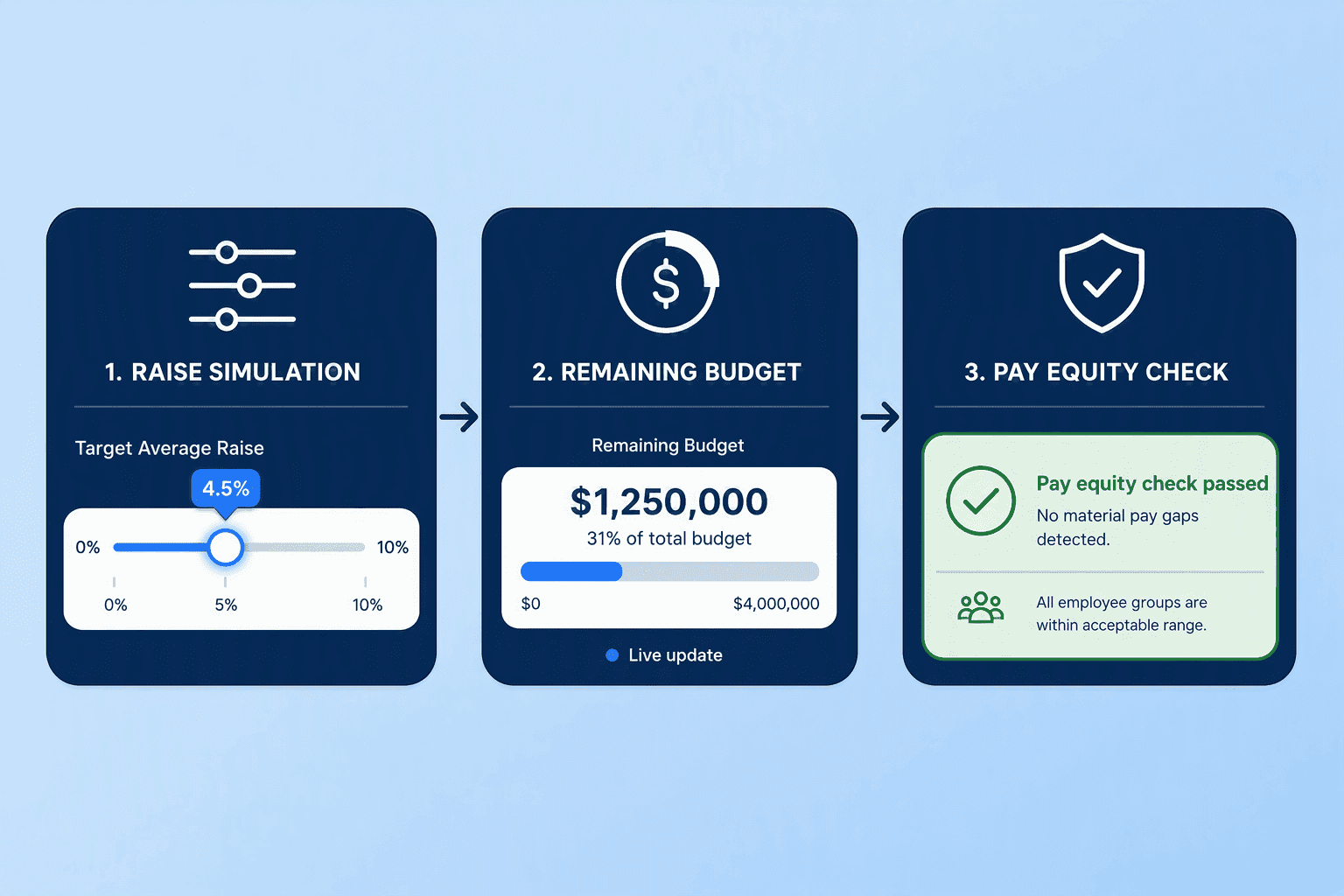
Real-time budget simulation lets you move from calculating a pay increase, then checking whether the numbers hold up, to testing scenarios and committing only when they do. The platform systematically addresses both quantitative and qualitative errors:
When evaluating technology to end the spreadsheet chaos, a checklist of features matters far more than brand recognition. The right platform must function as a system of record, a calculation engine, and a collaborative workflow tool. The feature set that solves the specific delays and anxieties you've been facing is surprisingly well-defined.
At the foundation is a real-time budget dashboard. This gives every stakeholder from the first-line manager to the CFO an unfiltered, instantaneous view of spend against allocation. Without this single source of truth, you are back to the master spreadsheet problem. On top of that, automated approval workflows that route plans based on predefined rules, as supported by platforms like Anaplan for compensation and equity modeling, are non-negotiable. They remove the human friction of chasing down signatures.
The third critical pillar is embedded pay equity and compliance.
These three features, when genuinely integrated and not bolted on, are the mechanism that transforms a compensation review from a high-risk data entry marathon into a rapid strategic exercise. The goal is more governance with less human touch.
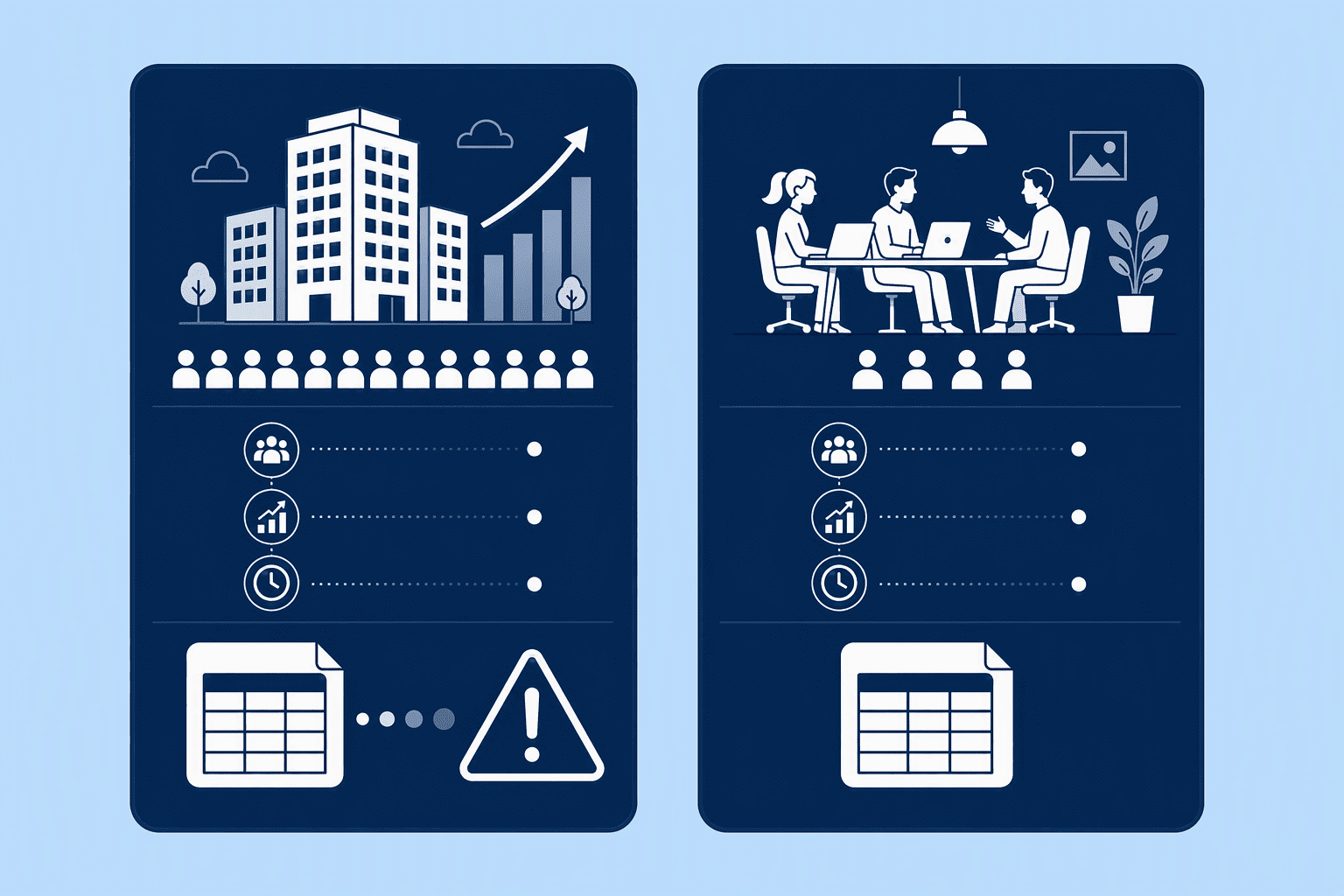
The urgency to move off spreadsheets follows a pattern. Manual processes cross the line from inconvenient to operationally dangerous at predictable thresholds.
| Scenario | Automate Immediately | Manual May Still Suffice |
|---|---|---|
| Headcount Scale | Organizations with 100-plus employees, where a single manager can no longer manually audit the entire population's data. | Very early-stage startups with fewer than 30 employees and a flat structure where the CEO personally reviews every figure. |
| Approval Complexity | Any company requiring multi-level approvals from managers, HR, and finance. Sequential handoffs carry a high probability of error propagation. | Companies where a single decision-maker holds budget authority and no cascading reviews are required. |
| Equity Exposure | Any company facing regulatory pressure, public scrutiny, or a structured DEI mandate. Manual pay equity analysis creates legal vulnerability because it demands sustained accuracy, not a one-time check. | Pre-revenue startups with a homogeneous team focused purely on survival and no formal pay equity reporting obligations. |
| Frequency of Cycles | Organizations running more than one compensation cycle per year, including quarterly bonus runs or off-cycle promotions. | Companies that make all compensation decisions once annually and have no mid-year adjustments. |
The root cause of your compensation review stress and delays is a spreadsheet process that is 89% likely to contain errors and structurally designed to serialize failure. The antidote is an integrated platform that replaces handoffs with automated workflows, swaps manual rework for real-time simulation, and embeds pay equity as a system setting rather than a late-stage panic. Break the cycle by prioritizing a platform evaluation focused on the three pillars that matter: a live budget truth, automated approvals, and embedded equity analysis. If you're weighing options, CompUp is worth a closer look.
The primary bottlenecks are serial spreadsheet handoffs. Managers, HR, and finance pass files sequentially via email, creating a chain where each reviewer can only act after the prior version is complete. One missing deadline or formula error triggers a full-cycle rework that consumes days of manual reconciliation.
Managers become unwilling forensic accountants. They must audit unfamiliar cell references and fear undetectable mistakes that affect people’s pay. Panko and Halverson’s research highlights that hard-coding errors and unprotected cells can silently corrupt budget data, creating a high-anxiety 'Ctrl+Z' loop of constant double-checking.
Software replaces sequential email chains with automated workflow routing and creates a single source of truth. Managers enter data directly into a live, version-controlled environment. By eliminating the rework caused by version confusion and formula errors, a weeks-long manual cycle can compress into a targeted three-day process.
Prioritize a strict audit trail, real-time budget dashboards, and automated multi-level approval workflows. Embedding pay equity analysis is critical for de-risking decisions. These features prevent manual reconciliation and ensure that governance happens automatically, not as a separate, post-cycle cleanup.
Automation moves pay equity analysis from a periodic, manual audit to a persistent system setting. Tools flag gaps across gender, level, and location automatically, eliminating manual calculation bias. For budget accuracy, real-time simulations let managers test increases and instantly see their precise impact against the remaining pool.
It replaces static spreadsheet calculations with dynamic 'what-if' testing. A manager can apply a percentage increase to a team and immediately see the financial impact without rebuilding formulas. This eliminates the class of quantitative formula errors and prevents over-allocation before a plan is ever submitted.
Community Manager (Marketing)
As a Community Manager, I’m passionate about fostering collaboration and knowledge sharing among professionals in compensation management and total rewards. I develop engaging content that simplifies complex topics, empowering others to excel and aim to drive collective growth through insight and connection.
Revolutionizing Pay Strategies: Don't Miss Our Latest Blogs on Compensation Benchmarking