
A pay disparity left unaddressed in 2026 is not a procedural oversight; it is an active balance-sheet liability. With states like New York and New Jersey now authorizing triple damages for violations of equal pay acts, and the EU Pay Transparency Directive forcing global subsidiaries to disclose salary ranges, the cost of inaction has multiplied. The old defense of relying on a candidate's salary history is legally dead, Malta’s bill effective June 7, 2026, included a strict salary history ban, and similar bans now anchor legislation from California to New Brunswick.
This shifting legal terrain means your organization cannot audit pay equity with a simple spreadsheet pivot table. You need a statistically grounded audit that isolates the effect of protected categories like gender or race after controlling for legitimate, job-related factors. This guide walks you through a seven-step process to identify unexplained pay gaps, model the remediation cost, and embed recurrence prevention into your compensation architecture.
This operational framework distills the full audit cycle into the core strategic commitments your organization must make before diving into tactical execution.
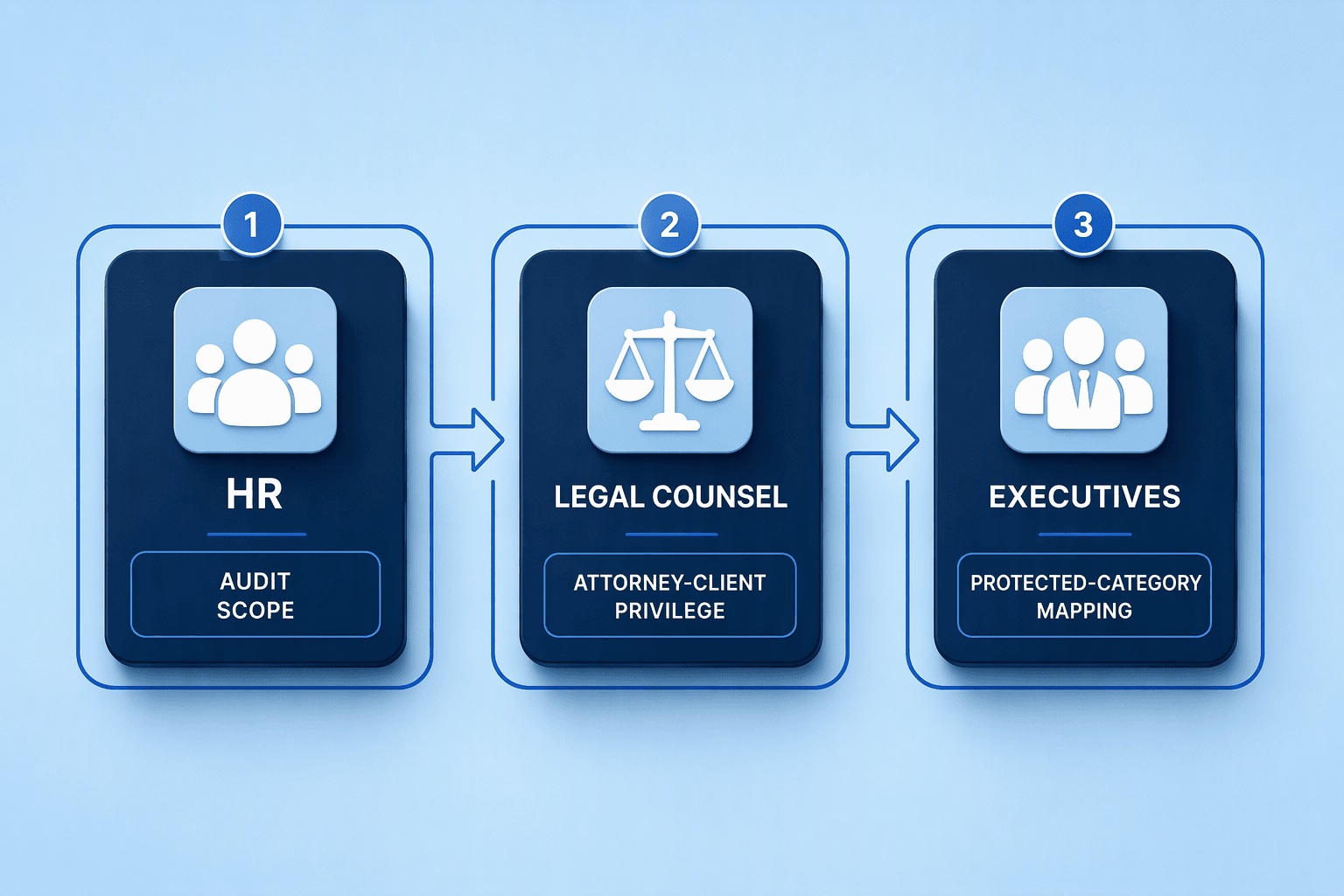
Start an audit without a real mandate and you hand plaintiff attorneys a curated list of your own pay gaps, complete with internal emails debating what to call them. Your first move is to lock arms with the C-suite, legal, and HR around a scope that can actually be defended.
Fisher Phillips attorneys stress that the preliminary analysis to identify pay discrepancies should be conducted under privilege so the employer can evaluate exposure and plan remediation before any disclosure is made. That distinction is what separates a strategic correction from a self-inflicted exhibit in litigation.
Your regression output inherits every flaw in the data you feed it. Running an analysis on HRIS records where job titles, geography tiers, or performance ratings follow three different conventions is a reliable way to produce results an auditor will shred.
Define "substantially similar work" groupings before you model compensation. Employees need to be compared on a composite of skill, effort, and responsibility. Get that grouping wrong and your controls paper over real pay gaps instead of isolating them.
Once job structures are locked, select your compensable factors. Bona fide factors in pay equity analysis include tenure, time in company, time in job, and performance, but this list is neither universal nor exhaustive. Avoid subjective proxies that could mask bias.
Data that is messy kills the project. You can use a tool like CompUp to automate the extraction and normalization of this data across multiple HRIS connectors, but the foundational logic of which employees perform substantially similar work must remain a human-led, legally reviewed exercise. The model cannot decide who is comparable; it can only test if comparable people are paid differently after controlling for the factors you select.
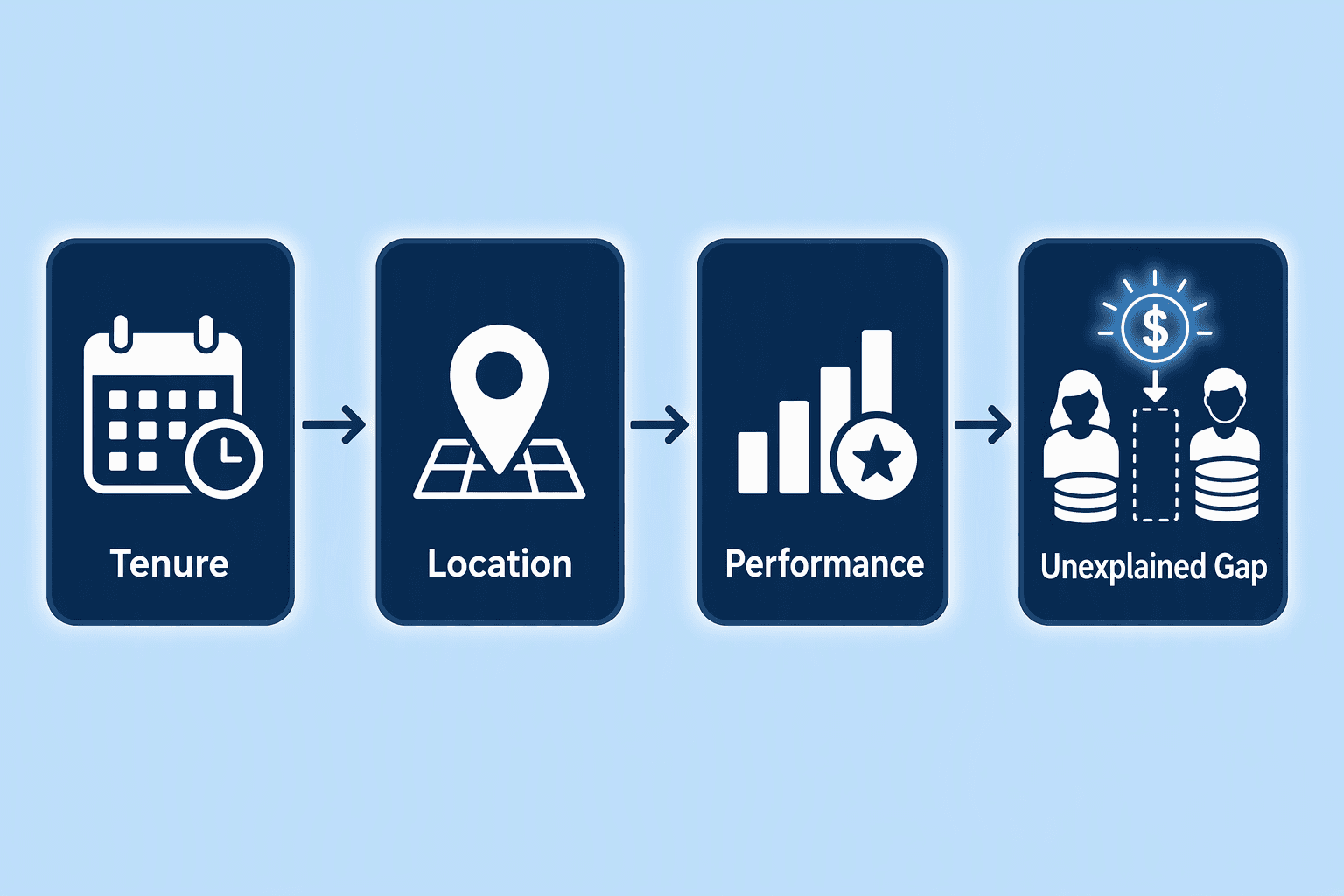
Moving beyond anecdotal inequity requires multiple regression analysis. This method isolates the effect of a protected category, gender, for instance, on compensation after controlling for legitimate factors like tenure, location, and performance rating. There are two major types of data in MLR analysis: quantitative (numeric) data and qualitative/categorical data. Categorical variables with more than two categories must be handled with indicator variables, not sequential numbers, or the model will return inaccurate results.
When the regression completes, you will face a list of statistically significant raw-dollar gaps that cannot be explained by the factors you fed into the model. A gap of two standard deviations or more in a job family of fifty or more employees typically demands immediate remediation. This is the moment where a broad commitment to fairness becomes a specific, dollar-denominated liability that the organization must either fund or legally defend. Pay equity software like Syndio or CompUp automates this regression engine, running thousands of comparisons across job families and flagging outliers that manual spreadsheet analysis misses.
Statistical significance is evidence of a systemic pattern. You pursue remediation on those patterns, and you ignore the small random fluctuations that are normal in any dataset.
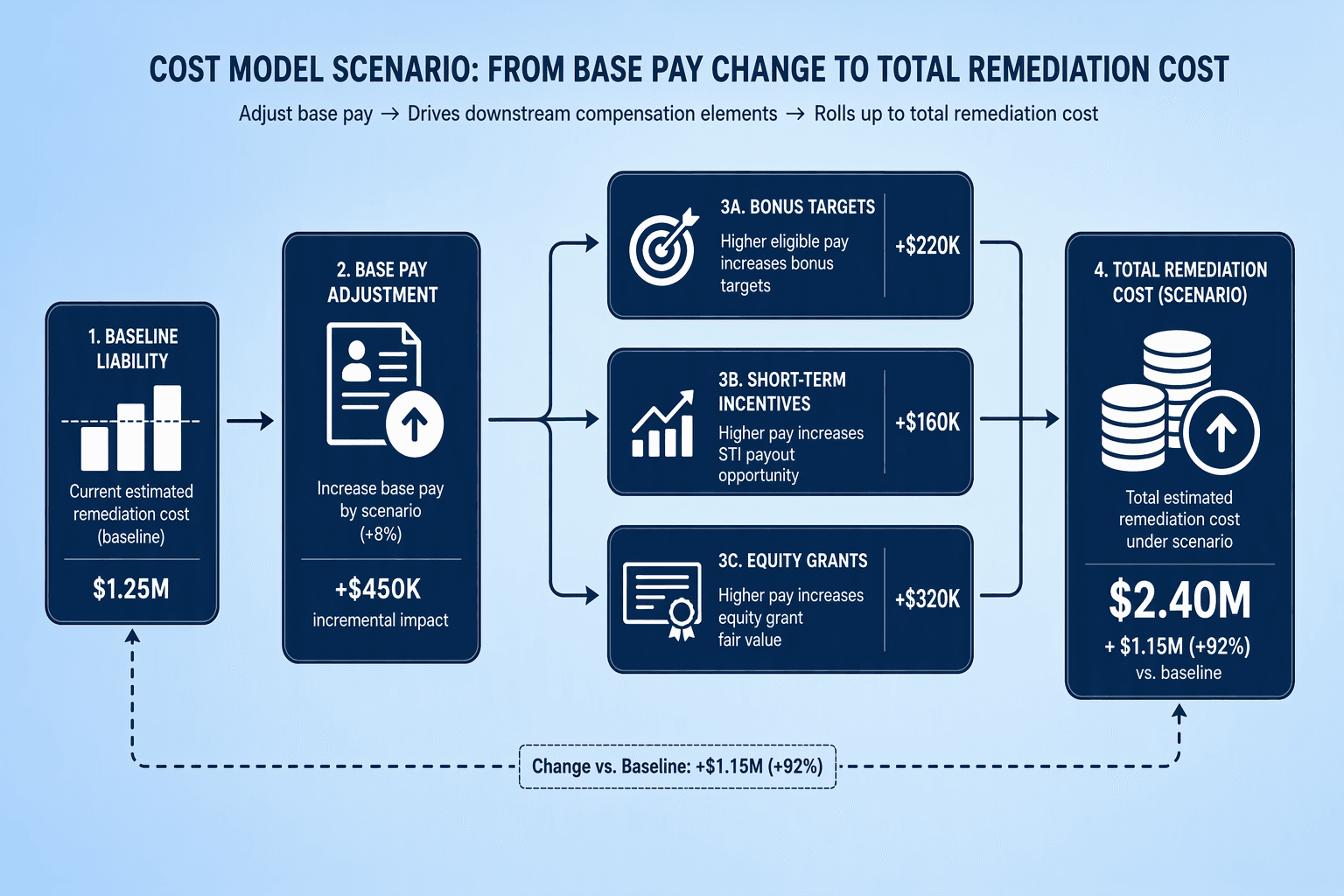
Translating regression outputs into a budget request is an exercise in workforce cost modeling. Start by calculating the aggregate base-pay adjustment needed to bring all statistically significant cohorts to the regression line. This is your baseline liability.
Then model the ripple effects. Closing base-pay gaps often triggers adjustments in short-term incentives, target bonus percentages, and long-term equity grants that are indexed to base salary. If you skip these secondary costs, your upfront budget ask will be too low and you will return to the CFO a second time, eroding credibility.
Project forward. If you leave the structural drivers untouched in Step 6, model what the same regression would return in twelve months. That forward-looking liability projection often moves leadership from approving a one-time fix to funding systemic workflow changes.
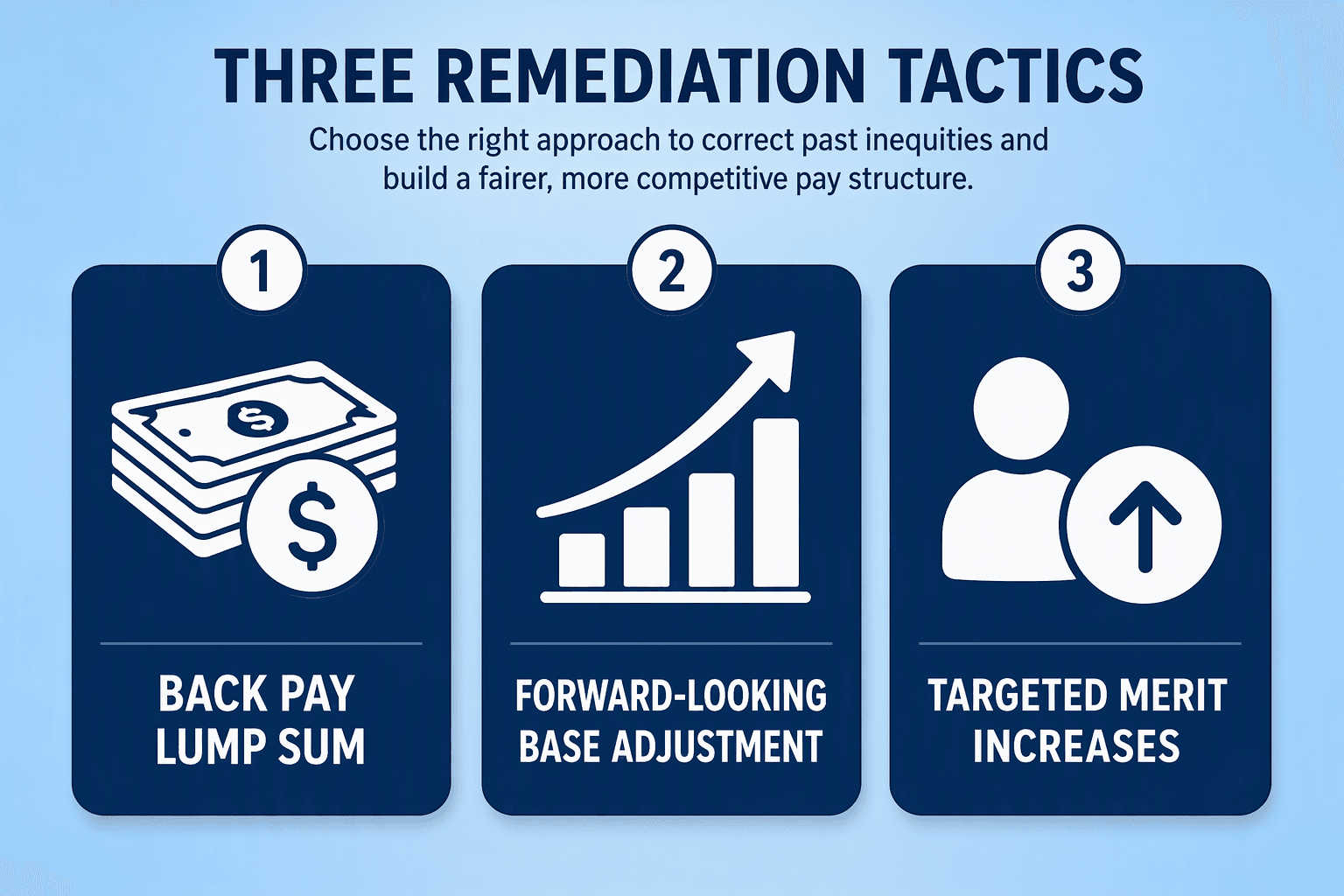
You have three financial levers to remediate disparities, and the operational sequence matters.
| Remediation Tactic | Operational Mechanism | Best Used When |
|---|---|---|
| Back pay lump sum | One-time payment covering the differential for a lookback period (often two to three years) | Legal liability is clear, and the organization wants a definitive, documentable closure of past exposure |
| Forward-looking base adjustment | Permanent salary increase to bring the employee to the regression-predicted line | The ongoing compensation structure is the root cause, and continuing underpayment would compound liability |
| Merit/bonus cycle integration | Allocating a portion of the annual merit budget or a year-end bonus to clear the differential | Fixed salary budgets cannot absorb the full adjustment immediately, and bonus pools provide discreet, off-cycle funding |
According to the Fisher Phillips framework, using year-end bonus cycles to correct backward gaps while adjusting base pay forward is a practical path. The critical rule is this: do not fund remediation by suppressing future merit increases for the impacted employees. That recreates the disparity you just closed. You can use a platform like CompUp to run real-time budget simulations that model remediation allocation against fixed salary pools, preventing the "robbing Peter to pay Paul" scenario.
A raise that lands as a mystery line item breeds cynicism. Tie every pay adjustment back to the audit's statistical methodology by name. Managers should deliver a version of this: "We analyzed compensation for substantially similar work using a regression model that controls for legitimate factors.
Your adjustment is a direct output of that analysis, and it was calculated independently of your performance rating." Give every manager a one-page script. The numbers are too specific to ad-lib, and a fumbled delivery can undo a legitimate correction.
The hard block against recurrence is policy. Ban salary history inquiries in hiring effective immediately. Require that every compensation decision, a merit increase, a promotion adjustment, a starting salary, carries a documented, non-discriminatory business rationale. Skip this documentation step and the same regression will flag the same gaps in two years.
Look at your performance management data while you are at it. When bias in performance ratings is what feeds the pay engine, no amount of compensation cleanup holds. The audit frequently surfaces a rational pay system sitting on top of contaminated inputs. That is two projects running in parallel: a compensation fix and a talent management cleanup. Resource both, or expect the cleanup to unravel.
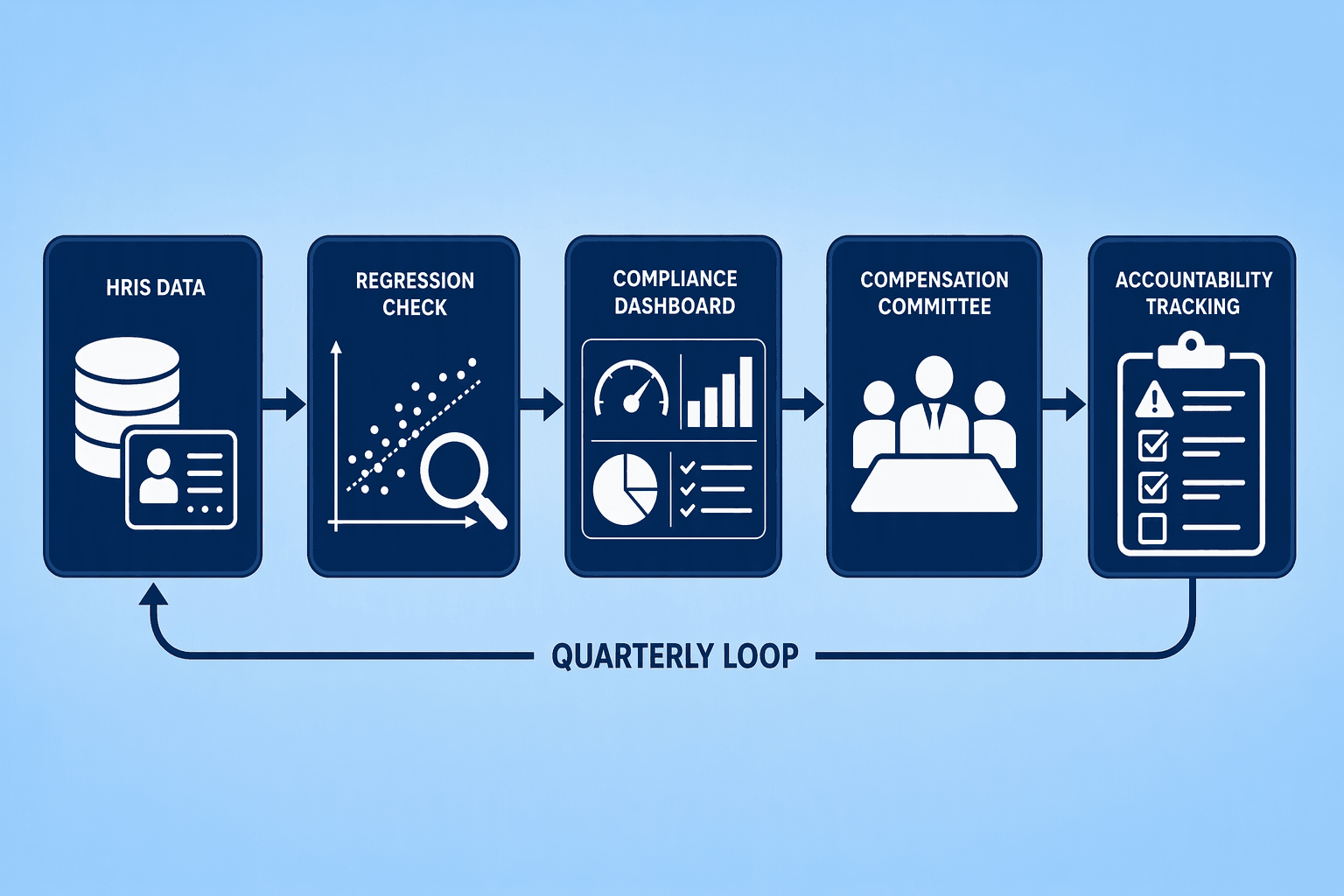
An audit that happens once every three years is a reactive liability detector. You need a quarterly or bi-annual rhythm where the regression model runs on current HRIS data and flags new statistically significant variances before they compound into class-wide exposure. This monitoring cadence should produce a one-page compliance dashboard for the compensation committee. It tracks the aggregate unexplained pay gap by protected category, remediation spend against budget, and any newly flagged cohorts.
Continuous monitoring frameworks shift pay equity from a project to a process. The operational peace of mind comes from knowing the system will catch its own drift. Tie a portion of executive compensation or CHRO performance goals to maintaining the regression within acceptable thresholds. Without that linkage, monitoring becomes a report everyone reads and no one acts on.
A completed, defensible pay equity audit with a funded remediation plan and embedded recurrence prevention turns a reactive compliance scramble into a recruiting advantage. Pay transparency laws now force salary range disclosure in job postings across multiple states. During your next hire, a candidate can compare your advertised range and your actual distribution in seconds. When the numbers line up, that coherence closes candidates faster than any employer-brand campaign ever will.
The point of an audit is not a single clean regression. It is a compensation architecture that keeps pay fair without heroic effort every cycle. Build the governance rhythm, fund the corrections, and run the refresh on a fixed annual cadence. Then your default is equity. You stop treating a widening gap like a fire drill and start catching it as routine maintenance. If you're weighing options, CompUp is worth a closer look.
A statistically significant pay disparity exists when compensation differences for employees performing substantially similar work, grouped by gender or race, persist after controlling for legitimate factors like tenure and performance. It is measured using multiple regression analysis. A gap of two standard deviations or more in a sufficiently large cohort is the typical threshold for remediation.
The most common root causes of pay inequity include:
US employers face expanded state pay transparency laws, mandatory salary range disclosures, and the risk of triple damages for willful violations in states like New York and New Jersey. The federal Equal Pay Act remains a foundational risk. Plaintiff attorneys actively seek discovery on internal pay audits that were conducted but not remediated.
Build the process in seven sequential steps:
Compensation software offers three key advantages over manual spreadsheets:
Manual spreadsheets cannot reliably run the thousands of comparisons required, and they lack the audit trail and real-time budget simulation that platforms like CompUp provide.
Companies communicate adjustments by tying them directly to the statistical audit methodology, not a generic 'market adjustment.' Managers deliver a standardized message that the increase is independent of performance. Prevention requires three actions:
Community Manager (Marketing)
As a Community Manager, I’m passionate about fostering collaboration and knowledge sharing among professionals in compensation management and total rewards. I develop engaging content that simplifies complex topics, empowering others to excel and aim to drive collective growth through insight and connection.
Revolutionizing Pay Strategies: Don't Miss Our Latest Blogs on Compensation Benchmarking