
Your CFO walks into your office with a single question: where are we against the merit budget right now? You open a spreadsheet that was last updated three managers ago and feel your stomach drop. The data is stale, and the answer you give is already an estimate built on last week's email chains. This is the pain of lagging compensation data. It turns strategic decisions into guesswork and leaves you defending numbers you cannot fully trust.
Manual spreadsheet reconciliation carries real danger. A mistyped cell or a bounced email can mean a $50,000 overage that nobody catches until finance closes the books. By then, the money is spent, the cycle is locked, and the explanation is an awkward meeting with a spreadsheet screenshot. The cost of this surprise is not just financial; it erodes the credibility of the Total Rewards function at the executive table.
The shift away from this fragility is already happening. Compensation management is moving from an annual marathon of spreadsheet ping-pong to a continuous, live-operating model. The platforms leading this change store budgets and enforce them in real time, showing you exactly what is left as managers enter recommendations. Automated governance turns what used to be an audit trail into an operating system.
This article maps how to leave manual tracking behind. We will define the metrics that matter, compare the platforms that deliver real-time visibility, and match specific tools to your organizational reality. By the end, you will know what to buy, how to measure success, and how to never answer the CFO with a guess again.
Real-time compensation tracking replaces lagging annual snapshots with continuous budget governance. Here is what you need to know before selecting a system:
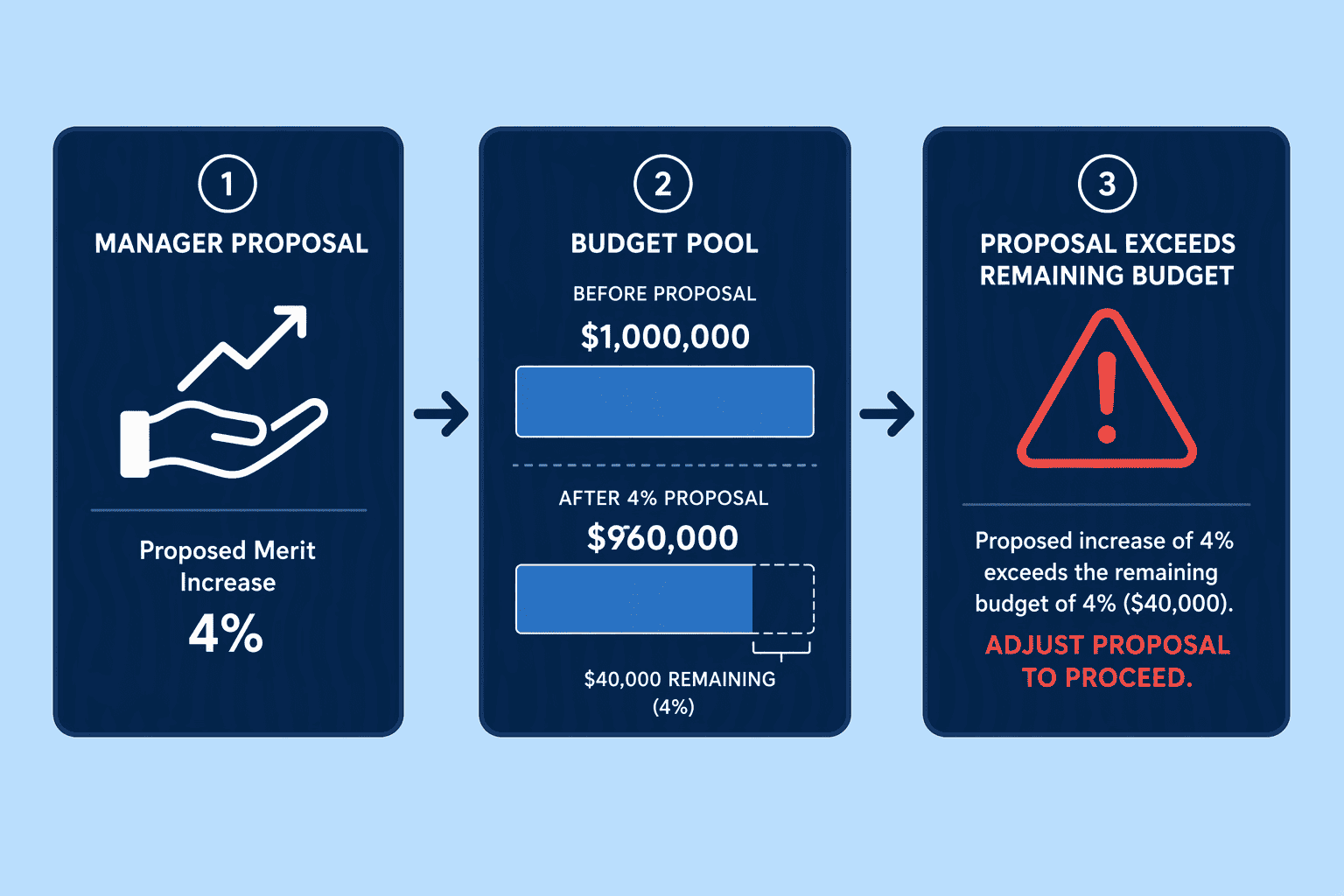
Centralized compensation management software is the only structural answer to real-time budget tracking. Spreadsheets are a record of the past, and workforce planning tools forecast headcount costs on a macro scale. Neither enforces a live budget during the moment managers are making recommendations. You need a system where the act of proposing a 4% increase immediately reduces the visible remaining pool, triggering an alert if it violates guidelines. This architecture eliminates the reconciliation surprise.
Platforms like Workday standardize this for complex enterprises. Workday's analytics dashboards let you filter live spend by budget type and model promotion costs instantly, cutting compensation planning cycle time by 50%. For globally distributed teams, Deel operationalizes this differently by pushing budget allocations directly to managers across countries. The manager sees a pre-loaded wallet and spends against it, with the system tracking every dollar in real time. The 40,000-plus companies using it don't wait for a month-end file to see where they stand.
Integration with payroll is the final lock. Without a real-time feed from payroll, your budget dashboard only shows approved recommendations, not actual cash outlay. Look for platforms that unify the cycle execution with the downstream system of record.
A system that tracks compensation as managers spend it moves you from a reactive, post-spend audit to a preventive control where finance and HR see the exact same live number. That alignment is what ultimately satisfies the CFO in your doorway.
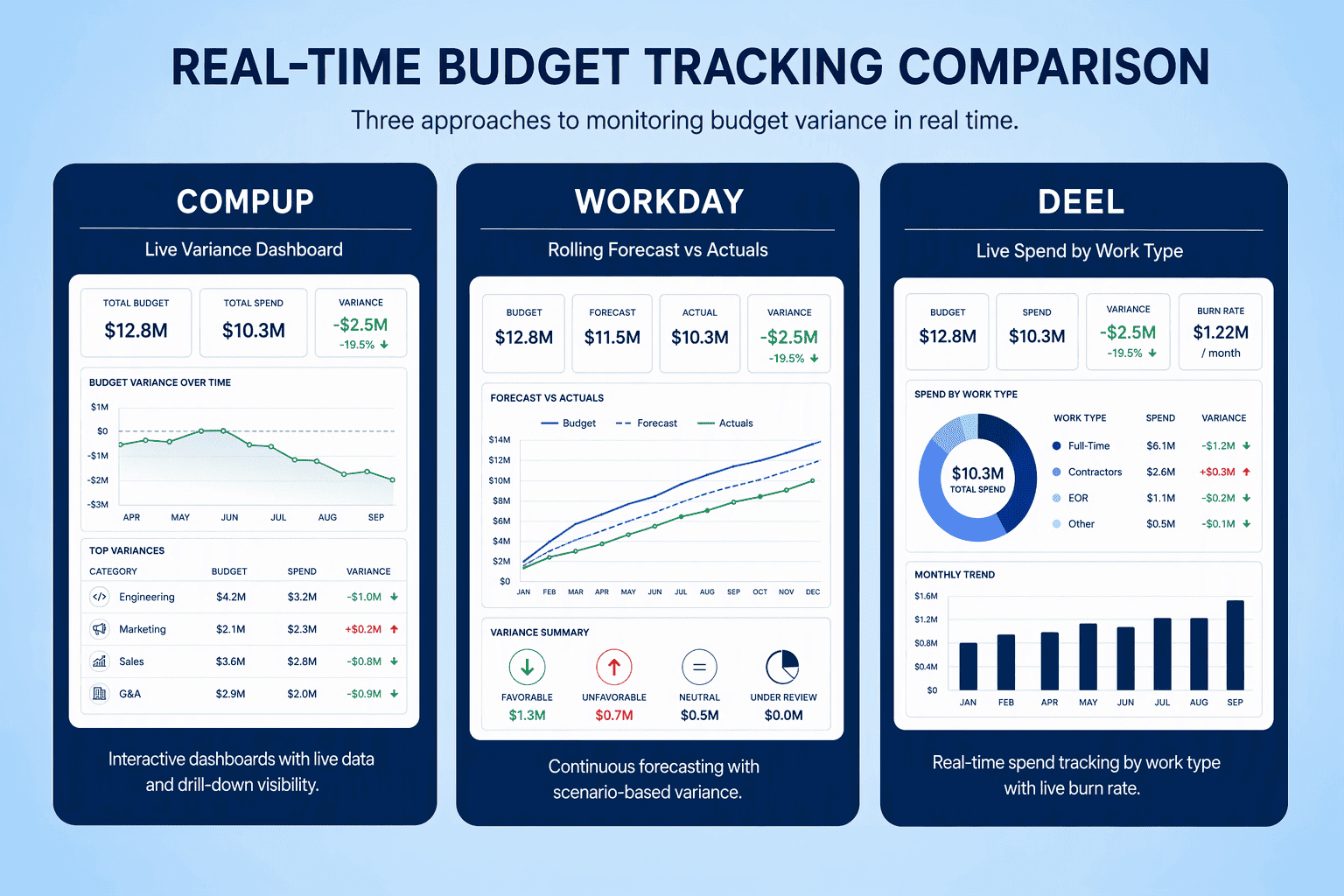
Live cycle governance demands a specific kind of tool. These three platforms track budget-to-actual variance as the cycle unfolds, not after it closes.
| Dimension | CompUp | Workday | Deel |
|---|---|---|---|
| Real-Time Budget Tracking | Unified performance and compensation dashboard with live budget utilization views. | Filterable analytics dashboards slicing live spend by spend type and budget type. | Live budget automation where manager allocations are tracked in real time against assigned limits. |
| Spend-Type Filtering | Supports filtering across merit, bonus, and equity within a single platform. | Filters by salary, bonus, and equity categories with instant scenario modeling for promotions. | Tracks salary and bonus pools allocated directly to managers across global teams. |
| Scenario Modeling | AI-assisted what-if simulations for adjusting merit budgets and headcount costs. | Instant modeling of promotion and merit cost impacts before cycle finalization. | Custom guidance rules and pre-lock simulations for globally distributed cycles. |
| Payroll Integration | Native integrations with HRIS systems like BambooHR and Darwinbox for data sync. | Deep integration within the broader Workday HCM suite for a unified record of pay. | Built-in global payroll infrastructure inside the same platform for immediate actuals. |
| Global Compliance | Multi-currency support and compliance dashboards for pay equity analysis. | Enterprise-grade compliance configurations suitable for complex, multi-country cycles. | Mandatory global-first architecture managing compensation across 150+ countries. |
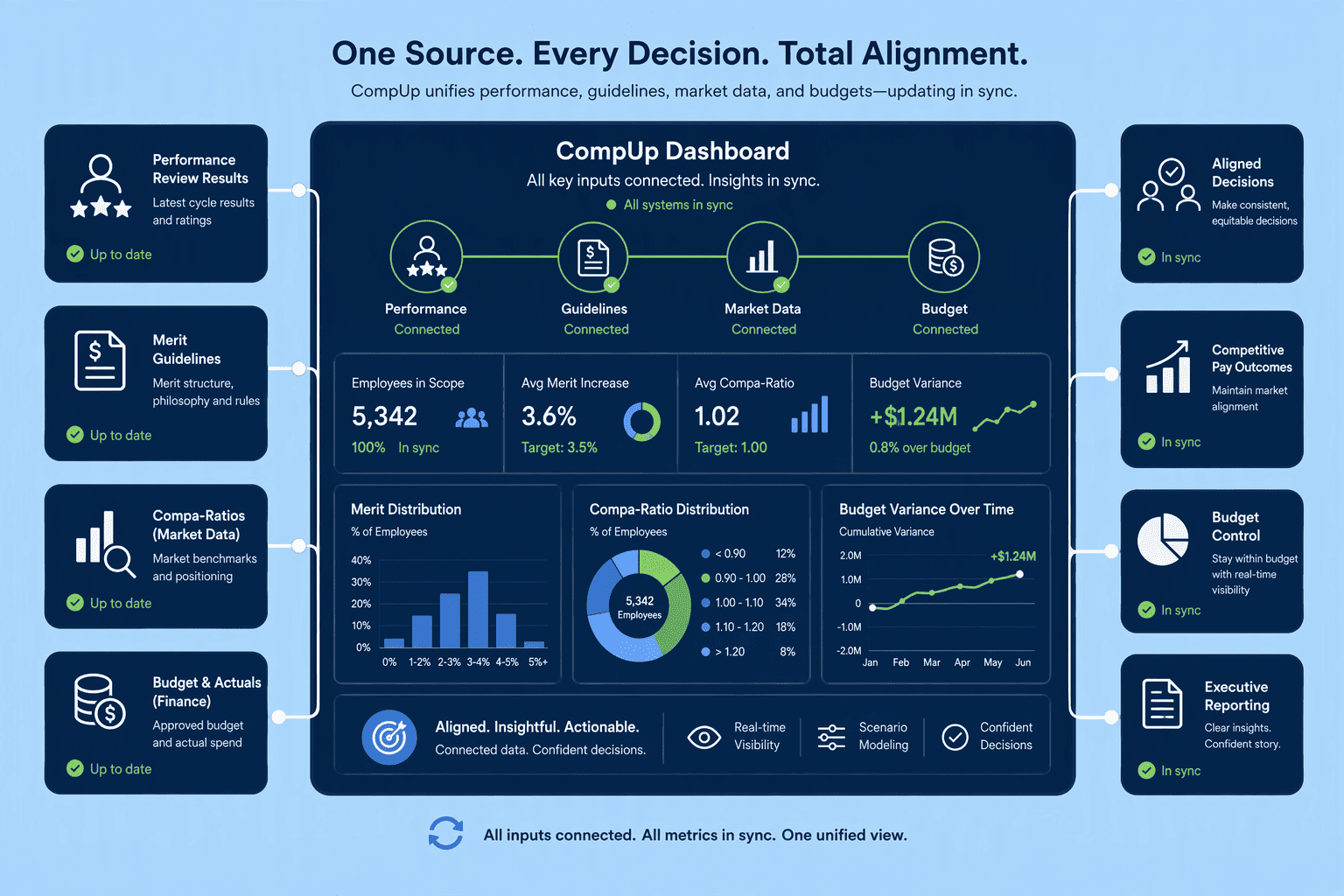
CompUp approaches real-time tracking by refusing to separate performance from pay. The platform is built for HR and Total Rewards teams who need compa-ratios, budget variance, and performance ratings to live in the same place, updating each other continuously.
When a manager completes a performance review in CompUp, the resulting merit guideline doesn't sit in a separate spreadsheet waiting to be manually married to a budget. Instead, the real-time budget tracking engine immediately shows the remaining available pool against the recommendation. CompUp surfaces issues like salary compression without requiring a separate report run.
Its AI-assisted scenario modeling then lets you adjust the merit budget, shift allocation between departments, or test different headcount assumptions, and see the utilization percentages recompute live. This is the operational difference between a system that records a cycle and one that governs it. With pricing starting at $3 per employee per year and a 4.9/5 rating on G2, it is weighted for mid-market teams who find enterprise suites over-engineered for their needs, yet still require advanced simulation.
The trade-off is intentional. CompUp does not position itself as an enterprise HCM suite. It is not your payroll engine or your global Employer of Record. It is a compensation-first platform that integrates with your existing HRIS. For a Total Rewards leader who needs deep compensation-specific analytics without buying an entire ERP, that specialization is the advantage.
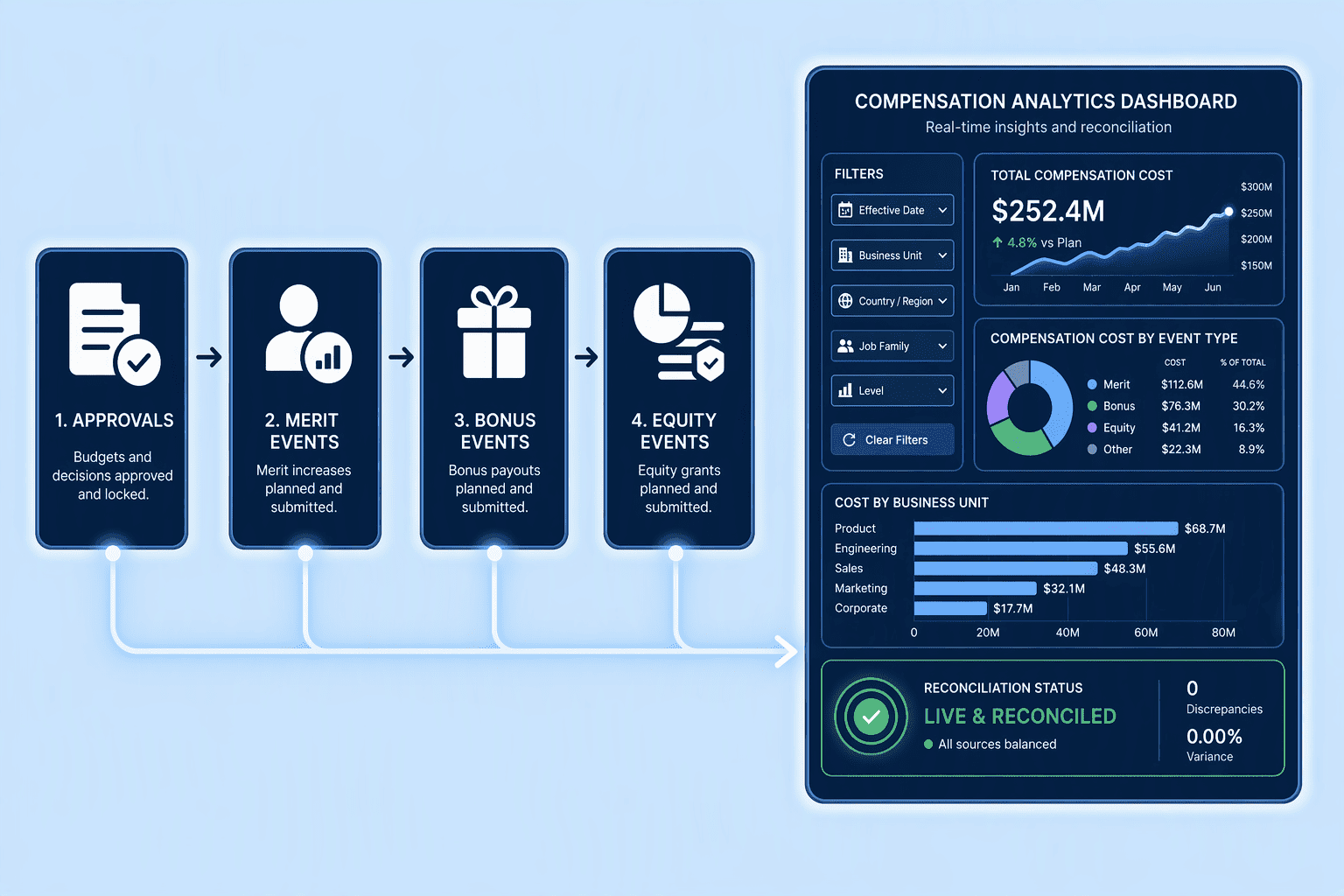
Workday is the benchmark when the compensation cycle is an intricate machine involving thousands of employees, multi-level approvals, and a mix of merit, bonus, and equity events that must all reconcile against a single financial truth. Its platform automates 80% of compensation processes, taking spreadsheet work out of the equation entirely. The real-time strength lies in its filterable analytics. Admins can slice live data by spend type such as salary, bonus, or equity and by budget type, instantly identifying where a specific department is trending over its allocation. The platform allows you to model a promotion cost on the fly, injecting it into the current budget view so the financial impact is visible before the manager even submits.
This level of configurability comes with the complexity and cost commitments of a full HCM suite. It is the right choice when the problem is not just tracking compensation but doing so inside an auditable, deeply integrated system of record that connects pay data directly to core HR and finance.
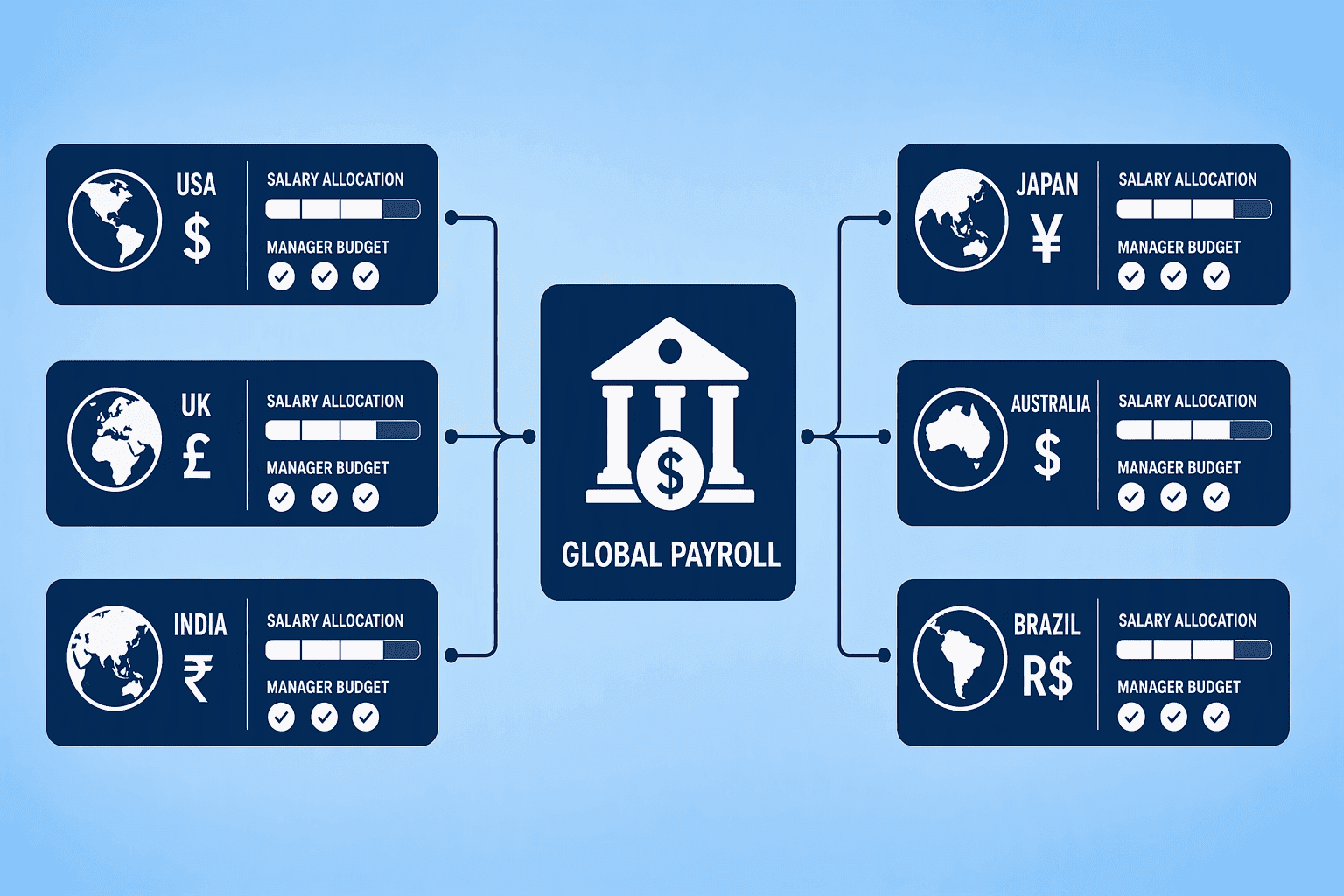
For companies where a compensation cycle means synchronizing budgets across 30 different countries with floating exchange rates, Deel solves a problem the other platforms treat as a feature add-on. Its architecture puts global payroll at the center, so tracking actual spend in real time is a native part of the workflow, not a month-end scramble.
| Feature | Deel Capability | Operational Impact |
|---|---|---|
| Budget Automation | Managers receive pre-loaded salary and bonus allocations. | Eliminates over-allocation at the source; spend is tracked live against limits. |
| Global Reach | Infrastructure supporting 40,000+ companies across 150+ countries. | Standardizes a single budget-vs-actuals view across all legal entities. |
| Scenario Modeling | Custom guidance rules allow pre-lock simulations of new compensation guidelines. | Finance can model the global cost of a new bonus target before managers ever see it. |
| Executive Reporting | Real-time budget usage dashboards designed for leadership progress updates. | Replaces a manual monthly slide deck with a live url. |
Your organizational structure dictates the tool. If you run compensation for a North American mid-market firm and need performance data to drive your merit matrix natively, look at a unified platform like CompUp. It connects the review to the reward in one live dashboard. You get compliance and pay equity analytics without the overhead of a full HCM re-platforming.
For large, complex enterprises with deep finance integration and multi-cycle demands, Workday's real-time modeling depth is hard to beat. The system makes an intricate promotion and merit cycle legible to a CFO at any moment.
If your workforce is globally distributed and you live inside entity-level compliance, Deel is a logical starting point. Real-time tracking means nothing if the actuals coming from international payrolls are stuck in someone else's system. You need a native connection between spend and the cash leaving bank accounts worldwide, and Deel provides that foundation.
Real-time compensation governance ends the habit of staring at month-old spreadsheets to explain where the money went.
Budget tracking moves from a reactive audit to a continuous feed. Finance and HR work from one live set of numbers.
Which platform you pick depends entirely on what you need to solve. Choose a system that natively handles performance alignment if that is the sticking point. Choose one built for enterprise modeling depth if complexity is the real cost driver. Choose one wired for global payroll connectivity if paying people across borders keeps creating fire drills.
Pick the platform that solves your hardest problem first. That beats chasing a perfect all-in-one that only half-covers what you actually need.
Suggested Read: 8 Best All-in-One Platforms for Workforce and Compensation Planning in 2026. If you're weighing options, CompUp is worth a closer look.
The system must include a centralized budget database, live spend-type filtering for salary/bonus/equity, manager-level allocation enforcement, and a live dashboard showing utilization percentage. It also needs direct integration with payroll to reflect actual cash disbursements, not just approved recommendations, to provide an accurate variance analysis.
Start by configuring spend types and budget types within the platform to mirror your compensation policy. Allocate specific pools to managers before the cycle opens. Enable real-time analytics views, often found in the cycle management section, that compare submitted recommendations against the remaining budget by department.
Monitor budget utilization percentage, which shows the portion of the pool currently consumed. Track spend variance by department and compa-ratios to flag compression risk in real time. Also measure equitable allocation to ensure pay is distributed without bias as recommendations roll in.
Workforce planning tools forecast long-term headcount costs. Compensation management software executes and governs the actual live cycle, including merit increases, bonuses, and equity. Compensation software enforces budget limits in real time as managers make recommendations, which planning tools typically do not do.
Data latency from manual spreadsheet entry creates large gaps that lead to over-allocation. The solution is using centralized platforms without local file versions. In-cycle audits and payroll integration are also critical, ensuring that approved spend aligns with actual bank disbursements and reducing manual reconciliation errors.
Platforms allow you to adjust merit budgets, change incentive targets, or test new headcount assumptions and instantly see the updated budget utilization. This happens by rolling up recommendations into dynamic totals, letting you compare scenarios and quantify trade-offs before locking the final cycle.
Community Manager (Marketing)
As a Community Manager, I’m passionate about fostering collaboration and knowledge sharing among professionals in compensation management and total rewards. I develop engaging content that simplifies complex topics, empowering others to excel and aim to drive collective growth through insight and connection.
Revolutionizing Pay Strategies: Don't Miss Our Latest Blogs on Compensation Benchmarking