

Your best engineer just found out a new hire with less experience earns more than she does. She updates her LinkedIn profile that afternoon. In a team of 25, that one departure can trigger a cascade of counter-offer anxiety that eats through your culture and your runway before you realize what happened.
The compliance clock is ticking louder in 2026. California, Colorado, New York, and Washington now require defensible salary ranges on every job posting. The EU Pay Transparency Directive is rewriting global expectations. A growing candidate pool will simply skip a role that omits a stated range. Pay structures have moved from a nice-to-have for Series-B companies with dedicated HR teams to a legal and recruiting necessity.
The turnover risk of perceived unfairness is immediate and quantifiable: employees who think their pay is unfair are 45% more likely to start looking for other roles, even when the pay is objectively market-competitive.
Yet the startup that builds competitive bands early locks in a retention advantage. Employees in organizations with high pay transparency are 59% less likely to leave than those in non-transparent ones. This article lays out the full method for moving from gut-feel offers to a repeatable, defensible system that prevents costly turnover and keeps you on the right side of the law.
The process distills into a repeatable framework:
Every pay band is an expression of a prior choice: what does 'competitive' mean for this startup, right now, with this runway? The answer is never universal. Two founders staring at the same market data should draw different bands if their cash positions and hiring urgency differ. You must define your philosophy before you touch a single benchmark.
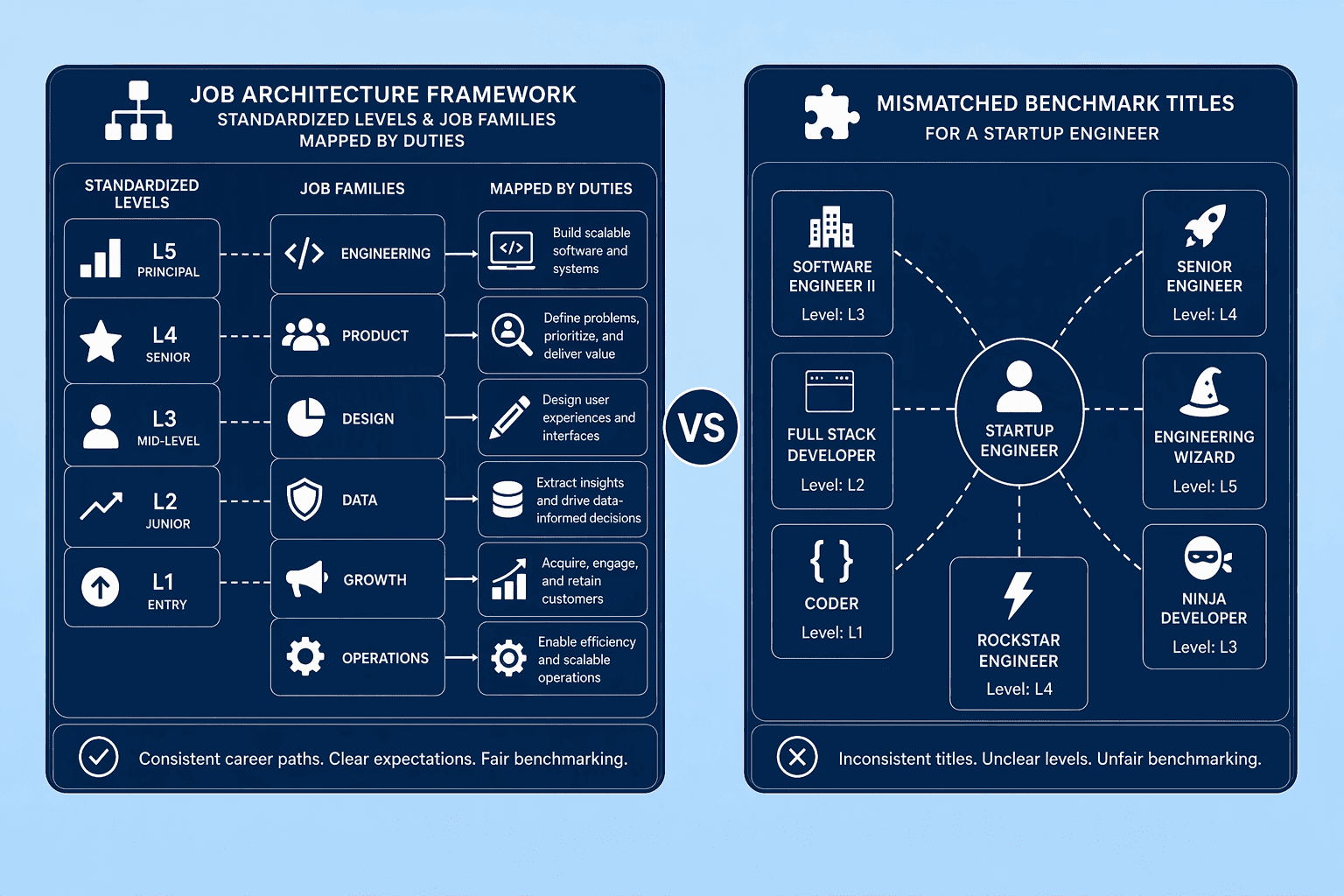
Compensation bands fail at the point of comparison. A founder sees a benchmark for 'Senior Engineer' and maps it to the full-stack lead who has been with the company since the seed round. But the benchmark was built on large-enterprise profiles managing five direct reports. That mismatch silently warps every range that follows.
Job architecture prevents this error. A job architecture is a framework of standardized levels and families, defined by duties, not floating titles. Instead of pricing 'Front-End Developer' and 'Back-End Developer' and 'Full-Stack Developer' as separate roles, you create a software engineering family with levels that describe increasing scope: Engineer I executes defined tasks under review; Engineer II owns features independently; Senior Engineer leads technical design for a product area. Each level maps to a set of benchmark duties that exist in the primary surveys you source next.
Creating families makes market pricing cleaner. One family with three to four levels produces better data matches than a dozen one-off titles. You need one market reference for the software engineering family at each level, which instantly cuts the number of survey calls you run.
The instinct is to over-specify, especially for the role you just hired. Resist it. When in doubt, err toward fewer levels and families. You can add granularity later; you cannot easily collapse a tangled structure of fifteen function-specific titles into something a compensation survey can match. Aim for no more than five to six job families across the entire organization.
The distance between a defensible pay band and a spreadsheet number starts with data quality. Primary surveys from providers like Radford, WTW, or ISG Partners collect compensation data directly from participating employers under written submission rules. Generic crowd-sourced platforms do not, and the legal weight behind each source differs when an auditor asks questions.
Every primary survey reports its own participant count, revenue cutoffs, and industry segmentation. Radford's technology survey, for instance, can filter by company size before you export. A Series A startup in Austin pulls different parameters than a late-stage company in San Francisco from the same provider. That paper trail matters when a candidate questions your range or a pay equity audit asks for source documentation.
Pull P50 figures for each leveled role across your job families first. The midpoint is a policy decision, not the raw P50 number from the survey. Your compensation philosophy chooses whether the midpoint equals P50 at target. The decision itself is the artifact. Without it, you have market data pinned to roles, but you still have no structure an auditor can trace.
Filter by geography and company stage at the survey level before you download. Most primary providers let you set a revenue band, employee count range, and location in one pass. The result is a single dataset keyed to your operating reality, not a separate cut for every sub-scenario.
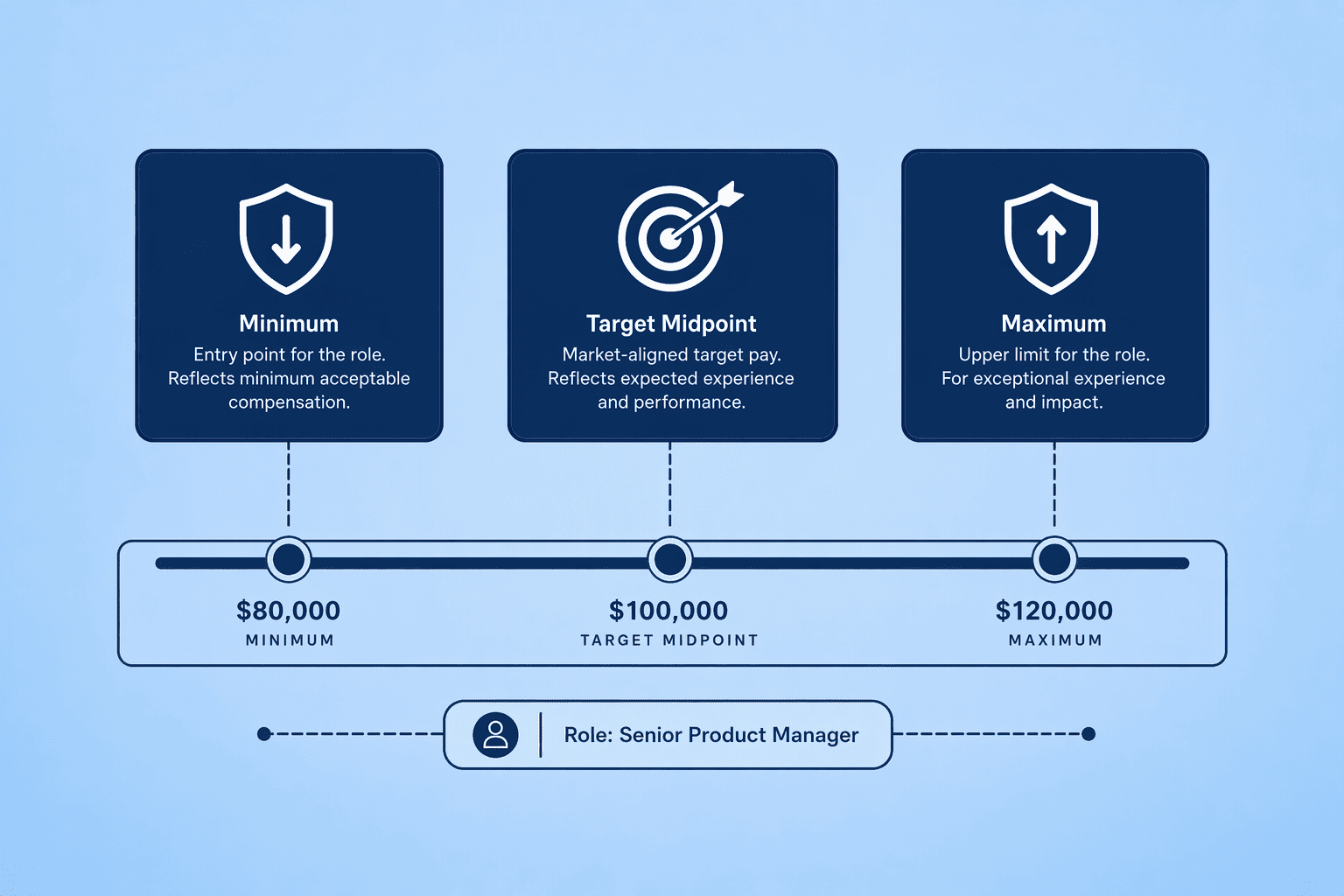
Each band has three points: a minimum, a target, and a maximum. The target is the rate for someone who can do the job end to end without hand-holding. The spread around that number gives you room to hire and room to grow.
| Parameter | What It Represents | Common Startup Practice |
|---|---|---|
| Minimum | Entry point for a new hire or a developing team member | 80% of the target midpoint |
| Target (Midpoint) | Market reference for a fully competent performer in the role | Equals P50, or a deliberate offset per your philosophy |
| Maximum | Ceiling for a high performer with sustained impact at that level | 120% of the target midpoint |
| Spread | Total range from minimum to maximum | Roughly ±20% from target; width measured relative to the midpoint yields approximately 40% |
A range of $80,000 to $120,000 has a $100,000 arithmetic midpoint. Measure the width relative to the midpoint (40%, not 50%) because that number stays comparable when you look across roles.
Do not stretch the spread to fit a candidate you already have in mind. A band that runs 40% to 50% of midpoint is the working range. Make it wider and the floor stops being competitive. Make it wider and the ceiling becomes something you cannot explain in a comp review.
Before you lock anything, run current employees against the draft structure. Anyone sitting below the new minimum needs a correction conversation queued up immediately.
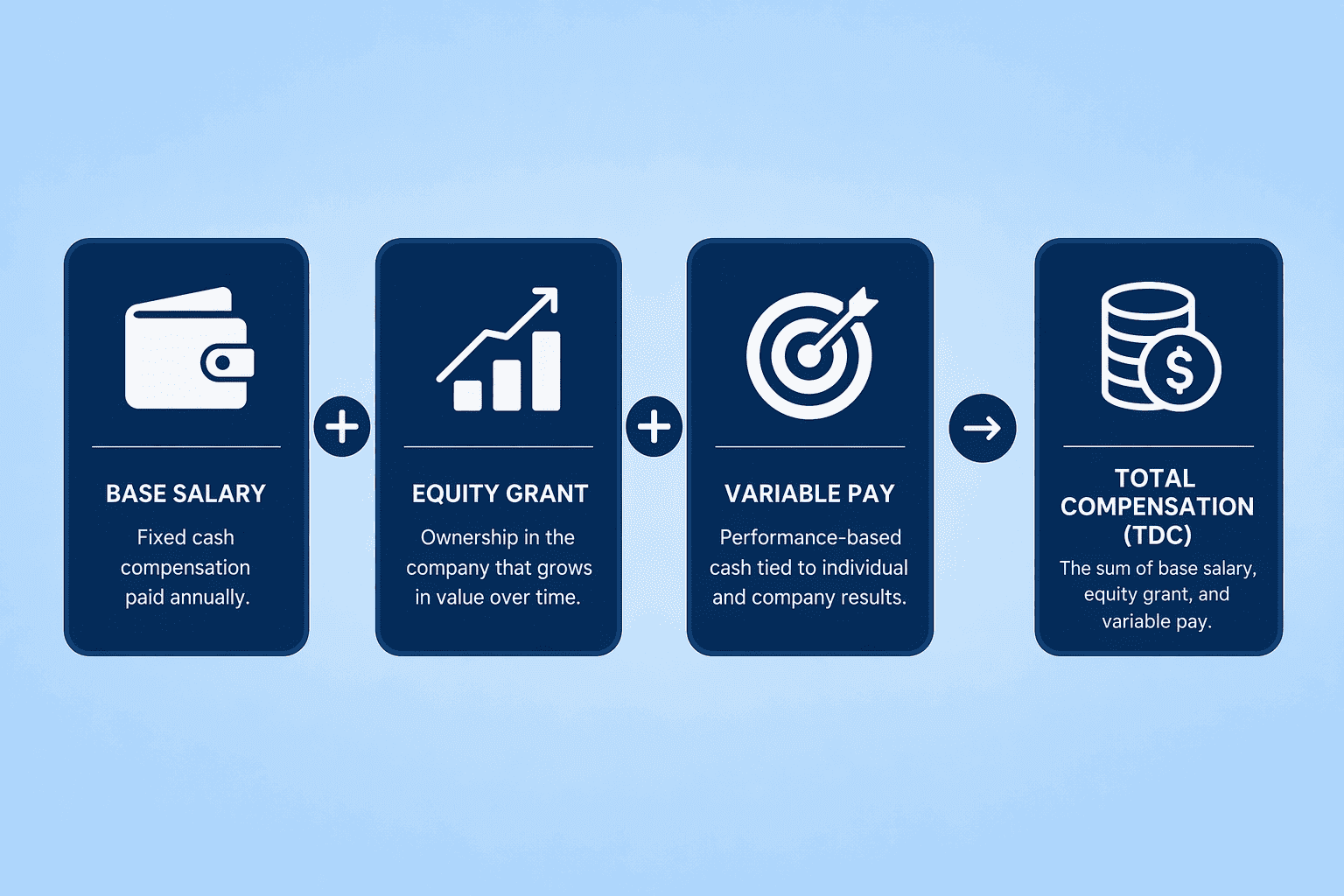
A band that shows only base salary deceives both your candidates and your current team. For startups, equity is the primary wealth driver. Omit it from the framework and your cash-constrained offers look weak to talent who do not yet understand your value story.
To build total compensation visibility into your bands, follow this order:
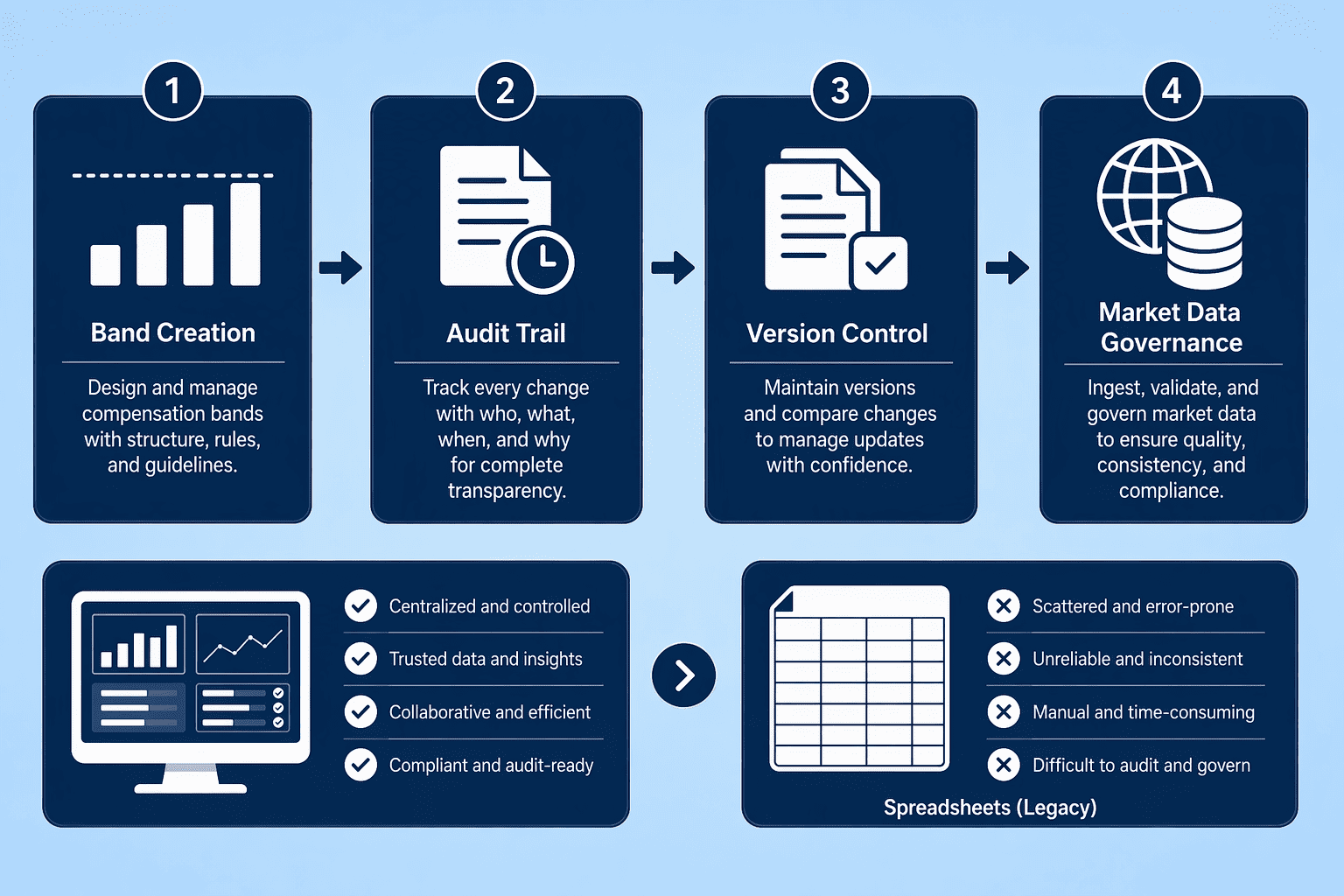
Spreadsheets collapse under the weight of pay transparency compliance. They offer no audit trail, no version control, and no way to prove that the range you published on a Colorado job posting six months ago matched the market data you used to build it. For a startup past 30 employees, this is a liability that compounds with every hire.
The fix is a compensation management platform. Tools like Pave, Lattice, and CompUp absorb the governance burden that makes manual band maintenance unsustainable:
Implementing pay structures at 20 to 30 employees produces considerably less clean-up than waiting until you have 100-plus people and years of ad hoc compensation decisions to reconcile. Purpose-built tools make early adoption operationally trivial rather than a multi-month retrospective project.
You can use a tool like CompUp to benchmark roles against industry-specific data and automatically generate Total Rewards Statements at the close of each appraisal cycle, giving every employee a clear line of sight from their performance to their full compensation picture.
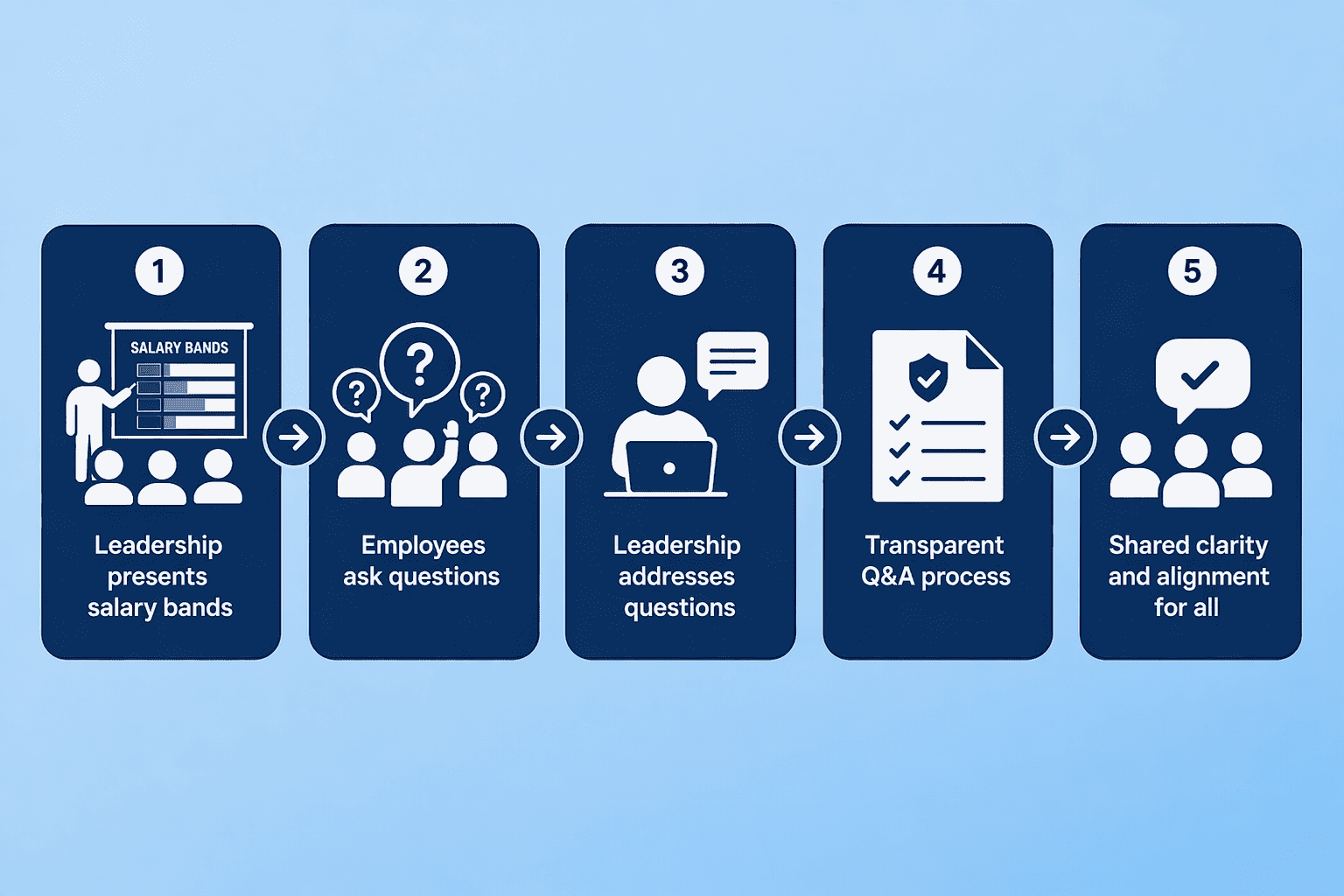
Most founders avoid pay transparency because they dread the conflict. Salary secrecy ends up fueling the very gossip and counter-offer anxiety they hoped to prevent. Employees who merely perceive their pay is unfair look for a new job at a 45% higher rate, even when the numbers show they are paid fairly. Silence feeds that perception.
The rollout meeting is your chance to starve the rumor mill. Bring the whole team into one room and walk through the three-tier framework, department by department. Open with the compensation philosophy: why you chose P50, how equity fits, and which market data shaped the bands.
Then show the minimum, target, and maximum for every level in each job family. Expect hard questions right there in the room, "Why am I near the minimum?" and "What do I need to do to reach the next band?"
Be ready with a promotion criteria document that ties band progression to demonstrated scope and impact, not time served. Repeat this conversation every year when market data refreshes. That consistency matters more than any slide deck.
Employees stop guessing whether they are underpaid and start knowing what it takes to advance. The outcome is a framework that holds up under scrutiny at any stage of growth.
Competitive pay bands convert compensation from a reactive, anxiety-producing negotiation into a strategic system that retains key talent and satisfies the transparency mandates now active across multiple jurisdictions. The structure you build today, anchored at P50, backed by primary survey data, and governed through a unified platform, will carry your startup through the hiring growth that makes retroactive cleanups so expensive. Start when you are at 20 to 30 employees, because every hire you make from that point forward either strengthens the system or becomes a future exception you have to explain. If you're weighing options, CompUp is worth a closer look.
Competitive pay bands are structured min-target-max salary ranges for each role, tied to market data. Startups need them to meet 2026 state pay transparency requirements, reduce turnover, and prevent the internal pay inequities that drive top performers to job-search when they perceive unfairness.
Use primary surveys from Radford, WTW, or ISG Partners that collect data directly from participating employers under strict protocols. Avoid generic crowd-sourced aggregators. Filter by revenue band, company stage, and location to match your specific startup profile.
Define your compensation philosophy, build a job architecture of standardized levels and families, source P50 market data from primary surveys, construct min-target-max bands at roughly ±20% from target, integrate equity into total compensation, automate governance, and roll out with transparency.
Adopt a Pay Below Market (Lean) strategy: set base salary 10% to 20% below P50 and offset the gap with top-quartile equity grants. This model requires a strong mission story that attracts candidates who value long-term upside over immediate cash.
Pave, Lattice, and CompUp provide survey-connected band definitions, approval workflows, and compliance documentation trails. They replace error-prone spreadsheets with auditable systems that manage pay equity analysis, real-time benchmarking, and governance for transparency mandates.
Hold a company-wide session explaining the compensation philosophy, the market data source, and the three-tier structure for each job family. Provide clear promotion criteria tied to demonstrated scope and impact. Commit to annual refresh conversations and deliver individualized Total Rewards Statements.
Community Manager (Marketing)
As a Community Manager, I’m passionate about fostering collaboration and knowledge sharing among professionals in compensation management and total rewards. I develop engaging content that simplifies complex topics, empowering others to excel and aim to drive collective growth through insight and connection.
Revolutionizing Pay Strategies: Don't Miss Our Latest Blogs on Compensation Benchmarking