

Your annual pay review directly allocates the largest operating expense on your P&L. And odds are, you're running it in an environment where mistakes happen often. Research confirms nearly 90 percent of complex spreadsheets contain errors.
Those aren't typos in a formatting cell. They are misrouted wire transfers, incorrect equity grants, and budget overflows that cascade into the next fiscal year. Companies like Barclays and TransAlta have already paid the price for this error-prone approach. The multi-million dollar consequences are on the record.
Excel is a powerful individual productivity tool. For the multi-party, high-stakes orchestration of modern compensation, it functions as a primary source of risk. In 2026, continuing to rely on manual spreadsheets for your pay review is the most expensive strategic mistake a people leader can make.
This article examines four domains where Excel fails the pay review process: financial accuracy, data security, operational efficiency, and regulatory compliance. We quantify the hidden costs and compare the manual approach against the secure, automated alternatives that are now standard practice.
The case against managing your annual pay review in Excel rests on five compounding, irreversible risks:
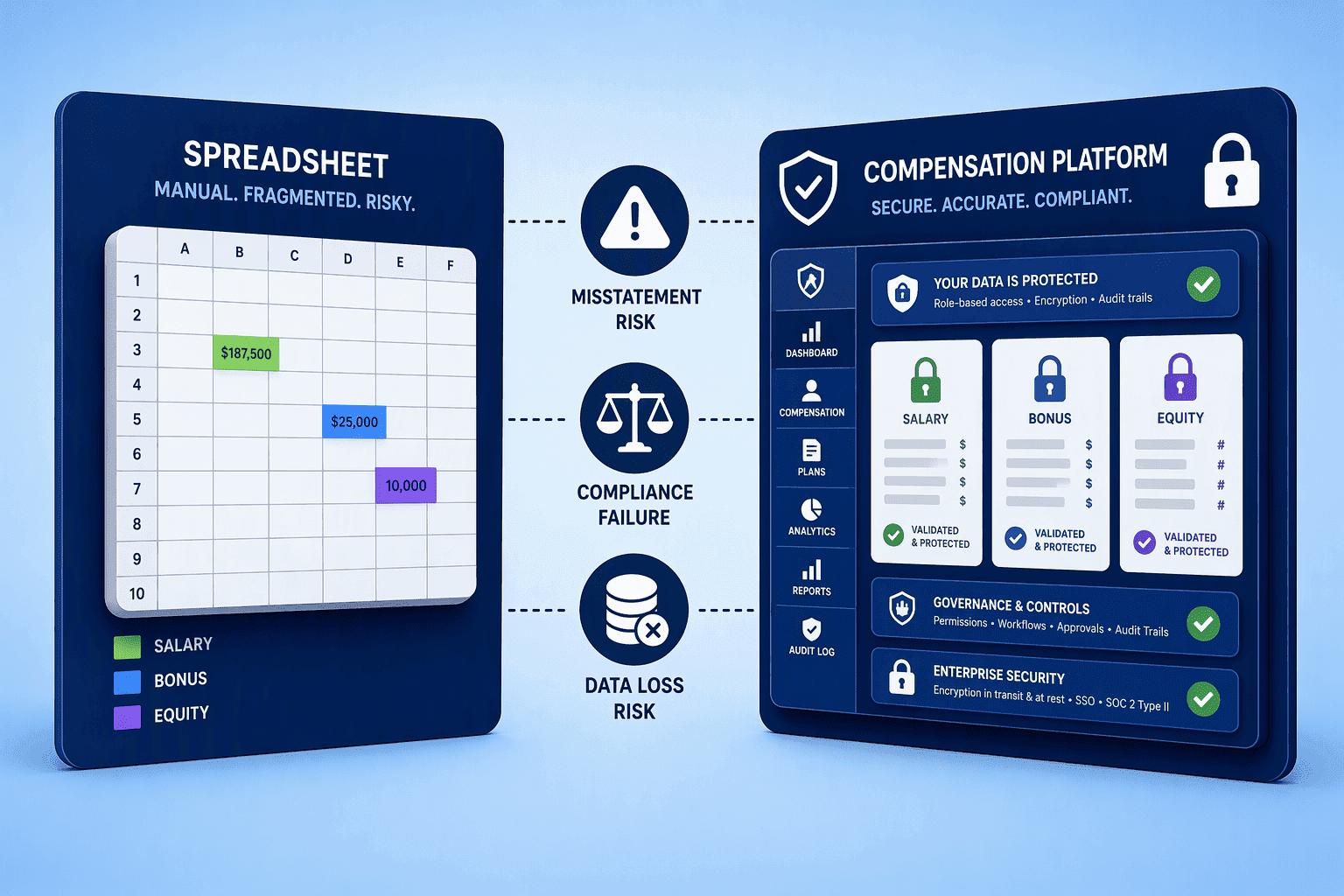
Using Excel for your annual pay review in 2026 is an active, material threat to your organization's financial and legal standing. A spreadsheet is a static data canvas with no native safeguards. When that canvas holds the salary, bonus, and equity decisions for your entire workforce, its inherent weaknesses convert directly into financial misstatements, compliance failures, and cultural damage that a dedicated compensation management platform eliminates by design.
This judgment comes from people who deal with the fallout. A platform like CompUp, for instance, connects compensation planning with pay equity analysis and compliance dashboards in a single system, a cohesion that no combination of cell references and email strings can replicate. A single formula error in a shared workbook can overpay a department by hundreds of thousands of dollars before anyone notices. You have moved from a compensation review to a costly accounting reconciliation. The sources are clear: hackers can hijack legitimate features within Excel to steal data, and the first draft you email is already a departure from security best practices.
The hard cutoff is clear. The source data defines it. Excel works for companies with fewer than 75 employees, a single office or country, and a compensation structure with no equity component.
Crossing 100 employees moves the risk from inconvenient to indefensible. At that threshold, you carry enough managers, enough roles, and enough compliance exposure that spreadsheet-based planning puts your business in active peril. The numbers are finite. The outcome, on current evidence, is damage for which you will be held accountable.
The fatal weakness of a spreadsheet-based pay review is not a lack of features; it is the lack of a system. Every cell reference, every manual cut-and-paste from one workbook to another, and every emailed 'finalversionv3' introduces a new point of inevitable human error. The core risk is not a rare bug but an expected output: nearly 90 percent of complex spreadsheets contain errors. When those errors sit inside the master file that controls your salary increases and incentive payouts, the financial exposure is direct and immediate.
These are not hypothetical risks. The documented cases are a permanent warning to any finance or HR leader who believes their existing process is sound. A transposed decimal or a broken link can silently corrupt a payout calculation in a way that no amount of visual review will catch until it has left the bank account. You are betting your budget on the assumption that none of those inevitable errors will land on a material figure corresponding to a senior leader or a large department. The research shows that the odds are not in your favor: when errors occur, they become million-dollar consequences for the unprepared organization.
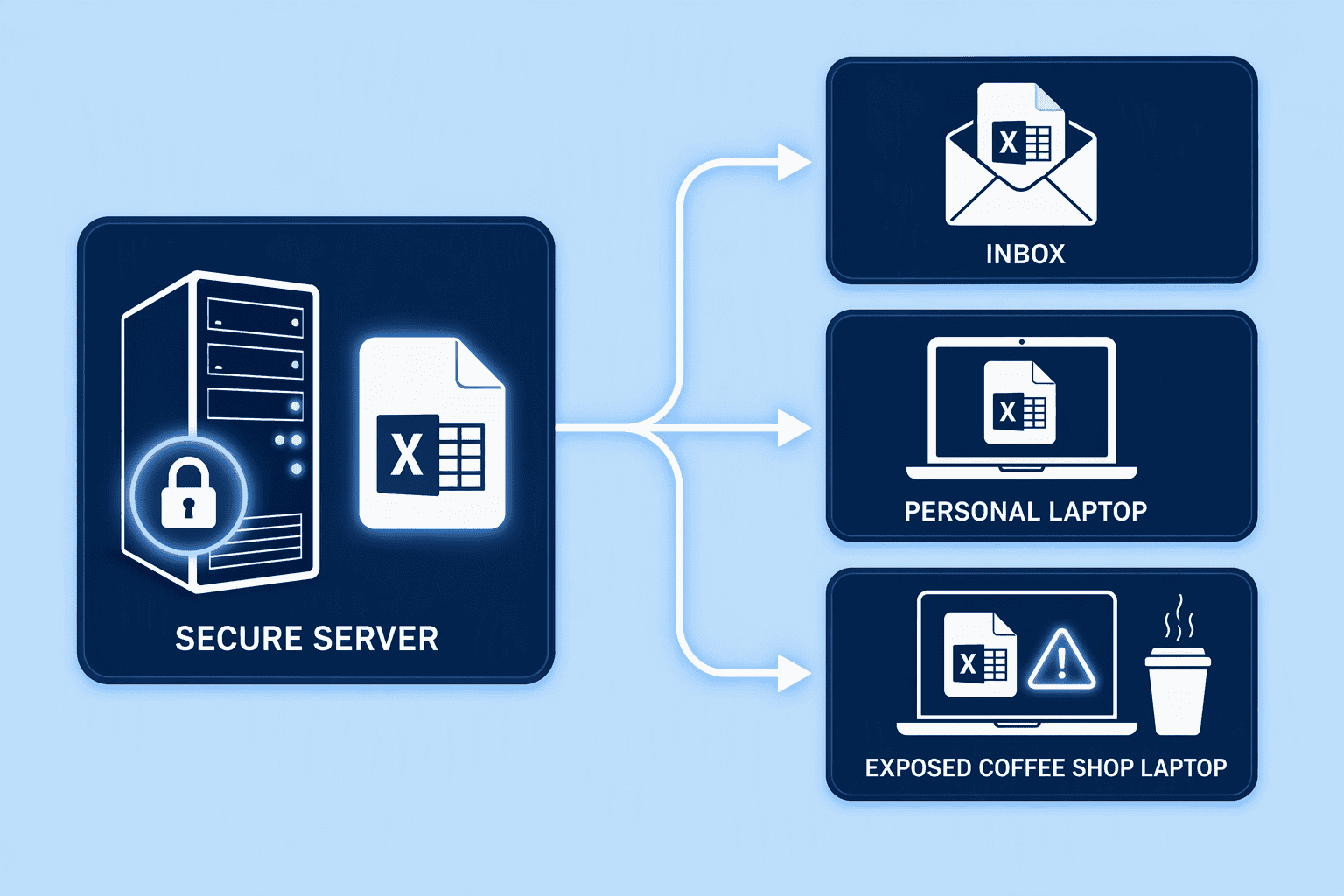
Moving a static spreadsheet around during a pay review violates every basic rule of data security. You hand a master copy to the recipient and give up control over its fate. An emailed Excel file can be forwarded, saved to a personal device, or left open on a screen in a coffee shop long after the review cycle closes.
The mechanics that create this risk are straightforward:
A platform like CompUp provisions users and their permissions on demand. The system enforces access, not a manager's attention to the 'To:' field. Spreadsheets leave an open vulnerability. Hackers can hijack legitimate features within Excel to steal data and cripple internal systems. A spreadsheet emailed during a review cycle is your company's most sensitive unprotected asset.
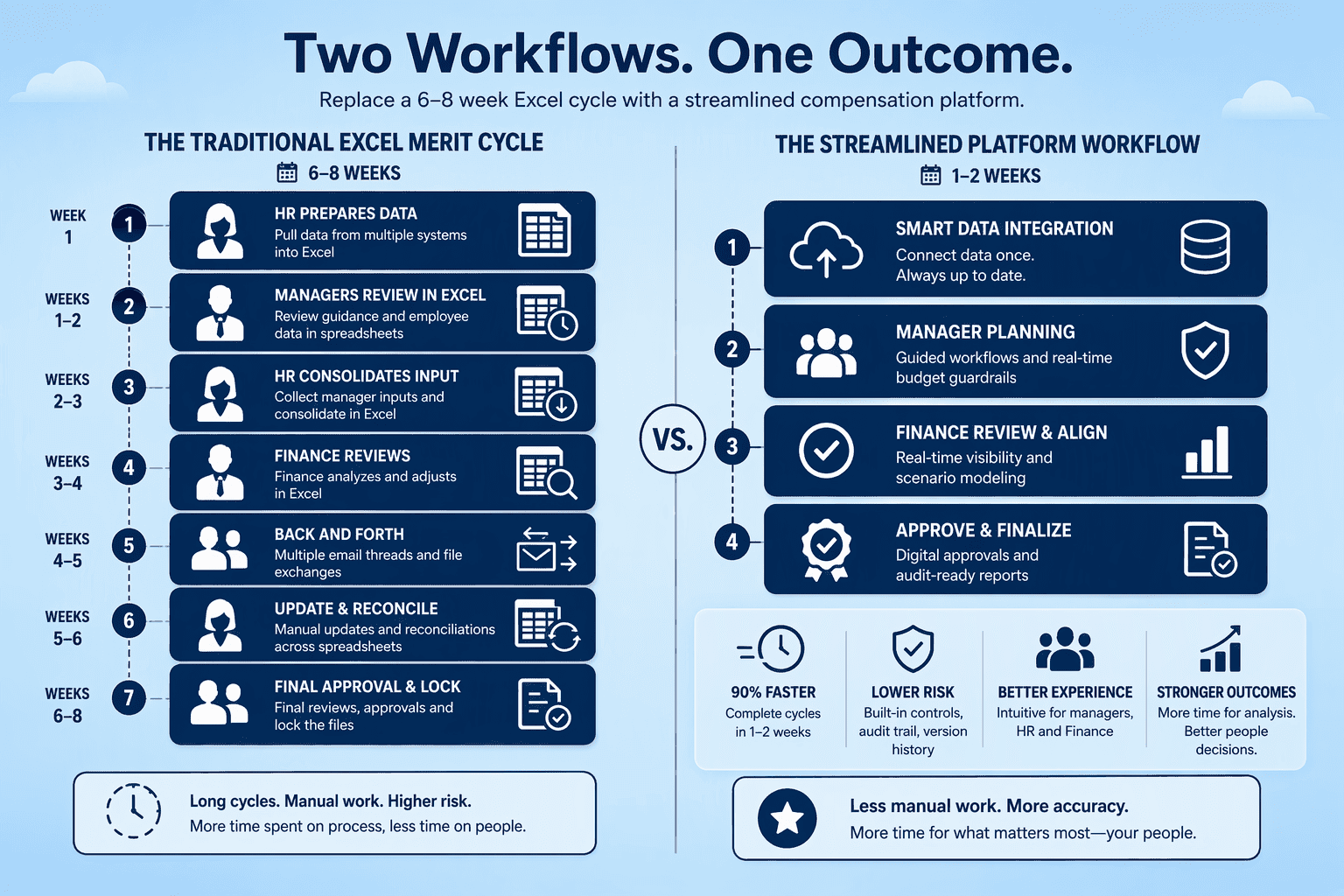
A six-to-eight-week merit cycle burns thousands of dollars in salary, not in license fees. The real drain is the manual hours of high-cost HR and Finance talent that Excel consumes. That operational cost destroys any perception of the tool being 'free.' Below is the direct comparison of what that time looks like in a spreadsheet environment versus a dedicated system.
| Cycle Metric | Excel-Based Pay Review | Dedicated Compensation Platform |
|---|---|---|
| Cycle Duration | Stretches merit cycles to six to eight weeks. | A well-run compensation cycle on dedicated software takes one to three weeks. |
| Primary Time Drain | Manual consolidation from an average of nine HR and finance systems into a single static workbook. | Direct API integrations and native system connectors that auto-populate template data. |
| Saved Resource Potential | No structural time savings; each cycle replicates the full manual and auditing load. | Companies report saving 40 to 60 percent of the time previously spent on compensation cycles. |
| Audit & Reconciliation | Hours-long manual investigation to trace a single formula cell across dozens of unlinked sheets. | Instant, timestamped digital audit trails that track every permission, access, and line-item change. |
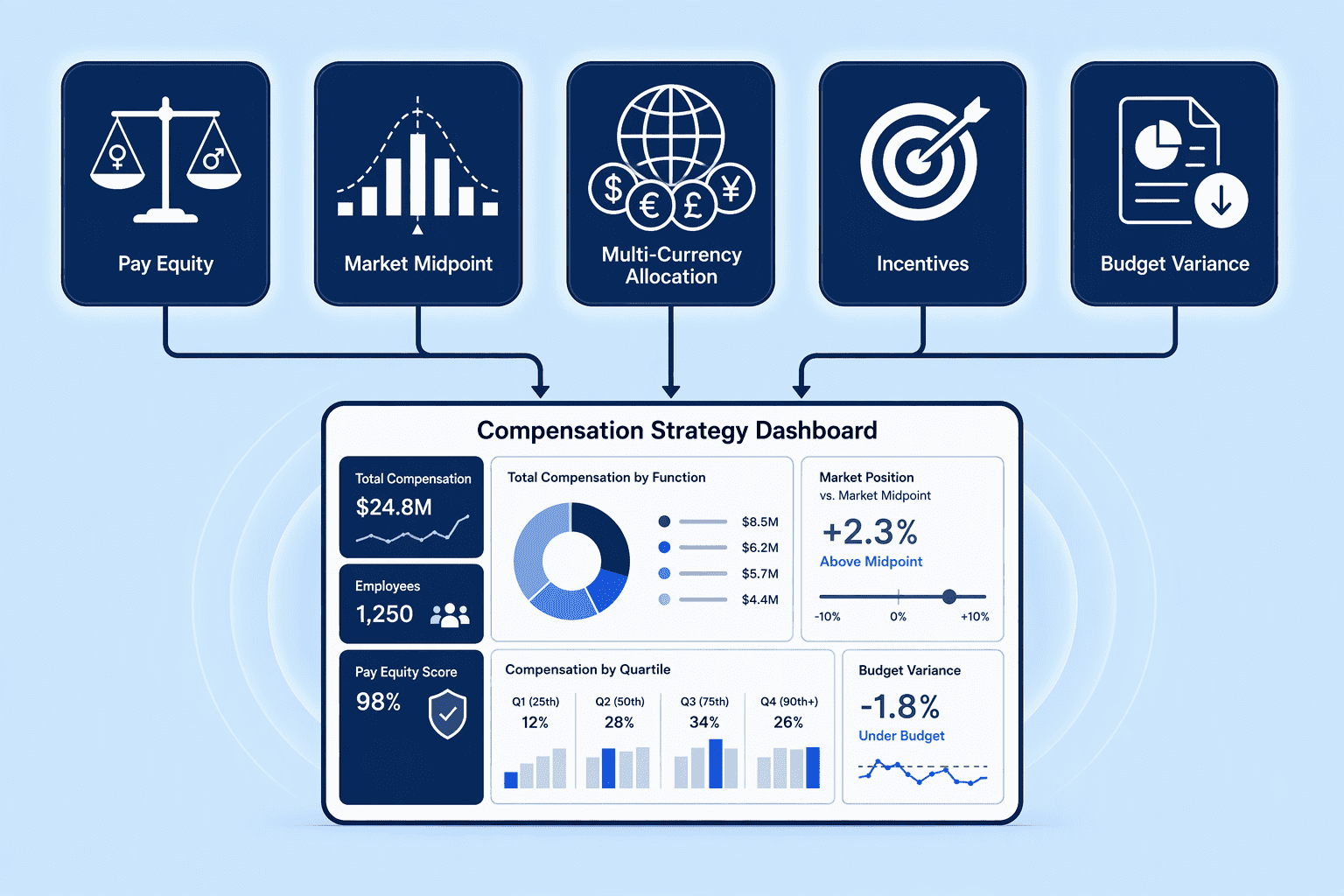
Modern compensation is a dynamic, multi-variable modeling challenge. Excel is a static grid. The gap between what the strategy requires and what the tool can deliver keeps growing.
Today's total rewards strategy asks you to balance internal pay equity, gender-based pay gap analysis, market midpoint comparisons, multi-currency allocations, incentive unit striping, and real-time budget variance tracking. In Excel, each of those is a distinct, manual, and disconnected project. A pay equity analysis means isolating protected classes, controlling for legitimate pay drivers, and regression-testing your decisions. No manual spreadsheet performs this at scale without a level of single-threaded analytical effort that pushes the cycle well past the point of strategic value.
A platform like CompUp provides real-time budget simulation and native multi-currency support so that you can run compensation scenario simulations instantly for thousands of employees. The alternative is a series of static models, each slightly out of date the moment you share them. When a department head asks how a 3% merit pool increase will impact their equity grants against the new pay bands, you cannot give them an instant, accurate answer in Excel. You can only promise them a laborious recalculation. The manual approach surrenders the strategic, data-driven agility that defines modern talent retention.
Pay transparency has shifted from a cultural preference into a jurisdictional mandate, backed by financial penalties. The year 2026 sharpens regulatory scrutiny, with legislation requiring auditable, provable fair pay.
For any organization still running their pay review in a collection of emailed workbooks, the requirement to produce a defensible, legally sound compliance argument is a landmine. A regulatory audit is not satisfied by a clean, final version of a sheet. It specifically examines the process: the approvals, the changes, and the evidence that no bias altered a final number from its original, logical calculation. Spreadsheets lack this fundamental version control. The manual chain of custody on a workbook is immediately suspect under legal review because there is no non-repudiable timestamp on every cell modification.
This is not alarmism. The FDIC's proposed rulemaking on incentive-based compensation arrangements categorically prohibits features that encourage inappropriate risks, and extends re-proposed regulatory text to align governance with actual pay records. The enforcement mechanism is the audit, and a non-automated system fails the test. When a state regulator or an internal legal team asks for the raw data trail to justify an equity decision made in the last cycle, you cannot point to sixteen versions of a xlsx file as a valid control.
You are choosing your compliance infrastructure, and the 2026 pay transparency regulations set the ceiling.
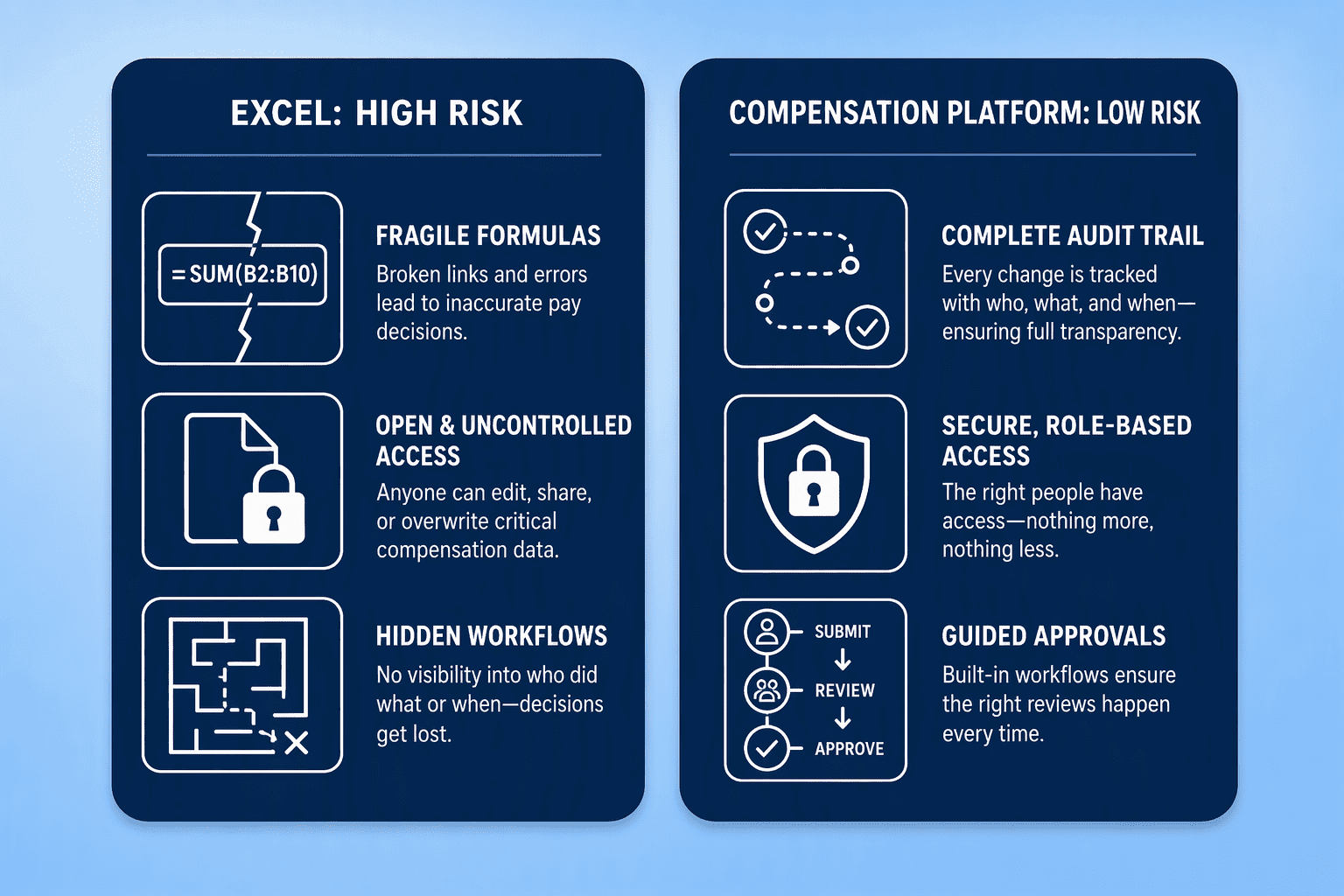
A spreadsheet carries three silent risks in compensation management: fragile formulas with zero audit trail, file-level permissions that anyone with a forwarded attachment can bypass, and workflow logic that exists only in somebody's head. A dedicated compensation platform addresses each one directly. The question is whether 2026 is the year those risks become too expensive to carry.
A compensation platform locks the operational actions a spreadsheet leaves open to chance. Calculation integrity. Access control.
Workflow routing. Time-stamped compliance logging. Each gets enforced by the system, not by a manager remembering to check a hidden cell reference.
The first dimension where platforms create distance from Excel is consolidated data. A static sheet hides its logic in fragile formulas. A compliant platform surfaces it in auditable logic.
Tools like CompUp let you run a full compensation cycle with real-time budget visibility, where every adjustment is a traceable, system-calculated event. That distinction is the difference between a tool that serves the business and one that threatens it.
The annual pay review carries enough financial and legal weight on its own without the tool you use adding to the burden. Continuing to run this critical process in an environment with a 90% documented error rate, no native security guardrails, and a weeks-long manual consolidation tax is not a defensible position for any people leader in 2026. The shift to a dedicated compensation management platform is a necessary risk-management decision, not a discretionary software upgrade. The case is closed: you are ready to move on from the spreadsheet for good. If you're weighing options, CompUp is worth a closer look.
The biggest risk is the near certainty of human error. Nearly 90 percent of complex spreadsheets contain errors, and when these hit a salary cell or an equity grant, they cascade into immediate, direct overpayments and budget blowouts. Cut-and-paste mistakes and broken formula links create a fragile, un-auditable process.
It destroys security by putting unprotected master files in uncontrolled email inboxes, and it fails compliance because no reliable, timestamped audit trail exists for manual cell edits. A pay equity dashboard alone is not enough for audit readiness, and manual workbooks fail the legal standard of a non-repudiable approval chain.
The main hidden cost is the HR labor drain: consolidating data from nine sources stretches a merit cycle to six to eight weeks, while dedicated software completes the same work in one to three weeks. Companies report saving 40 to 60 percent of the time when they switch.
No. Running a pay equity analysis requires isolating protected classes and regression-testing pay drivers, a process that is manually impossible at scale in a static grid. Real-time budget modeling is also not feasible, as every department request requires a full, error-prone recalculation of your workbook.
Dedicated platforms, including ADP, beqom, and CompUp, provide system-calculated logic, role-based access, and digital audit trails that Excel lacks. A purpose-built platform lets you run secure, automated cycles in one to three weeks.
It leaves the organization non-compliant by default. Pay transparency laws require a provable, traceable chain of custody for each decision. An audit board cannot accept a complex web of static, version-challenged spreadsheet files as valid legal evidence of non-discriminatory pay practices.
Community Manager (Marketing)
As a Community Manager, I’m passionate about fostering collaboration and knowledge sharing among professionals in compensation management and total rewards. I develop engaging content that simplifies complex topics, empowering others to excel and aim to drive collective growth through insight and connection.
Revolutionizing Pay Strategies: Don't Miss Our Latest Blogs on Compensation Benchmarking