
Your compensation team is being asked to make faster, more informed pay decisions in a market that's constantly changing. Meanwhile, pay equity laws are tightening, and employees expect transparency around how their compensation is determined. The pressure is on to get this right.
The problem? There is no single best compensation management platform. Your choice hinges on whether your priority is real-time employer-connected benchmarks, survey-based market pricing, or end-to-end compensation governance. Pick the wrong data model, and you'll either overpay for roles or lose talent to competitors.
A 2026 buyer's guide from CompBldr frames the decision around this split: specialized platforms focus on data sourcing and market pricing, while broader platforms embed execution. Pay equity and compliance hinge on workflow features, not just data. For companies evaluating platforms, the key differentiators are data-source depth for their hardest roles and geographies, integration with existing HRIS/PEO systems, and whether the platform separates benchmark data from execution tools.
This guide walks you through the 12 leading options in 2026, ranked by fit, data model, and practical strengths, so you can choose the platform that aligns with your compensation philosophy.
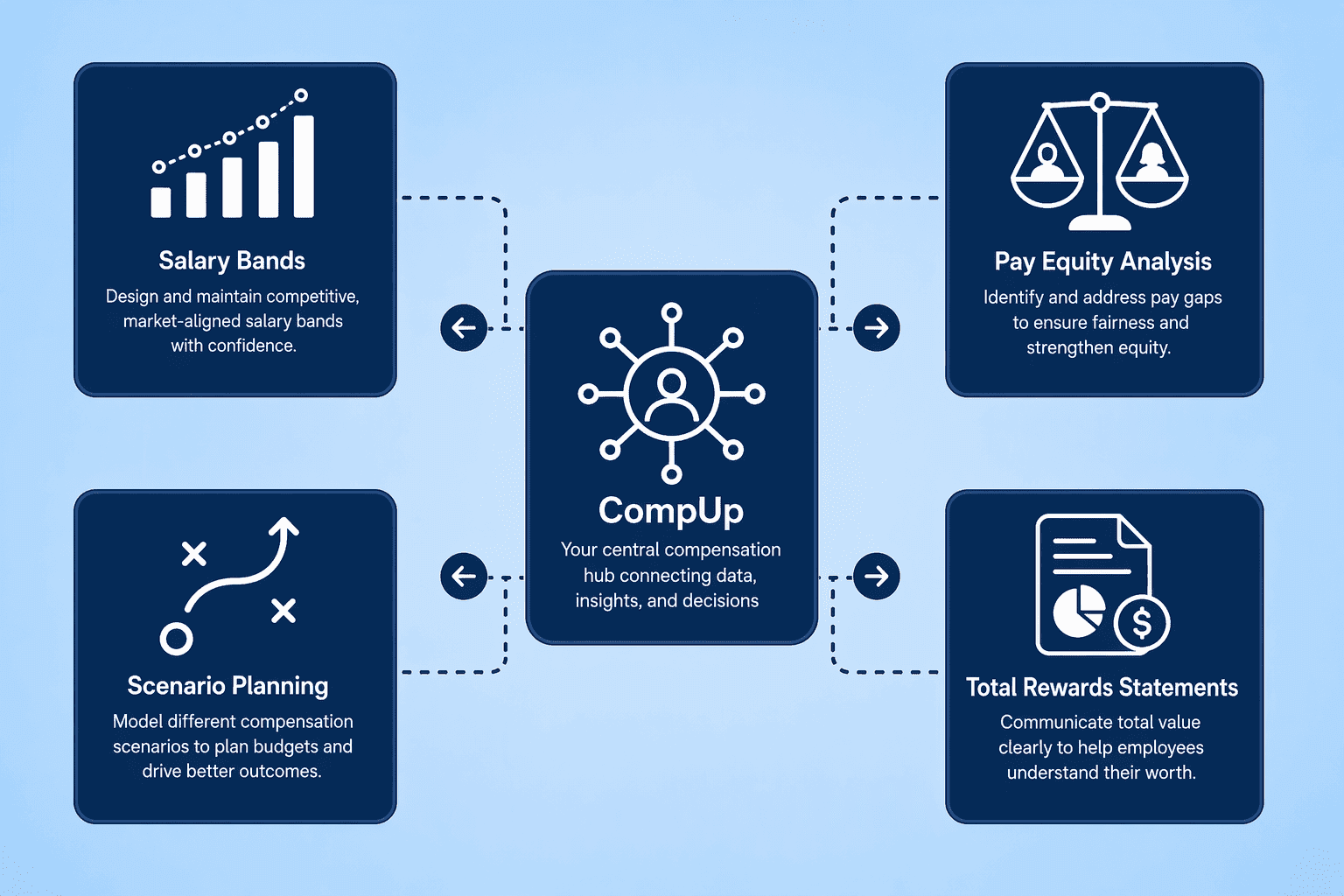
CompUp is a web-based SaaS platform that unifies compensation management, pay equity analytics, and total rewards communication in a single system. Its AI co-pilot ingests real-time, industry-specific compensation data across 80+ currencies, helping you set salary bands, run what-if scenarios, and generate personalized Total Rewards Statements at the close of your appraisal cycle. With a 4.9 rating on G2, it is the highest-rated platform in this guide.
What makes CompUp different is its refusal to separate benchmarking from execution. You are not toggling between a data source and a planning tool; the AI surfaces market rates inside the manufacturers you already use, such as BambooHR and Lattice. The platform includes Compensation Management, Total Rewards Statements, Appraisal Letters, Attrition Analysis, People Analytics, and Workforce Planning, all starting at $3 per employee per year. Its 100+ clients span 140+ countries, demonstrating global scale.
There is a trade-off. CompUp is not an enterprise HCM suite, and organizations with unusually complex equity awards or dedicated compliance teams focused on audit logs may find it lacks the granularity of a tool like beqom. But for most mid-to-large HR teams, this is a feature, not a bug: you get a specialized platform that doesn't require ripping out your existing HRIS. If your goal is to eliminate pay disparity while keeping managers and employees aligned through transparent communication, CompUp earns the top rank.
Pave is the benchmark for employer-connected compensation data. Instead of relying on surveys, it ingests real HRIS and ATS data from participating companies and updates cash and equity benchmarks monthly. For tech startups competing for talent in volatile markets, this near-live pricing lets you adjust offers before competitors even recognize a shift.
Pave’s strength is also its constraint: the data reflects its network, which is deepest in North American tech. If your hardest roles are in software engineering, product, or data science, Pave supplies granularity that survey composites cannot match. But for roles outside tech or in geographies like Europe, the coverage thins out, and you may need to supplement with another source.
It is best for growth-stage companies that prioritize speed and have an engineering-heavy headcount. Integration with your HRIS allows Pave to pull your internal data and map it to market, creating a live compa-ratio dashboard. The monthly refresh cadence means you are never benchmarking against stale data, which a 2026 CompBldr guide identifies as a critical differentiator in fast-moving sectors.
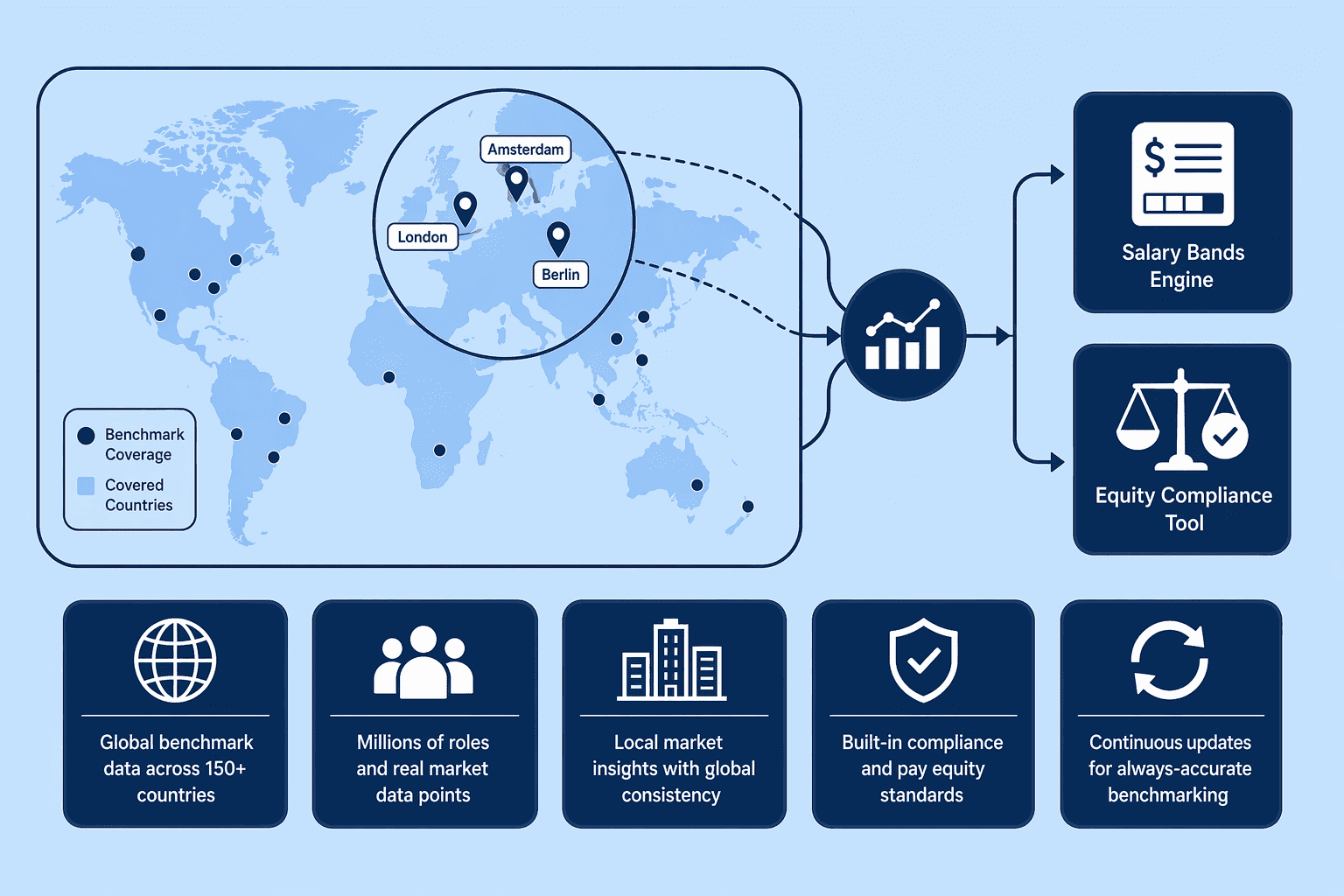
Ravio is a dedicated compensation management platform that combines real-time global total compensation benchmarking data with tools for salary bands and equity compliance. Its own materials say Ravio is best suited for high-growth, global tech companies that need accurate, up-to-date global data, with especially strong coverage across Europe. If your team is distributed across London, Berlin, and Amsterdam, Ravio's employer-connected model delivers local market rates that American-centric platforms miss.
Ravio's platform also includes workflow for salary bands and compliance, particularly around equity. For companies navigating EU pay transparency directives, a tool with regional compliance logic baked in reduces legal risk. The trade-off: its network is smaller than Pave's in the US, so coverage for specialized American roles is uneven.
The platform integrates with common HRIS and payroll systems, pulls internal data, and calculates compa-ratios and flags anomalies. For a Series C startup opening its first Berlin office, Ravio supplies ready-made compensation infrastructure. The alternative is stitching together local surveys and spreadsheets yourself.
Salary.com dominates traditional survey-based compensation data with a job library that stretches across industries and roles. Here is what sets it apart:
| Dimension | Salary.com | Employer-Connected Competitors (Pave/Ravio) |
|---|---|---|
| Data source | Multi-survey composites (HR-reported) | HRIS/ATS ingestion from participating companies |
| Update frequency | Annual or semi-annual surveys | Monthly |
| Job coverage | Broad, across all industries and non-tech roles | Deepest in tech, limited outside |
| Integration | New Deel integration for global payroll context | Native HRIS/ATS connections |
| User satisfaction | 96% of users rate it 4 or 5 stars on G2; G2 Leader for 19 consecutive quarters | Generally high in tech, variable elsewhere |
| Best for | Organizations needing reliable, defensible market pricing across diverse jobs | Companies in tight tech labor markets needing rapid updates |
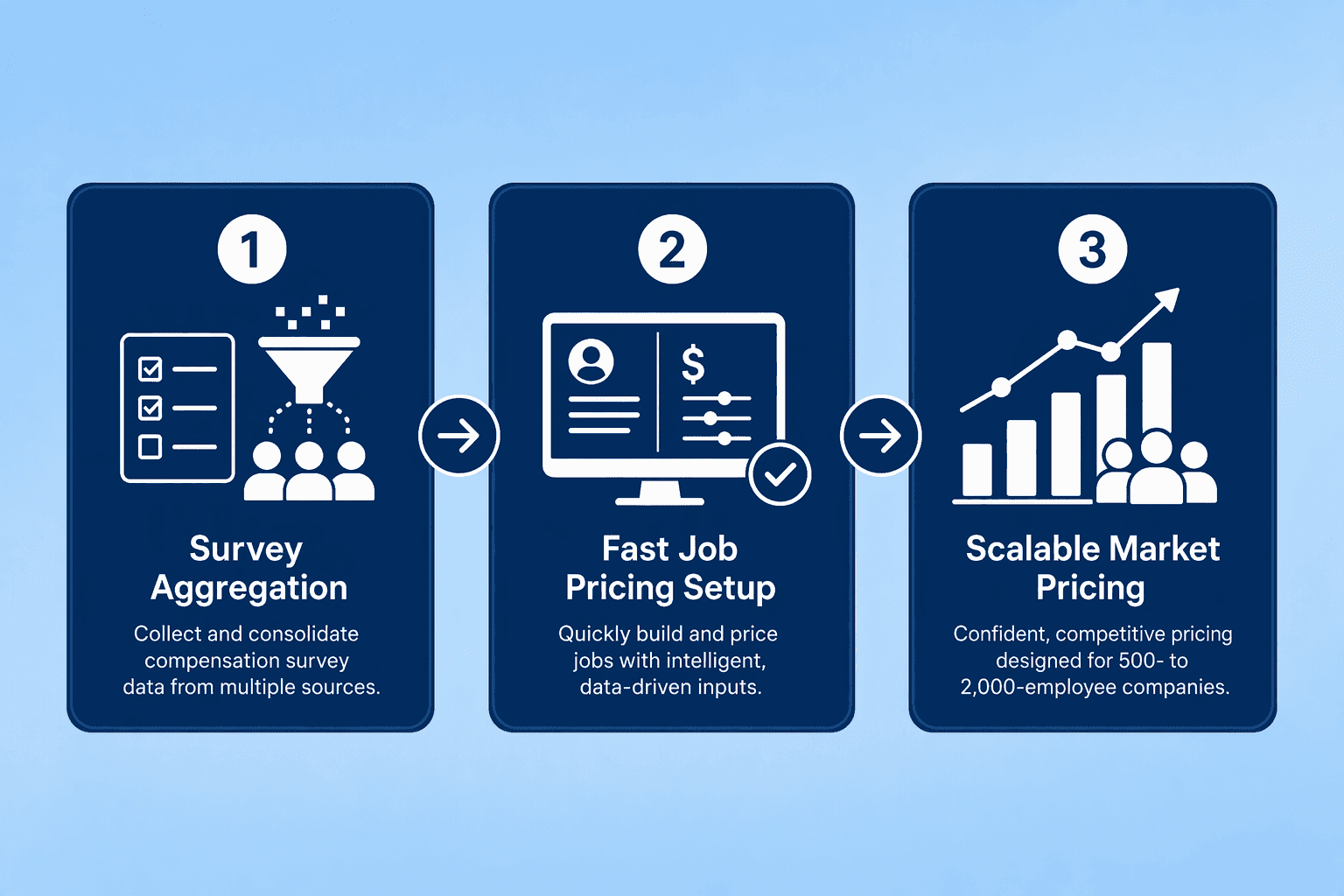
Bettercomp is built for mid-sized companies that find Salary.com too complex and Pave too tech-centric. It focuses on three core capabilities:
Bettercomp does not offer the real-time feeds of employer-connected models. For a manufacturing firm in Ohio hiring maintenance technicians and shift supervisors, that gap is beside the point. What counts is defensible market data you can get quickly, without the enterprise overhead.
Compport addresses a gap that Western platforms overlook: end-to-end compensation governance for APAC-headquartered or global firms. Most comp tools bolt on international features as an afterthought. Compport builds its workflows around the regulatory reality of Singapore, Australia, Japan, and the rest of the region from day one.
Its real value sits in three connected layers:
For a European or North American company with a growing APAC footprint, Compport avoids the headache of retrofitting a US-centric tool. The analytics and compliance logic come built in, which is what makes this the governance play for global teams.
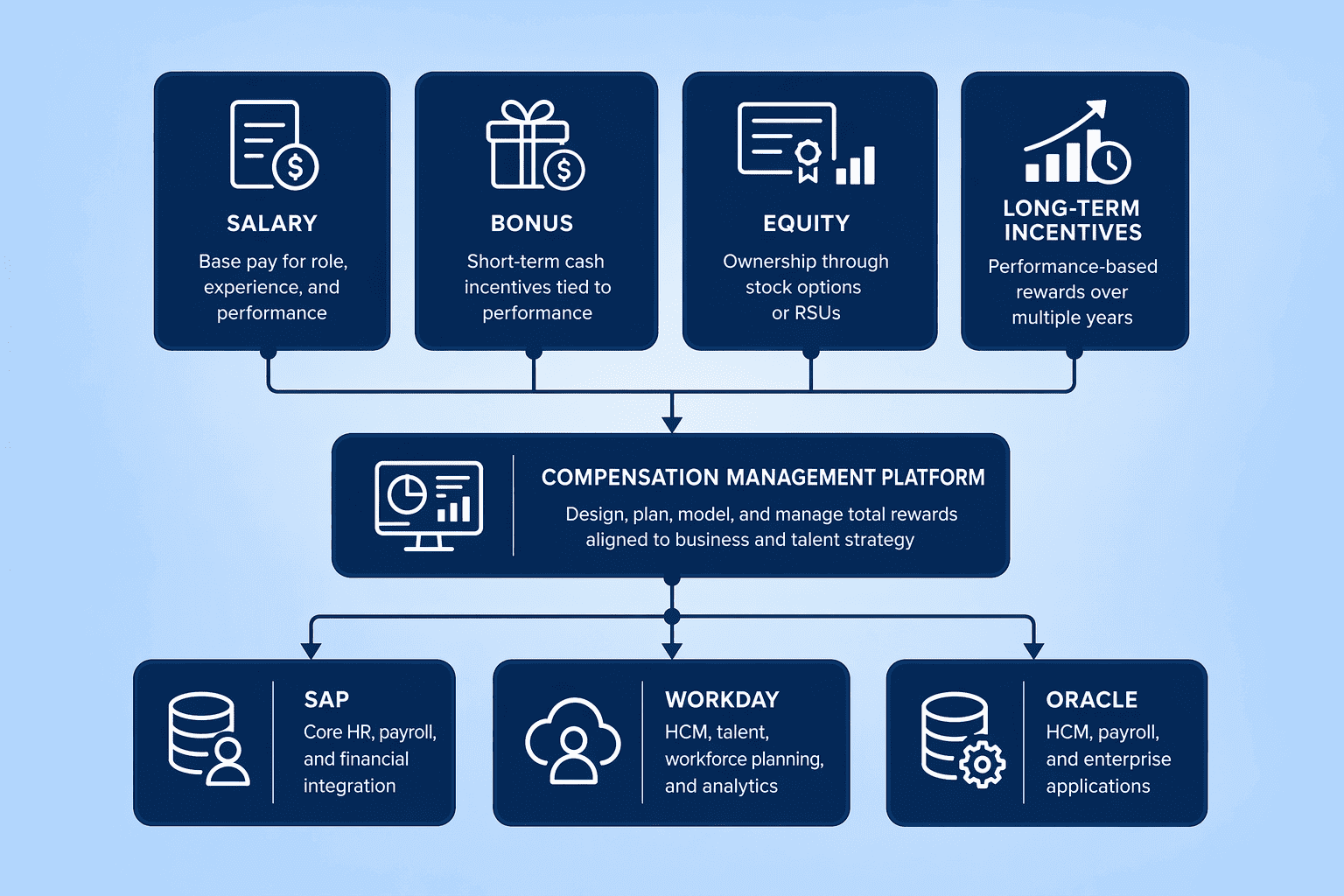
beqom is built for large enterprises whose compensation plans resemble a tax code. Sales incentive plans, equity waterfalls, deferred compensation, multi-country statutory requirements: beqom models it all. Its total compensation suite centralizes salary, bonus, and long-term incentives into a single engine, giving the C-suite a unified view of total rewards spend.
Integration is the platform's superpower. beqom connects to virtually any ERP or HCM system (SAP, Workday, Oracle), pulling position data and pushing budget outputs without manual intervention. For a global bank with 40,000 employees and 12 compensation cycles per year, this automation is not a nice-to-have; it is the only way to close plans on time. beqom reports a 99% customer retention rate, which signals that once enterprises commit, they stay.
This power comes with complexity. Implementation typically requires dedicated consultants, and the platform's admin interface assumes a compensation specialist at the helm. It is not for the HR generalist at a 300-person company.
beqom earns its rank for enterprises that have outgrown their HCM's native comp module. When your incentive plans threaten to break a simpler tool, beqom is the answer.
HRSoft refuses to be everything to everyone. It focuses exclusively on the compensation lifecycle: planning, merit and bonus cycles, total rewards statements, and analytics.
This tight scope is a strength for mature HR teams that already have an HCM like Workday or SAP running core HR. HRSoft layers on top, giving comp managers granular control over budgets, guidelines, and approvals without touching the underlying HRIS. The platform runs complex rules, tiered merit matrices by country, performance, and compa-ratio, that would strain a general-purpose tool.
The trade-off is that you must be willing to manage two systems. HRSoft does not replace your HCM; it augments it. For teams that have a dedicated compensation function and need lifecycle depth, that trade-off is often worth it. A 2026 CompBldr guide notes that separating lifecycle tools from HCM can actually increase agility, provided the integration is stable.
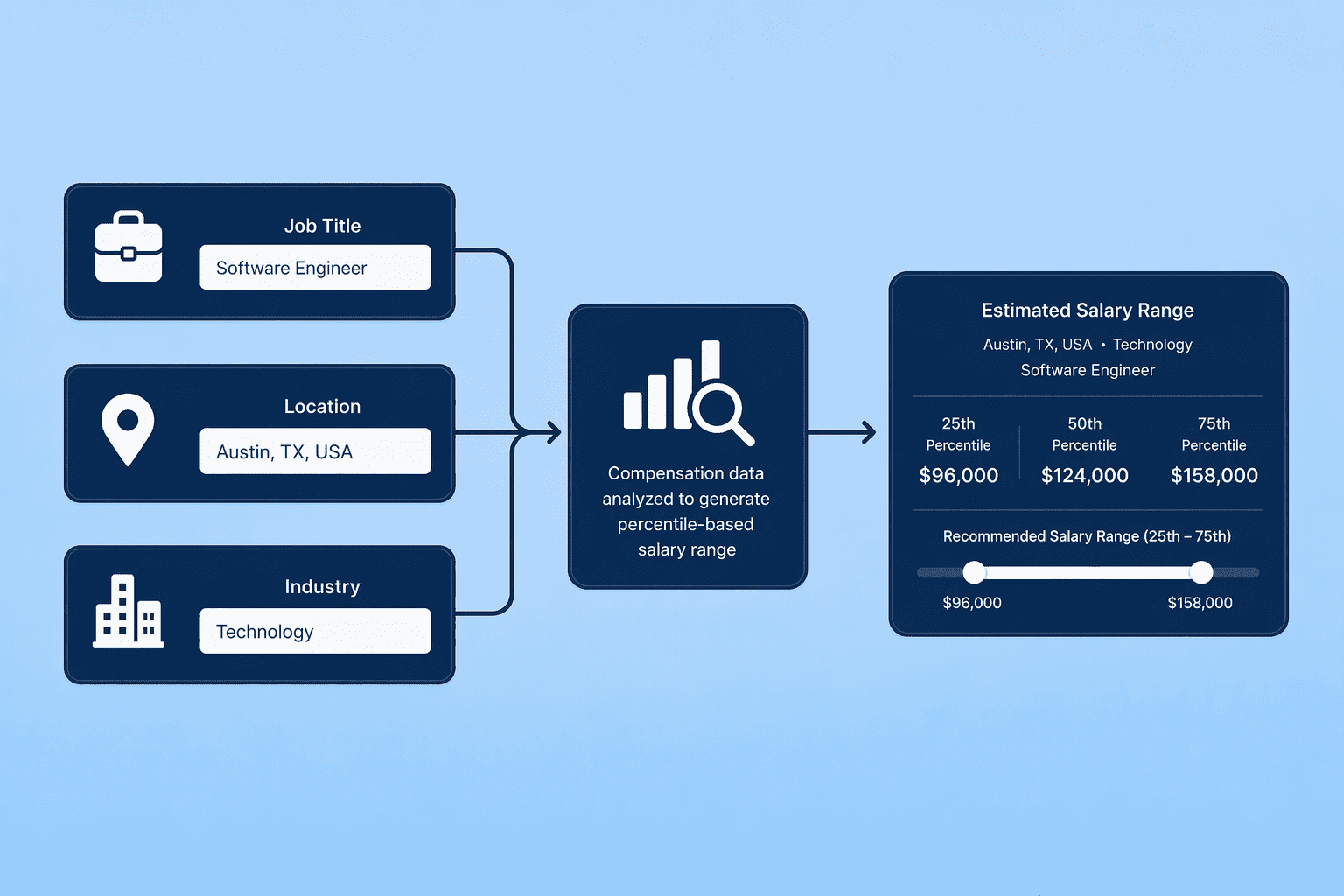
The Compensation Range Builder by CompUp is a free, self‑service tool that creates salary ranges using real‑time market data. You input a job title, location, and industry, and it generates a data‑backed range with percentiles, no sign‑up required. For HR teams still building their first formal pay structures, this removes the biggest barrier: cost.
It is not a full platform. There are no approval workflows, no analytics dashboards, no integration with your HRIS, and no ability to run what‑if scenarios across an entire organization. It solves one problem, quickly pricing a role, and does it well for free.
Think of it as a gateway. You can validate CompUp's data quality and user experience before committing to its full suite, which starts at $3 per employee per year. For a 50‑person startup debating whether to invest in compensation software at all, the Range Builder is the lowest‑risk way to get started.
Choosing a compensation management platform in 2026 comes down to your data model, your geographic coverage, and your governance needs. If speed and live market data matter most for tech roles, Pave or Ravio leads. If survey credibility across broad jobs is non-negotiable, Salary.com is the benchmark. For unified governance and pay equity without an enterprise overhaul, CompUp offers the strongest balance of analytics, communication, and price. Before committing, request demos from at least two tiers, one employer-connected, one survey-based, to pressure-test coverage for your hardest-to-fill roles. A good next step is seeing how CompUp puts this into practice.
An ideal platform should integrate a set of key capabilities:
Integration with your HRIS is critical so that market data flows into planning cycles. Look for audit trails that support defensible pay decisions.
They embed compliance into workflows through several mechanisms:
This creates an audit trail and reduces legal risk, especially as pay transparency regulations tighten globally.
Specialized platforms (like CompUp or Pave) focus on benchmarking and pay analytics with deep, fast data. Broad HCM suites (like Workday) embed compensation within core HR execution. Specialized tools are more agile for market pricing; HCM suites centralize but often aggregate slower, survey-based data.
CompUp stands out for its unified approach: combining real-time benchmarking, pay equity AI, and total rewards communication in one platform. It's web-based, integrates with major HRIS, and starts at $3/employee/year. It's not an enterprise HCM, but it outperforms on speed and actionable analytics.
Match your platform to your hardest roles and geographies with these guidelines:
Assess HRIS integration and whether you need end-to-end governance or just pricing.
They automate data ingestion from multiple sources, map jobs to market rates, and surface recommendations within planning workflows. Managers can model raise scenarios with real-time budget and compa-ratio visibility, then push approved adjustments to payroll, cutting weeks off cycle times.
Community Manager (Marketing)
As a Community Manager, I’m passionate about fostering collaboration and knowledge sharing among professionals in compensation management and total rewards. I develop engaging content that simplifies complex topics, empowering others to excel and aim to drive collective growth through insight and connection.
Revolutionizing Pay Strategies: Don't Miss Our Latest Blogs on Compensation Benchmarking