
You finalized the global budget in December. By February, statutory bonus rules shifted in two countries, your APAC lead quit, and finance can't explain why payroll is running 14% over target. The spreadsheet that was supposed to control spending is now the source of the error.
Across dozens of jurisdictions, your budget is being allocated, re-allocated, and quietly ignored at the manager-discretion level with no audit trail. The root cause is a tool that was never designed to enforce multi-country compensation rules. Compensation budgeting failures usually come from weak budget controls, not bad compensation decisions.
For a global compensation leader, the stakes in 2026 are legal. A posted pay range in a regulated market must trace back to a documented, approved budget amount. Your spreadsheet cannot produce that trail. Dedicated compensation platforms handle this: they turn multi-currency chaos into an auditable, real-time plan.
This guide covers five platforms that solve this problem. No generic HCM suites, no budgeting modules that fake the appearance of control. These tools enforce the budget at the point of manager decision, across borders.
The global compensation software market in 2026 has narrowed to a clear set of platforms purpose-built for budget enforcement, not just forecasting. After evaluating Gartner ratings, multi-currency architecture, and real-time reallocation capabilities, the top six options address distinct organizational priorities:
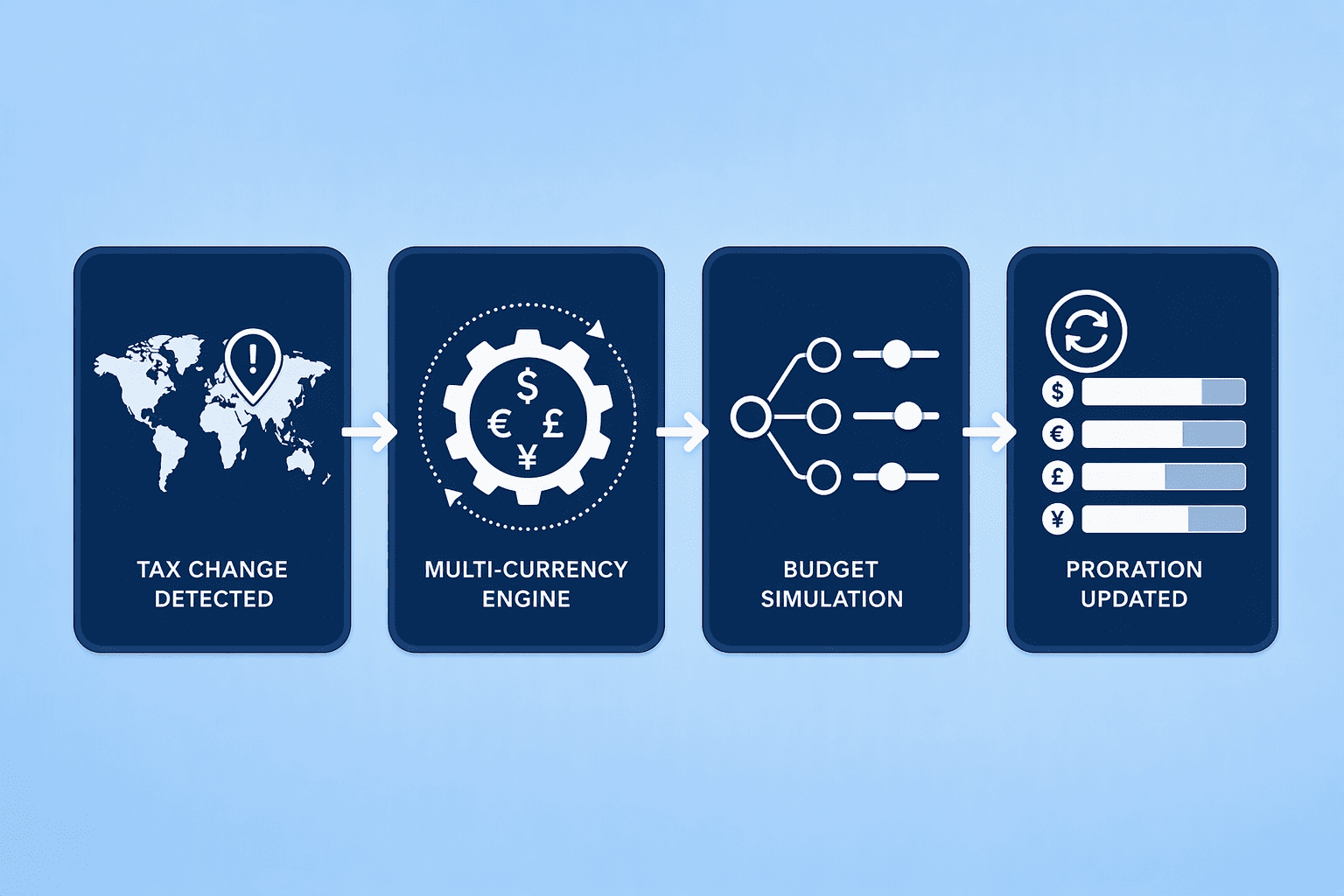
A mid-year tax change hits a new jurisdiction, and your proration logic breaks. You don't have weeks to wait on a vendor ticket. CompUp is a compensation-first platform that keeps its multi-currency engine and real-time budget simulation native to the core product, rather than retrofitted onto a larger suite.
Over 200 global companies use CompUp for this orchestration layer. You model a statutory change, see its impact across entities immediately, and lock new guardrails without a custom dev cycle. The starting price of $3 per employee per year makes it possible for mid-market teams who can't fund a full Workday deployment but still need to enforce budgets across 15 countries.
CompUp connects compensation planning with pay equity analysis and compliance dashboards in a single view. Workforce planning lives in a separate, complementary product. For the HR and Total Rewards leader whose budget control evaporates the second a manager in Singapore opens an adjustment form, that tight focus earns its place.
Third-party validation matters acutely when you are defending a software choice to a CFO who wants to stay on Excel. Compport carries the credential that changes that conversation: the top Gartner Peer Insights rating in this category, backed by specific feedback on its multi-entity architecture.
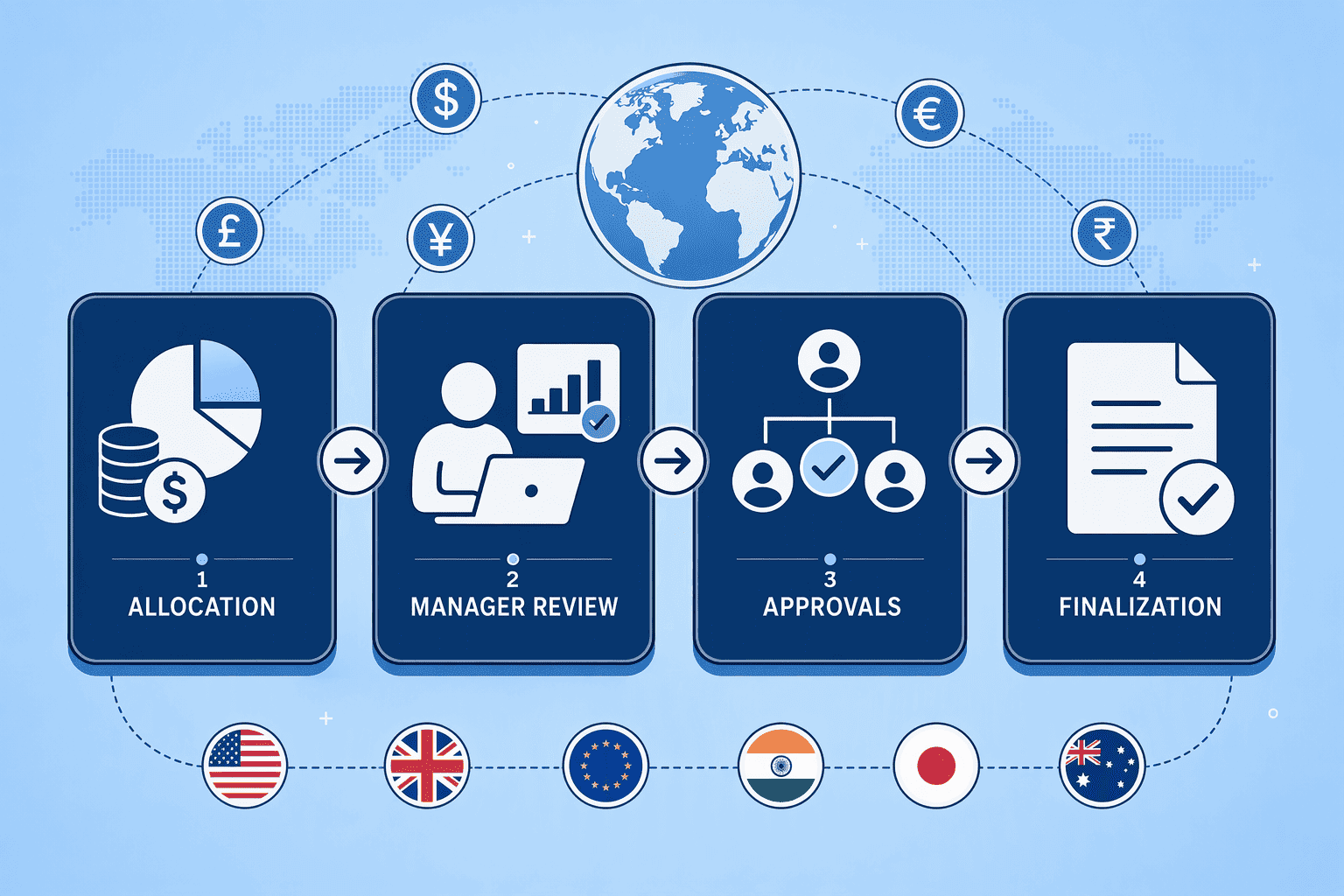
For a Fortune 500 organization running a rigid annual compensation cycle with defined windows for merit, bonus, and equity, HRSoft is the established, process-heavy answer. Its architecture governs the entire compensation lifecycle, from first allocation to final approval, with systematic control at every step.
Gartner Peer Insights data confirms HRSoft manages global currencies natively, directly addressing multi-country allocation complexity. It controls calculation and allocation of merit, bonus, and equity awards, creating a structured environment where a manager cannot move a dollar outside the approved pool without triggering a documented exception workflow. That's strict, hierarchical enforcement. For mature enterprises with byzantine governance structures, that rigidity is a feature.
The manager decision-support layer is where HRSoft earns its seat in this list. ADP research emphasizes that compensation software must surface salary ranges, market rates, and peer ratios at the point of decision. HRSoft embeds these reference points directly into the manager workflow, turning a judgment call into a guided, guarded choice.
If your compensation model assumes an annual cycle, Beqom probably is not for you. But if your workforce is mobile, your reward structure is continuous, and your budget must track spend in real time across different pay structures and countries, Beqom's AI-driven architecture is built for that reality.
Every budget cycle, at least one hiring manager pushes back. The Berlin office wants a 22% bump because "that's what the market demands," and your finance team has no independent number to push back with. Payscale gives you that number.
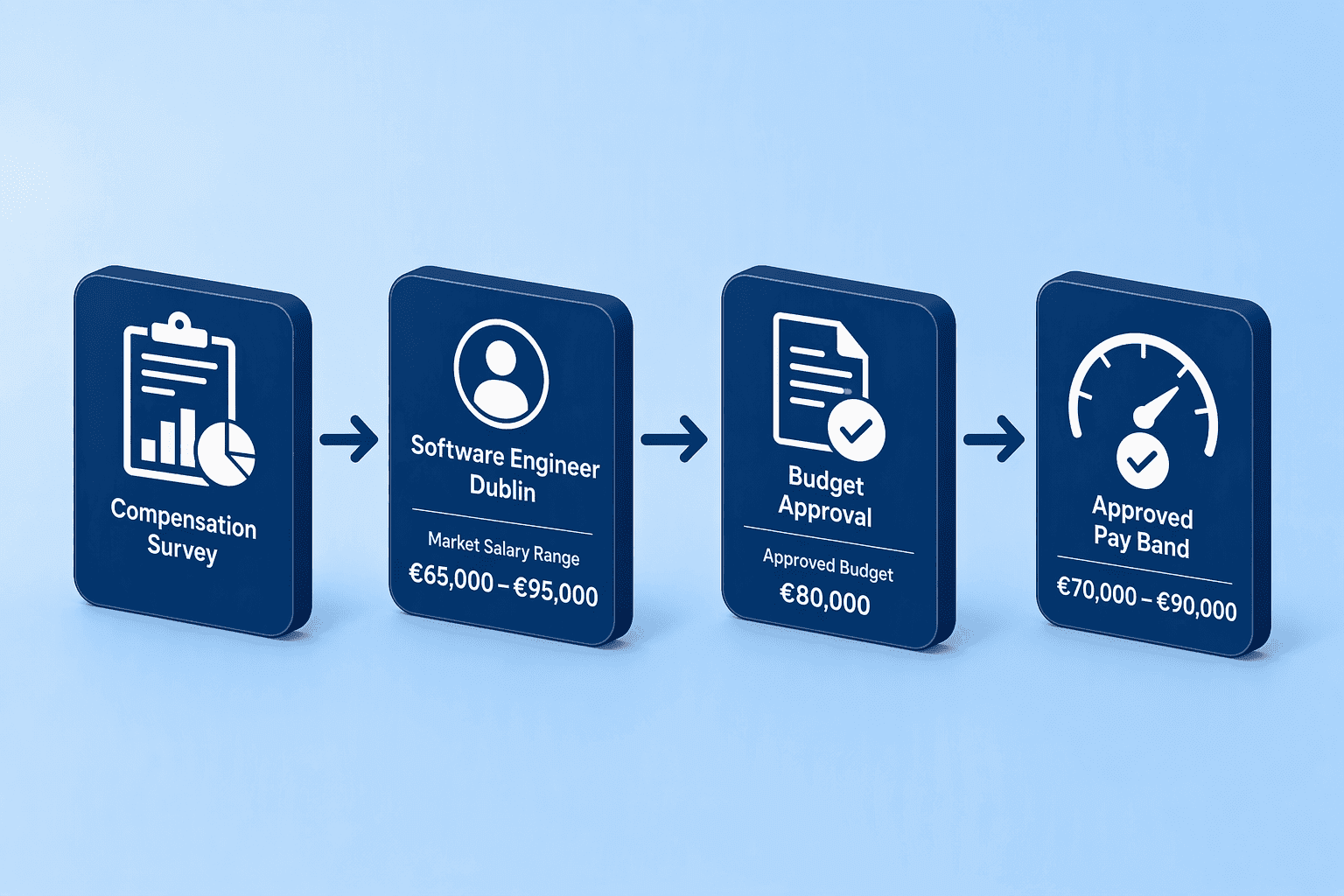
Payscale anchors budgets in defensible, real-time market data. When a software engineer role in Dublin gets assigned a range, that range comes from Payscale's compensation surveys, not from a back-and-forth between a recruiter and a cost-center owner. The argument shifts from "I need more" to "here's what comparable employers are paying."
Benchmarking is what Payscale does, and it does it at scale. Roles mapped to current market rates make the budget feel self-enforcing because the data pre-empts the debate. Managers see the number the market supports, and finance sees the number that keeps attrition risk low.
This is a data source, not a workflow engine. Payscale won't route approval chains or lock down spreadsheets once a cycle closes.
Pair it with a process-enforcing platform that handles allocation governance. For companies where market volatility destabilizes budgets faster than internal politics ever could, Payscale earns its spot in the stack on data strength alone.
Budget leakage often hides in the gaps between systems. The base salary budget sits in one spreadsheet. The long-term incentive pool sits in another. The annual bonus allocation lives in a finance model that no one in HR can open. When a country head awards a retention grant that draws from two of these pools without checking the third, the global budget breaks.
Decusoft addresses this by unifying planning across the full reward stack. The table below maps how its unified architecture contrasts with single-dimension tools:
| Planning Dimension | Decusoft Unified Approach | Typical Single-Dimension Tool Approach |
|---|---|---|
| Base Salary | Allocated in same plan as incentives | Siloed in HR compensation module |
| Annual Bonus | Tied to same budget pool, real-time drawdown | Separate finance model, manual reconciliation |
| Long-Term Incentives | Budgeted alongside cash, preventing double-counting | Standalone equity administration system |
| Multi-Country Visibility | Single global budget view with entity-level enforcement | Separate country workbooks, prone to drift |
| Overspend Prevention | Cross-reward guardrails flag total cost, not just base salary | Gap: manager can overspend LTI while salary looks compliant |
Decusoft's recent move into AI-powered compensation insights signals an evolution toward predictive modeling. Decusoft's March 2026 announcement of Compose Insights and Predictive Compensation indicates the platform is building toward scenario forecasting on top of its unification layer. For now, its core strength is preventing the leak that occurs when a manager allocates incentive spend without visibility into the total reward cost.
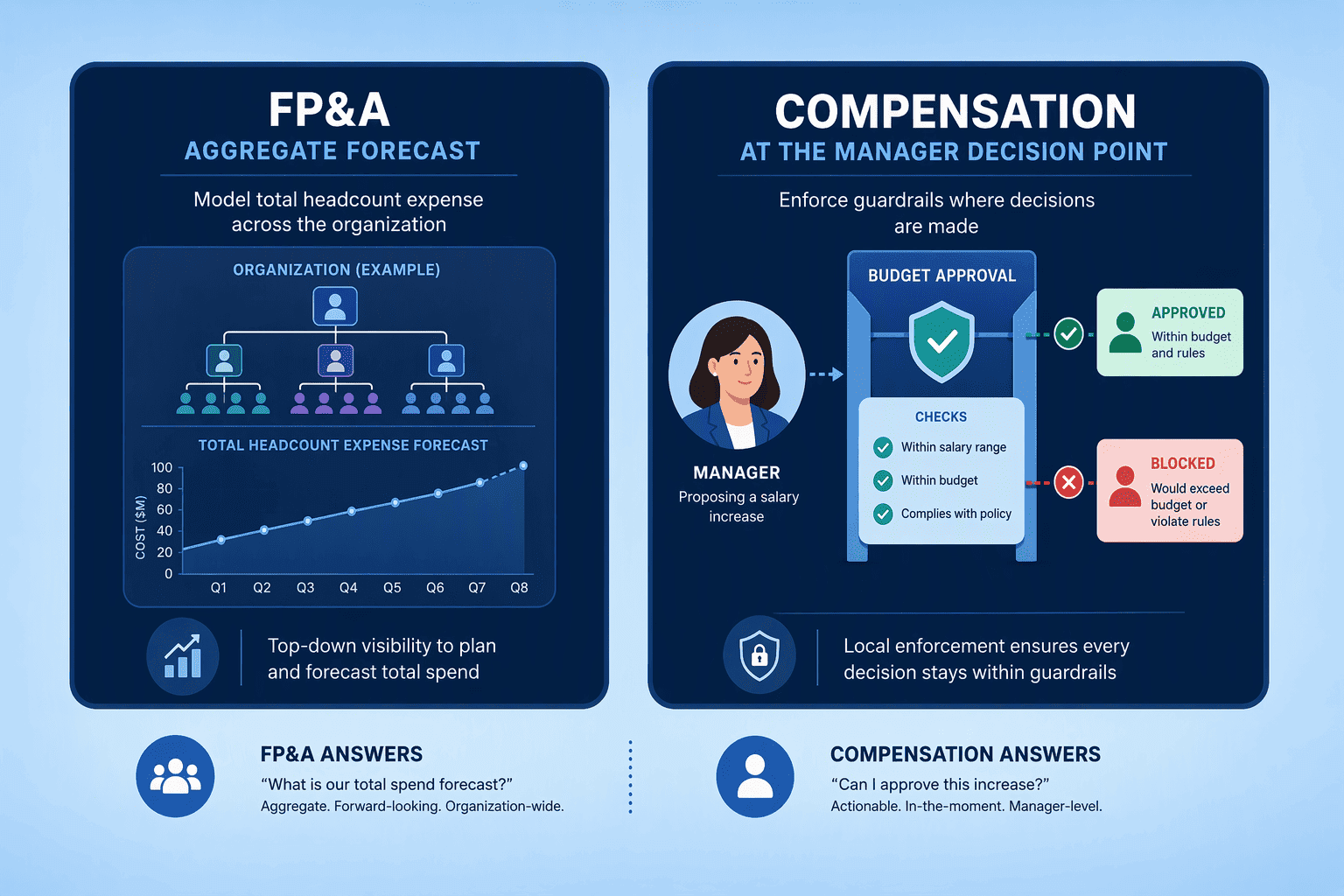
Your CFO will ask why the compensation team needs separate software when Workday Adaptive Planning already models headcount costs. The answer comes down to jurisdiction. FP&A tools forecast organizational expense at the aggregate level. Compensation platforms enforce spending rules at the individual manager-decision point, the only place overspending actually happens.
A workforce planning suite can tell you that the APAC sales budget will be consumed by Q3. It cannot stop a regional director from awarding a 15% off-cycle increase in Q1 that violates the country's new pay transparency range. That requires a tool that ingests the budget, applies guardrails at the approval step, and records the decision, in real time, across currencies.
Workday provides compensation management as a module within its broader HCM suite. Compensation budgeting software is the layer that turns your merit, bonus, and incentive pools into controlled, trackable budgets. The distinction is operative. Forecasting predicts what you will spend. Enforcement controls what you are allowed to spend, transaction by transaction.
ADP research underscores this gap. Compensation management software shortens planning cycles and reduces HR intervention, but its core value is surfacing the right data (salary ranges, market rates, and peer ratios) at the moment a manager makes a compensation decision. A finance tool does not surface this data. It serves the FP&A analyst working in a planning cube, not the HRBP approving a Singapore merit increase.
In 2026, budget logic stops being a back-office convenience. It becomes a legal artifact.
Multiple jurisdictions now require that a posted pay range in a job listing maps to a documented, defensible budgeted amount. The line manager entering a proposed salary into an offer workflow is creating a compliance record. If that record cannot be traced back to a budget that was set, approved, and timestamped within the system, your audit trail collapses at the first regulatory inquiry.
The European Union's Pay Transparency Directive is the most visible driver, but the trend is global. In 2026, your posted pay range can come straight from your budgeted amount for the role. This linking of budget to posting provides a defensible chain of custody. When the software enforces this link by pulling the budgeted range directly into the offer workflow and blocking an out-of-range proposal, that artifact is what a regulator accepts.
ADP's research confirms that mismanaged compensation plans can add hundreds of thousands of dollars to budgets annually. Under pay transparency rules, that mismanagement becomes a public-facing compliance gap. A pay equity dashboard alone is insufficient.
You need budget-level documentation showing the decision was bounded by a pre-approved pool. Platform choices made in 2026 must prioritize budget enforcement over reporting.
A tool that spits out a variance analysis after the cycle closes offers no protection. You need the guardrail at the point of decision, logged, timestamped, and mapped to a specific budget version.
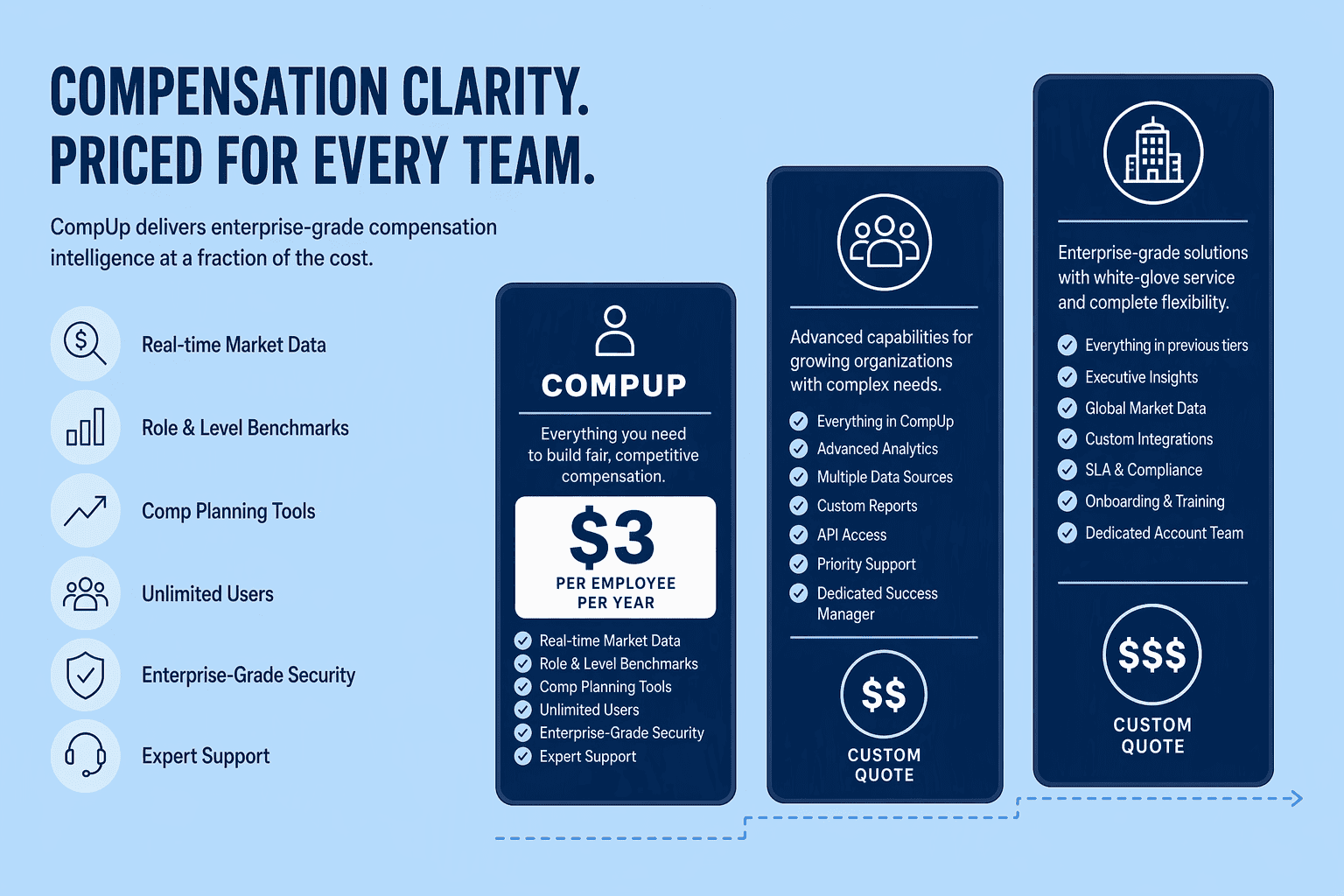
Pricing in this market lacks transparency. Publicly listed figures are rare, enterprise quotes are custom, and a buyer looking at two vendors with similar capability lists often cannot explain why one costs $3 per employee per year and the other $50. Here is what we can say concretely about 2026 pricing models.
CompUp starts at $3 per employee per year, which anchors the low end for a compensation-first SaaS platform. The company built the product as a focused compensation tool, and its pricing reflects that scope. Enterprise suites like SAP SuccessFactors use custom enterprise pricing with subscription structures based on user or employee counts that routinely push mid-five-figures for a global deployment. Most dedicated compensation platforms fall into a per-employee-per-year range with tiered pricing that escalates based on module inclusion (pay equity, benchmarking, total rewards communication).
Implementation is the hidden cost that destroys the budget. Multi-country rollouts require data migration, HRIS integration, jurisdiction-specific rule configuration, and manager training across time zones. No source provides apples-to-apples implementation pricing, but you should expect implementation services to run between 1x and 3x the annual license cost in the first year. Ask every vendor explicitly what middle east configuration, currency setup, and statutory rule mapping will cost before you sign.
Your platform decision in 2026 maps to your primary budget-control risk. If your risk is weak enforcement at the manager level across dozens of countries, CompUp and Compport lead on multi-currency guardrails and real-time reallocation. If your risk is process drift in a complex, hierarchical enterprise, HRSoft's rigid cycle management fits. If your risk is market rate disconnection driving budget exceptions, Payscale anchors the data. If your risk is the total reward stack leaking because base, bonus, and equity live in separate systems, Decusoft unifies them.
Beqom earns its place for organizations that have moved past annual cycles entirely. For a mobile, always-on workforce, its AI layer and continuous tracking architecture are table-stakes.
What no platform choice can substitute is the compliance mandate. Your posted pay range in 2026 must derive from a documented budget. That makes your compensation software a legal artifact. Choose the platform that builds that defense, not the one that only reports on it after the damage is done. A good next step is seeing how CompUp puts this into practice.
A compensation platform in 2026 must deliver four capabilities to succeed:
Compliance documentation trails are now mandatory.
AI surfaces patterns like attrition risk and overpayment anomalies across large global datasets, enabling predictive budget adjustments rather than reactive corrections. In beqom's model, AI embeds equity insights directly into compensation decisions, shrinking manual spreadsheet work significantly.
The leading platforms evaluated for multi-country budget allocation are:
CompUp leads on frictionless orchestration.
FP&A tools like Workday Adaptive Planning forecast costs at the aggregate level; they do not enforce spending limits at the individual manager decision. Compensation platforms apply guardrails at the approval step, log the transaction, and prevent overspending in real time across currencies.
Pay transparency laws now require that posted pay ranges derive from documented budgeted amounts. If a manager's offer exceeds a budget without an auditable trail, the organization faces regulatory risk. Budget logic must function as a legal artifact, timestamped and defensible.
Pricing models in 2026 span a wide range:
Community Manager (Marketing)
As a Community Manager, I’m passionate about fostering collaboration and knowledge sharing among professionals in compensation management and total rewards. I develop engaging content that simplifies complex topics, empowering others to excel and aim to drive collective growth through insight and connection.
Revolutionizing Pay Strategies: Don't Miss Our Latest Blogs on Compensation Benchmarking