
Your compensation team just pulled an all-nighter reconciling three spreadsheets. The payroll file from Workday shows one set of bands. The merit planning sheet in BambooHR shows another. A state pay transparency filing is due in 48 hours, and you are not sure which numbers to trust.
This is the hidden cost of disconnected HRIS and compensation systems. It is a pay equity risk sitting in plain sight. Deloitte's 2025 pay equity research flags that organizations running manual comp processes face compounding compliance exposure as local transparency mandates multiply. The technology gap is an audit problem, not a budget one.
In 2026, real-time data syncing between your HRIS core and your compensation platform has moved from a technical nice-to-have to an operational necessity. The platforms that get this right embed integration depth, automated pay equity analytics, and transparent communication workflows directly into their product architecture. The platforms that get it wrong leave you on the hook for custom API maintenance, sync delays, and data mapping errors that compound quarterly.
This list evaluates eight compensation platforms against the two HRIS systems that anchor North American mid-market and enterprise payroll: Workday and BambooHR. Each pick earns its spot based on integration architecture, pay equity automation depth, and what the actual implementation path looks like once you leave the demo. Here are the platforms that close the gap between your HRIS data and your compensation decisions.
The platforms that lead for integration depth, pay equity automation, and market fit in 2026 separate into clear lanes.
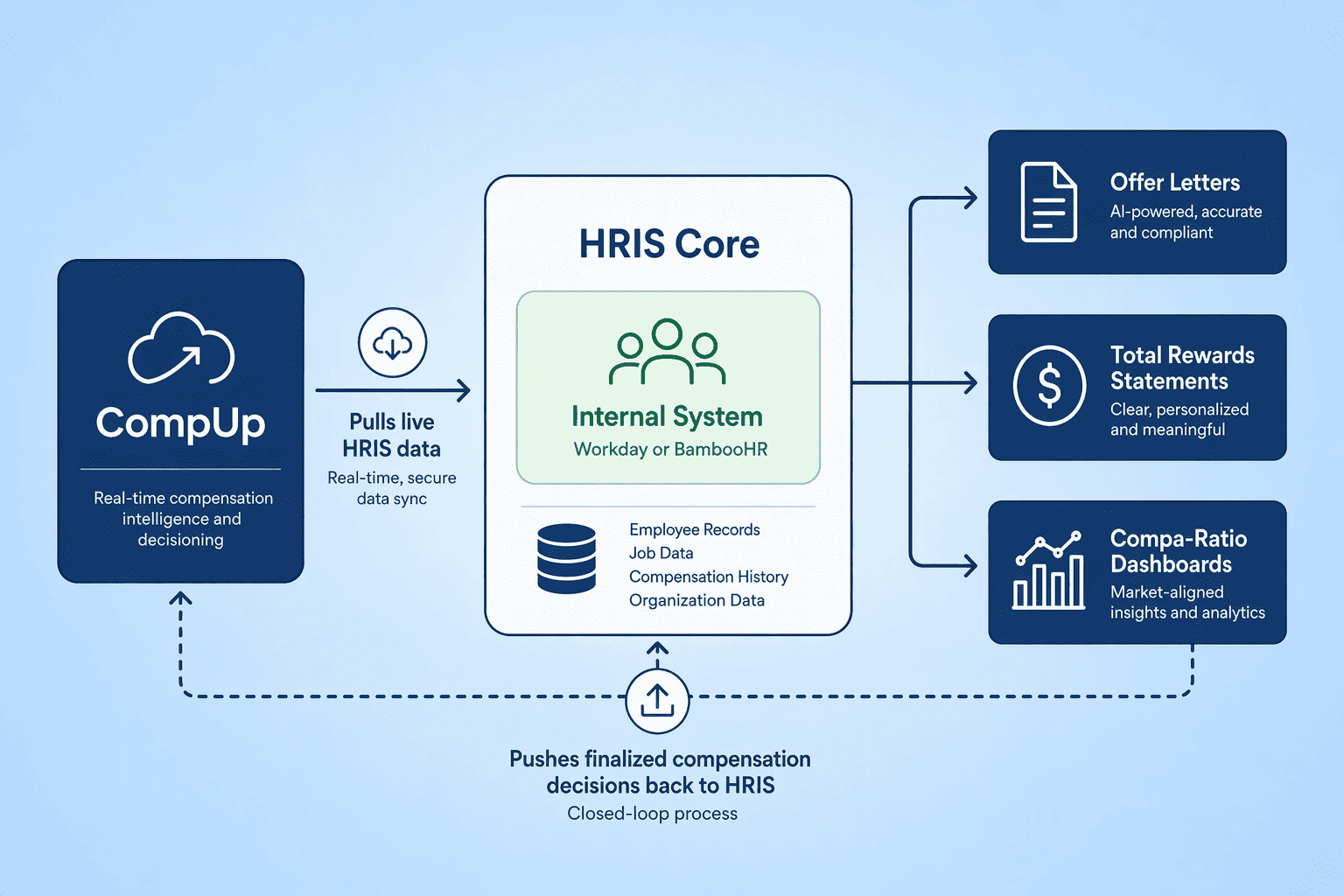
CompUp layers compensation communication and transparency workflows on top of your existing Workday or BambooHR instance via pre-built connectors. It does not require a core system replacement. The platform pulls live HRIS data into offer letters, total rewards statements, and compa-ratio dashboards, then pushes finalized decisions back into your system of record. For organizations where the HRIS is non-negotiable but the communication layer is broken, CompUp fills the gap with precision.
Suggested Read: Guide to Pay Raise Calculation and Equity Compliance in the US
beqom is the enterprise compensation platform that treats Workday and BambooHR integration as a first-class architectural decision, not a bolt-on. Its native-grade connectors are mapped to handle the compensation complexity that breaks lighter integrations: multi-currency STIP and LTIP plans, country-specific pay equity anonymization rules, and granular SLA configurations per jurisdiction. For a multinational organization running compensation cycles across 15 countries with different regulatory clocks, beqom removes the manual orchestration layer that consumes weeks of every cycle.
The platform's compensation logic handles base salary, bonus, STIP, LTIP, and equity awards with country-specific configuration depth. A plan manager in Germany can set anonymization thresholds that differ from the rules applied in Brazil, and beqom enforces both without requiring custom code per region. This depth is not academic. It is what keeps a pay equity filing in one country from creating a compliance exposure in another.
The architectural strength comes with a real-world timeline trade-off. beqom's average implementation time of approximately nine months reflects the configuration complexity of multi-country, multi-plan deployments. This is not a tool you spin up in a quarter. It is a platform you deploy as part of a structured enterprise transformation, with dedicated project resources and change management.
For organizations with 5,000+ employees, operations in five or more countries, and compensation plans that include both cash and equity components across jurisdictions, beqom is the right level of heavy. For a 500-person company running merit cycles in two countries, it is overbuilt. The fit is precise, and misapplying it burns budget and timeline.
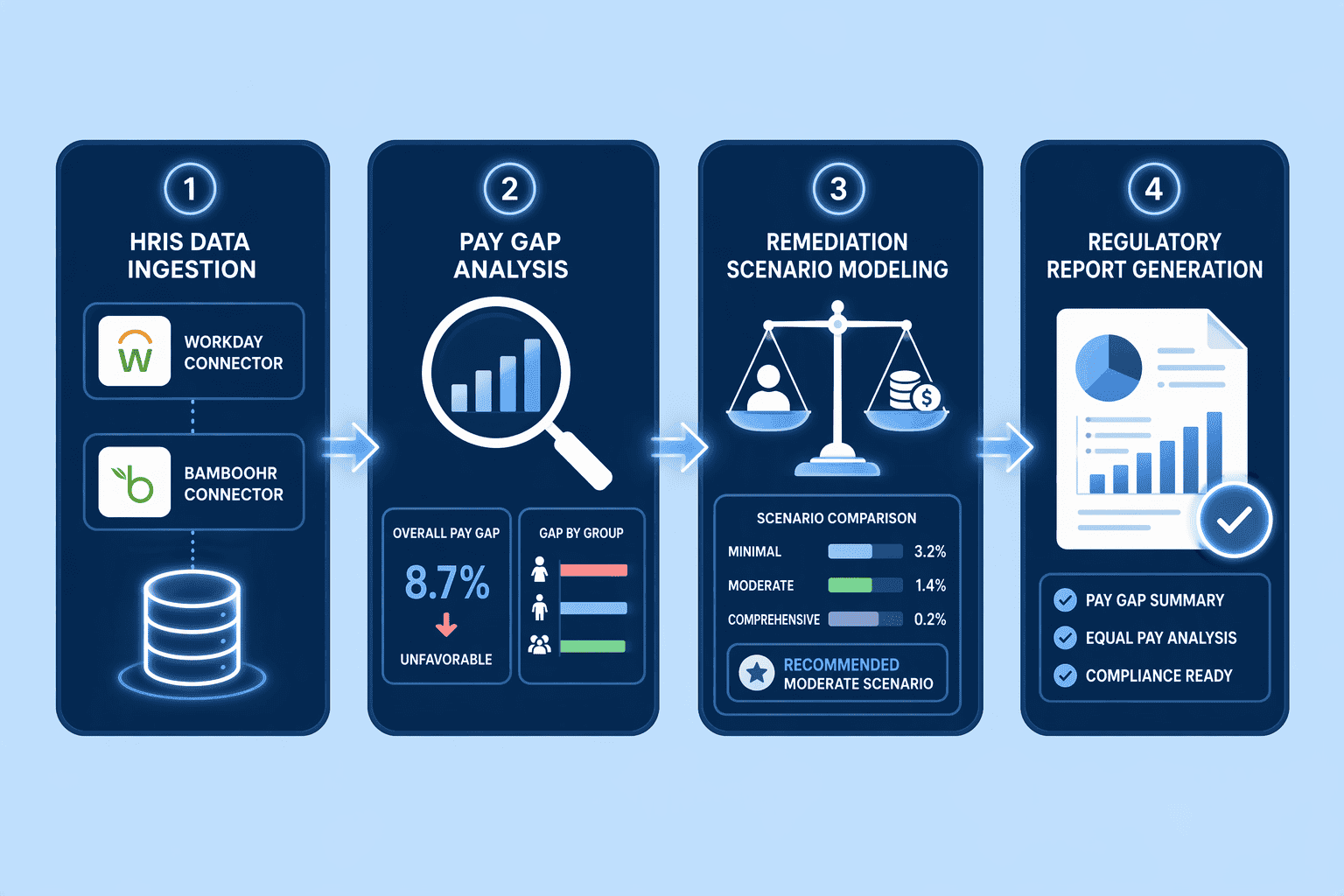
CompAnalyst automates the pay equity workflow that most compensation teams still run in spreadsheets: pulling live HRIS compensation data, surfacing statistically significant pay gaps, modeling remediation scenarios, and generating the regulatory reports that state pay transparency laws now demand. Its pre-built Workday and BambooHR connectors come with field mappings already configured for compensation data structures, which cuts the integration setup from weeks to days for teams on standard HRIS configurations. The platform ingests job architecture, tenure, performance ratings, and base pay directly from the HRIS, then runs regression analyses that flag pay gaps by gender, race, and other protected categories.
CompAnalyst produces the statistical output that outside counsel can review before you file. For organizations in jurisdictions with pay transparency mandates, that distinction matters. You get regression results structured for legal review, not another demographic heatmap that stops at surface-level disparity counts.
The modeling engine lets you test remediation budgets before you commit dollars. Adjust a group's base pay, see the ripple effect across compa-ratios and aggregate cost, and compare scenarios side by side. For comp teams that need to show leadership exactly what fixing a gap costs, this capability replaces the back-and-forth of offline model rebuilds.
CompLogix earns the highest aggregate satisfaction rating on this list because it solves the problem mid-market compensation teams name first: "I do not want to self-implement and then get handed a knowledge base article." The platform pairs a configurable compensation engine with a human-layered support architecture that does not scale back as you go live.
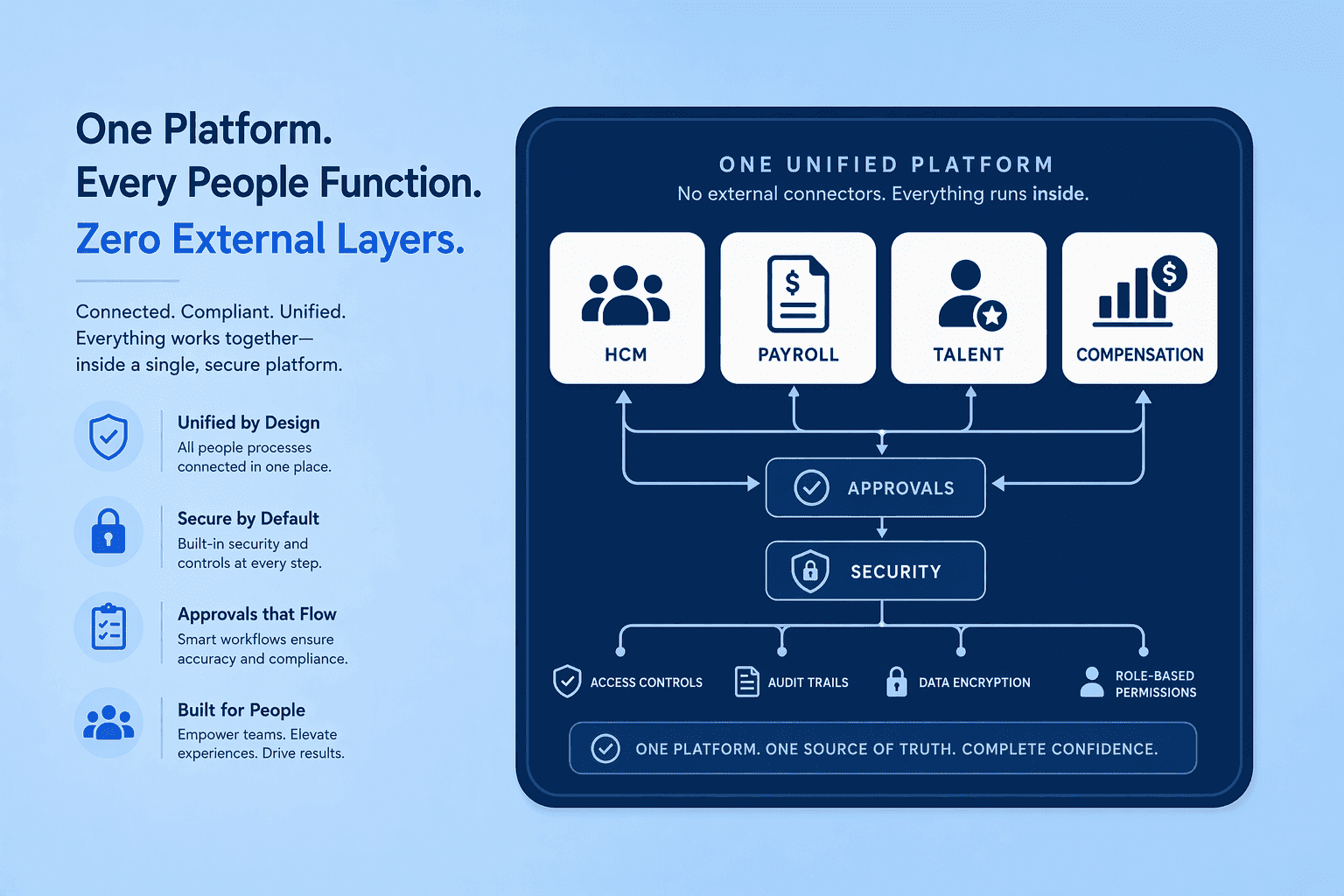
Workday's own compensation module delivers an obvious benefit: zero data latency, a single security model, and a unified UX that no third-party tool can fully replicate. When user access, compensation bands, and approval chains all live inside one system, the integration risk that dominates this article disappears. For an organization already running Workday HCM, Payroll, and Talent, adding Workday Compensation eliminates the connector layer entirely.
The trade-off surfaces when you need to configure anything outside the standard path. Here is how the native advantage breaks down against the flexibility cost:
| Dimension | Workday Compensation | Third-Party Comp Platforms |
|---|---|---|
| Data latency | Zero; single system | Dependent on connector architecture and sync frequency |
| Security model | Unified with HCM | Separate credential and audit management required |
| Configuration flexibility | Requires certified partner or consultant for most changes; weeks-long turnaround | Admin-configurable; changes in minutes for many platforms |
| Complex merit cycles | Consistently falls short for multi-country, equity-heavy programs | Purpose-built platforms handle STIP, LTIP, and equity natively |
| Pricing | Negotiated as part of HCM contract; not publicly listed | Ranges from $3/employee/year to custom enterprise pricing |
| Advanced features | Requires separately licensed Advanced Compensation add-on | Core feature set often includes advanced planning without separate upsells |
Consultant dependency ranks among the top three recurring complaints from enterprise HR administrators, with users citing weeks-long turnaround times for changes that dedicated compensation platforms allow admins to make directly. If your organization is fully committed to the Workday ecosystem and your compensation complexity stays within the module's design envelope, the native fit is hard to beat. If your merit cycles involve multi-country equity grants or complex STIP formulas, the configuration friction will accumulate quarterly.
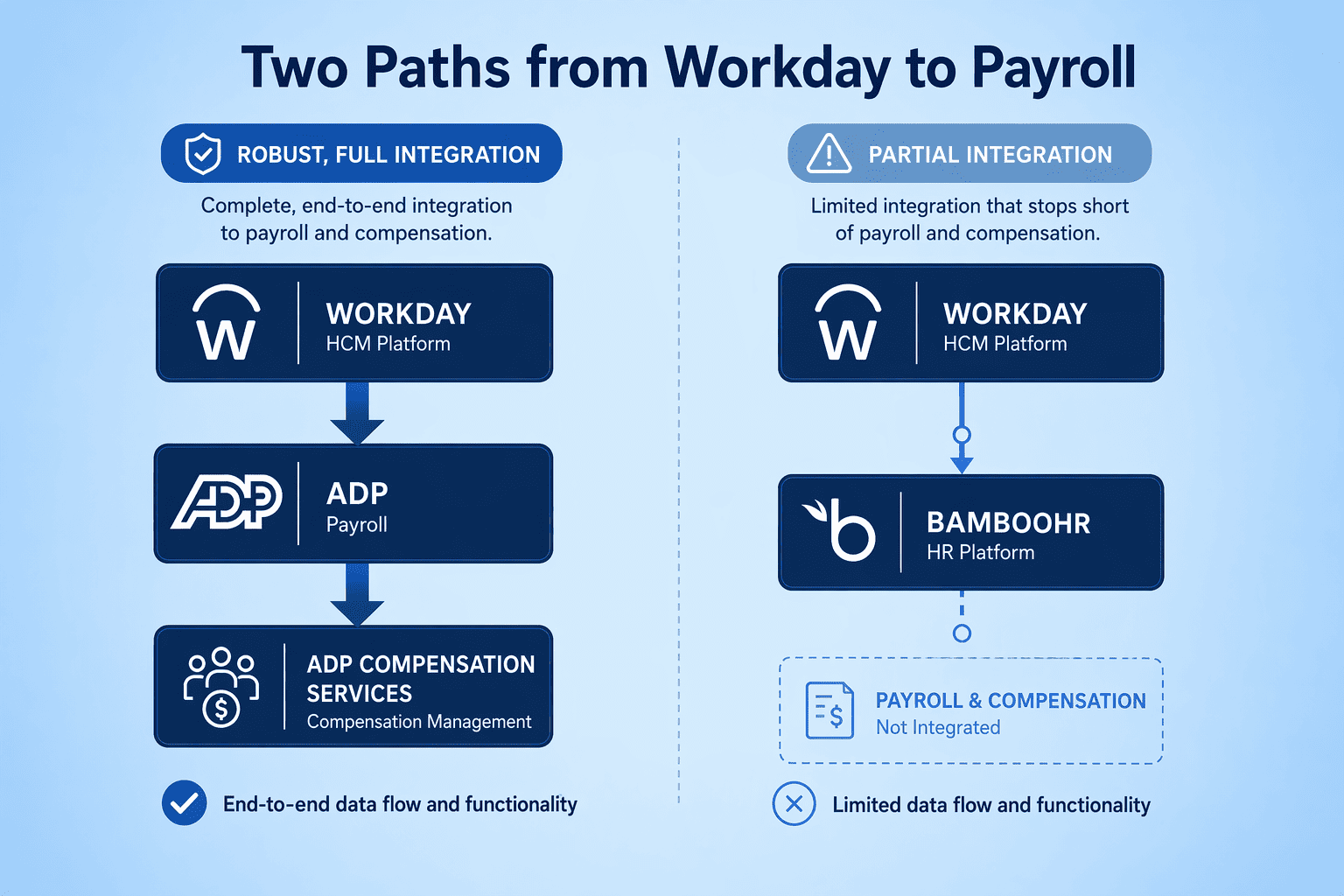
ADP Comprehensive Services is the payroll giant that compensation buyers consider because it is already in the building. When your payroll runs through ADP, extending that relationship into compensation planning feels sensible. ADP offers compensation planning and pay equity modules, and the Workday-to-ADP integration path is well-trodden enough that many enterprise teams have already mapped it. For organizations running Workday as the HRIS and ADP as the payroll engine, the data flow is functional, if not elegant.
The problem emerges when BambooHR enters the picture. BambooHR and ADP lack native compensation data integration. You need a middleware connector or custom API work, and that introduces sync delays between your HRIS records and your payroll system's compensation calculations. During a live merit cycle, where managers are submitting adjustments daily and finance expects current figures, even a 24-hour sync lag between BambooHR and ADP creates reconciliation work that compensation teams absorb manually.
ADP's compensation planning depth shows a similar fragility. The platform covers base salary and bonus planning competently. It thins out on multi-country equity administration, granular pay equity analytics, and the kind of statistical reporting that state-level pay transparency filings demand. ADP can house the data, but it does not produce the regression outputs that a platform like CompAnalyst generates as a standard workflow.
Mapping errors become the hidden cost over time. When HRIS and compensation fields do not align perfectly, job codes, grade bands, currency conversions, your compensation team carries the manual correction burden during the tightest window of the annual cycle. For organizations that run ADP for payroll and want to keep compensation planning inside the same vendor relationship, the Workday integration lift is manageable. The BambooHR gap is real enough to require a dedicated connector evaluation before you commit.
SAP SuccessFactors Compensation is the logical default for organizations that already run SAP as their ERP backbone. The integration between SuccessFactors HCM and the compensation module is native in the same way Workday's is: zero latency, shared security, one vendor relationship.
The path to Workday and BambooHR is where the viability thins. There is no pre-built, SAP-maintained connector that maps SuccessFactors Compensation to a Workday or BambooHR HRIS. Organizations running this hybrid architecture, SAP for comp planning, Workday or BambooHR for HCM, build and maintain custom integration layers. That means API work, field mapping ownership, and ongoing sync monitoring that falls entirely on internal IT or a contracted integration partner.
Compliance capabilities inside SuccessFactors Compensation are strong for SAP-centric enterprises. The platform supports multi-country regulatory frameworks, including the granular pay reporting that European and increasingly North American jurisdictions demand. For a global manufacturer already running SAP S/4HANA with SuccessFactors layered on top, the compliance continuity argument is real and defensible. SuccessFactors can model pay equity scenarios across dozens of countries within the same environment where payroll runs.
The realistic use case is narrow but valid: enterprises with SAP as the ERP, SuccessFactors as the HCM, and no appetite for introducing a separate compensation platform requiring external HRIS connectors. For these organizations, SuccessFactors Compensation is the cleanest path. For any organization whose HRIS sits on Workday or BambooHR, the custom integration overhead pushes SuccessFactors out of the top tier, not because the compensation engine is weak, but because the connection to the source data is the entire game.
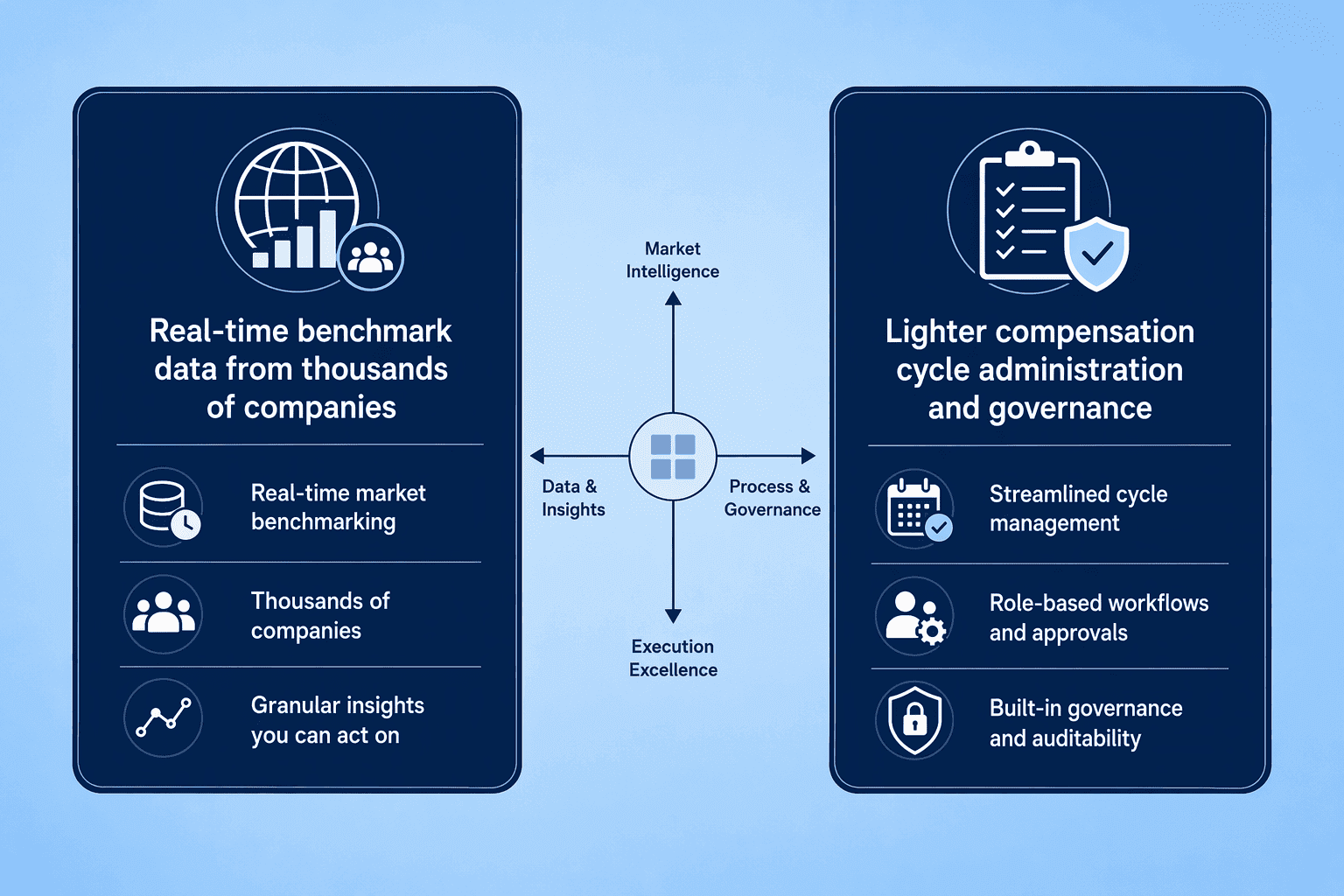
Pave wins on market data freshness. The platform pulls real-time benchmarking data from 8,700+ companies, updated via live HRIS integrations, with a data set that is strongest for tech and growth-stage roles where offer packages move weekly. When your compensation team needs to know whether a staff engineer band in Austin shifted in the last 30 days, Pave answers first.
The trade-off is governance depth. Pave handles base salary and equity benchmarking with precision, but it offers lighter formal cycle management than CompLogix or beqom, and less on the multi-country STIP, LTIP, and compliance reporting capabilities that enterprise buyers require.
A side-by-side decision matrix that lines up every platform against the dimensions compensation buyers cite as deal-breakers.
The table below does not capture every nuance, implementation timelines vary by scope, and pricing is often negotiated, but it gives you a filterable view of which platforms align with your HRIS footprint, pay equity maturity, and company size before you schedule the first demo.
A quarter-sync connector puts your audit at risk. A native connector gives you infrastructure you can defend to a regulator.
| Platform | Integration with Workday | Integration with BambooHR | Pay Equity Depth | Ideal Company Size | Support Model | Pricing Tier |
|---|---|---|---|---|---|---|
| CompUp | Pre-built connector | Pre-built connector | Real-time compa-ratio tracking, compliance automation | 200 to 5,000 employees | Self-service with dedicated support escalation | Starts at $3/employee/year |
| beqom | Native-grade connector | Native-grade connector | Country-specific anonymization, multi-currency pay equity | 5,000+ employees, multinational | Enterprise-grade with implementation partner | Custom enterprise pricing |
| CompAnalyst | Pre-built, field-mapped connector | Pre-built, field-mapped connector | Statistical regression, audit-ready regulatory reports | 1,000+ employees | Vendor implementation + ongoing support | Vendor-negotiated |
| CompLogix | Reliable pre-built integration | Reliable pre-built integration | Cycle-based equity checks within comp planning | 500 to 50,000+ employees | Dedicated account rep per client | Mid-market tiered pricing |
| Workday Compensation | Native; zero latency | Not applicable | Requires Advanced Compensation add-on for depth | Existing Workday HCM customers | Consultant-dependent for changes | Negotiated within HCM contract; not publicly listed |
| ADP Comprehensive Services | Functional via connector | Limited; middleware/API required | Basic pay equity modules | Payroll-first organizations | Payroll-support model | Payroll-bundle pricing |
| SAP SuccessFactors | Custom integration only | Custom integration only | Strong for SAP-centric multi-country compliance | SAP ERP customers | SAP partner ecosystem | Custom enterprise pricing |
| Pave | Live HRIS integration for benchmarking | Live HRIS integration for benchmarking | Light; not a full pay equity audit platform | 200 to 2,000 employees, tech-heavy | Self-service with benchmarking support | Per-employee SaaS pricing |
The best compensation platform for your organization depends on two variables that are already fixed: which HRIS you run, and how many countries your compensation plans span. For large multinationals on Workday, beqom's native connectors and multi-country compliance depth justify the nine-month implementation. Mid-market teams on BambooHR get the highest satisfaction return from CompLogix's dedicated support model and 4.9-star rating.
If pay equity audit readiness is the primary driver, CompAnalyst's pre-built statistical reporting cuts the path from raw HRIS data to defensible filing. Organizations fully committed to the Workday stack get zero-latency data flow from Workday Compensation but must budget for configuration overhead. And if real-time market benchmarking drives your comp decisions more than formal cycle governance, Pave's 8,700+ company data set updates faster than any alternative.
The common thread across every top pick: prioritize real-time data syncing and a dedicated support architecture. A compensation platform with a weak connector becomes an expensive reconciliation exercise. If you're weighing options, CompUp is worth a closer look.
beqom provides the deepest native-grade connectors for both Workday and BambooHR, purpose-built for multi-country compensation complexity. CompAnalyst by Salary.com and CompUp offer pre-built, field-mapped connectors that pull live data without custom API work. Workday's own compensation module is native but locks you into the Workday ecosystem.
beqom leads on native connectivity and global compliance depth at custom enterprise pricing. CompUp starts at $3 per employee per year with pre-built connectors focused on pay transparency communications. ADP integrates functionally with Workday for payroll but requires middleware for BambooHR depth. SAP SuccessFactors only connects natively to SuccessFactors HCM, requiring custom builds for Workday or BambooHR.
Prioritize pre-built connectors with field-mapped integrations, not generic APIs that require custom mapping. Look for real-time or near-real-time sync frequency, not scheduled batch pulls. Verify that the platform handles your specific HRIS data structures, job architecture, grade bands, currency fields, without manual translation. Downloadable connector documentation is a stronger signal than a demo slide deck.
Non-native connectors introduce sync delays that produce stale pay equity data, mapping errors from mismatched fields like job codes and currency conversions, and ongoing internal API maintenance costs. During a live merit cycle, even a 24-hour sync lag creates manual reconciliation work. Over time, mapping drift erodes audit readiness and multiplies the compliance exposure Deloitte flags for manual comp processes.
Live HRIS data feeds pull base pay, job architecture, tenure, and performance ratings directly into the compensation platform. The platform runs regression analyses to surface statistically significant pay gaps by gender, race, and other protected categories, modeling remediation costs before generating audit-ready regulatory reports. CompAnalyst, beqom, and CompUp automate this from data ingest to report generation without the spreadsheet export-import loop.
In 2026, best practices center on real-time HRIS data syncing, automated pay equity audits with statistical rigor, and pay transparency readiness across multiple state-level mandates. Organizations should move away from quarterly manual compensation reviews toward platforms that surface pay gaps continuously and produce the regression outputs that regulatory filings require. Dedicated vendor support during live cycles has become a standard expectation, not a premium add-on.
Community Manager (Marketing)
As a Community Manager, I’m passionate about fostering collaboration and knowledge sharing among professionals in compensation management and total rewards. I develop engaging content that simplifies complex topics, empowering others to excel and aim to drive collective growth through insight and connection.
Revolutionizing Pay Strategies: Don't Miss Our Latest Blogs on Compensation Benchmarking