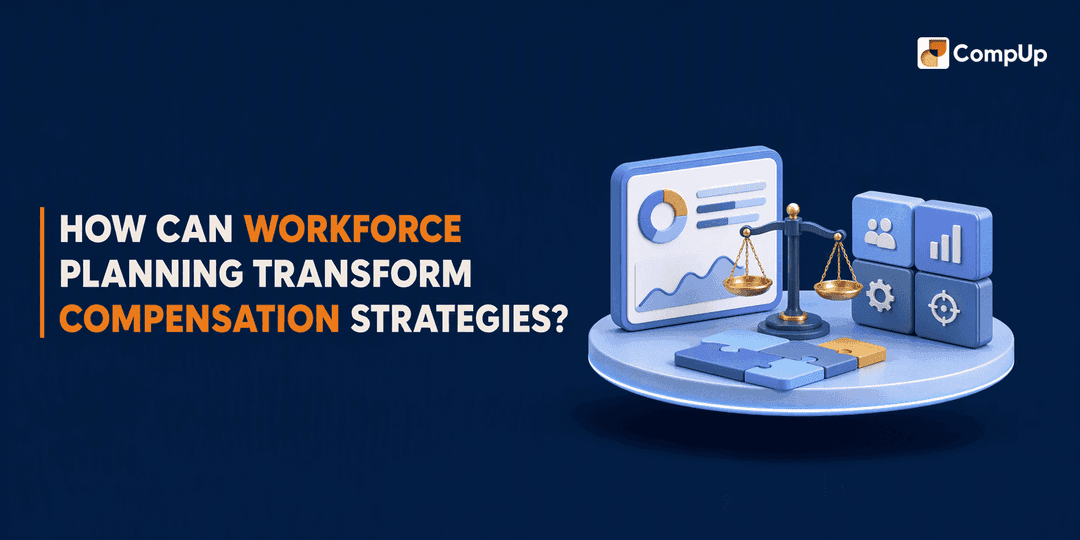

Your Q3 hiring plan just landed on the CFO's desk. Headcount is approved. Salary bands are locked. Yet within days, a critical skills gap opens in your data science unit, and market rates have already moved past your spring benchmarks. The static, annual plan you signed off on is operationally stale before the ink dries.
Traditional workforce planning separates strategy and finance from the real-time dynamics of skills and pay. Leaders set a top-down budget, and finance forecasts the headcount. In an environment of constant uncertainty, traditional workforce planning may no longer be enough. This fragmented approach leaves the business exposed to attrition risk and cost overruns that no static spreadsheet can predict.
The pressure is quantifiable. 98% of HR leaders report that their organisation faces significant skills shortages, with the potential to derail business transformation. The market has shifted. True competitive advantage will likely lie in an organization's ability to flex human capacity and capabilities in real time: moving the right people and skills to the right work faster.
This shift demands a new software category: the all-in-one workforce and compensation planning platform. These systems unify headcount, skills-based modeling, and compensation benchmarking into a single, continuous data loop. Instead of an annual PowerPoint exercise, planning becomes a live, collaborative model connecting the CHRO's people strategy to the CFO's financial ledger. This article breaks down the seven platforms driving the change in 2026, from AI-native disruptors to enterprise-scale HCM suites.
The decisive differentiator in 2026 isn't just a feature set; it's how tightly a platform connects workforce cost to business outcomes without locking you into a rigid vendor footprint. Here are the critical findings for building your shortlist:
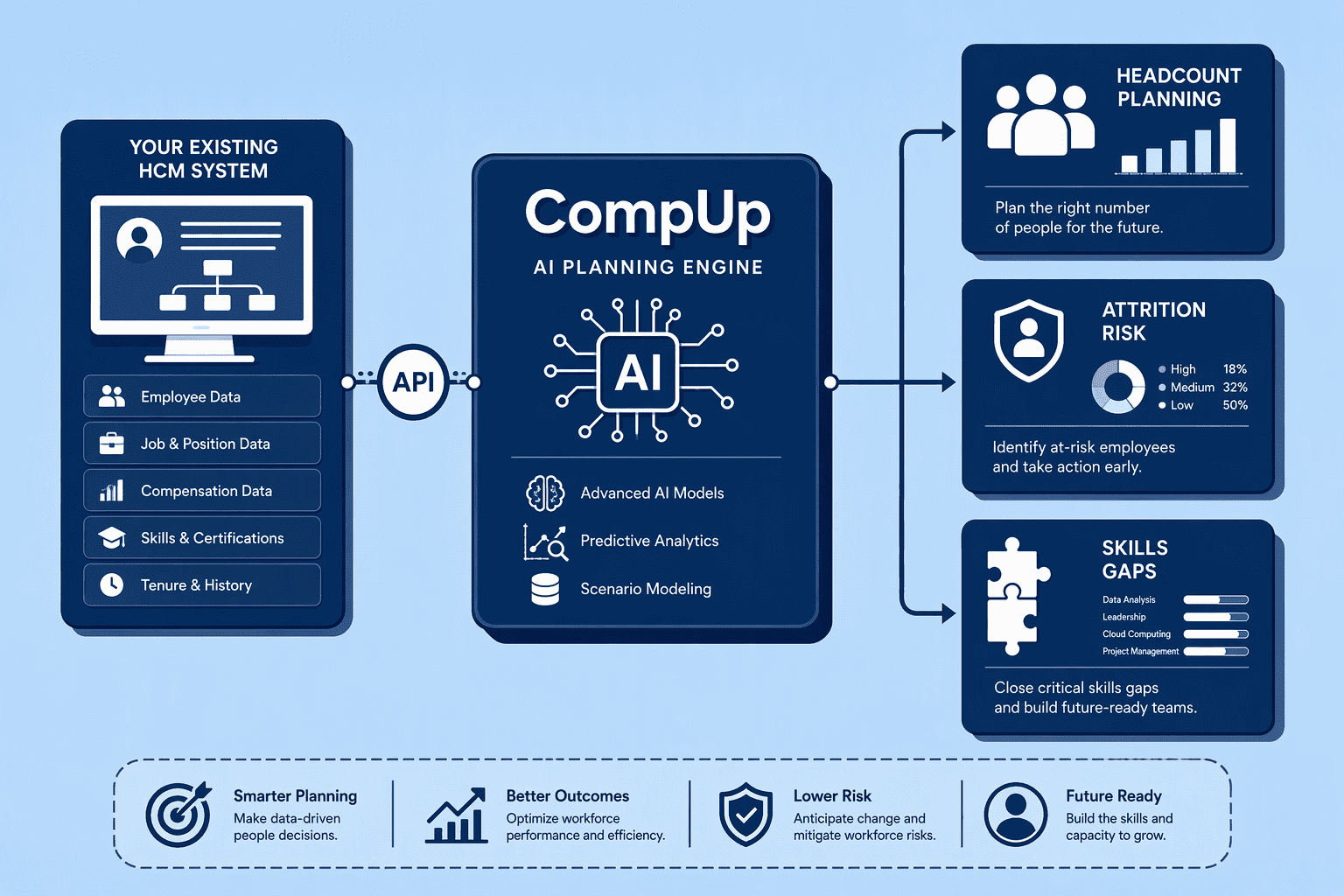
CompUp charges a flat $3 per employee per year and connects to your existing HCM through APIs, no rip-and-replace required. Finance and HR teams use it to run AI-driven scenario models on headcount, attrition risk, and skills gaps without touching the core system they already run payroll through.
It addresses a specific, expensive problem. Deloitte frames it plainly: organizations need to flex human capacity in real time, not against a static annual plan. Most installed HCM suites can't do that. CompUp layers on top of what you have, reads the live data, and lets you run supply-demand what-ifs without a multi-year ERP project.
The platform covers three workflows that HR, Finance, and Talent Acquisition actually share: headcount planning, role-level demand forecasting, and annual manpower budgeting. Inside those workflows, you get AI-powered attrition risk signals, not a separate dashboard buried in an analytics module, but surfaced in the same place where you're making decisions about who to hire and when.
CompUp (YC S22) is not a full HCM suite and does not pretend to be. For teams stuck with a legacy system that lacks modern planning intelligence, it fills the gap without requiring a migration. You keep your core HCM. CompUp adds the modeling layer on top, running talent gap simulations against current demands rather than last quarter's org chart.
Anaplan does one thing that almost no other workforce tool does well: it holds a live financial model of your entire global workforce and lets you change any assumption, in any country, and see the P&L ripple in real time. Most planning platforms stop at headcount aggregation and cost roll-ups. Anaplan's Hyperblock engine was built for the kind of multi-variable problem a finance team faces during a multinational restructuring, where severance rules differ across 40 jurisdictions and every headcount decision touches three cost centers.
That is the gap the following table maps out. It is not a feature checklist. It is a contrast in modeling philosophy: one platform designed to serve as the central FP&A nervous system, the other designed to bolt intelligent planning onto the HCM you already run.
| Dimension | Anaplan | CompUp (For Contrast) |
|---|---|---|
| Core Architecture | Hyperblock in-memory calculation engine for massive, multi-variable models. | API-first, AI-native planning core that sits atop existing HCM data. |
| Primary Use Case | M&A synergy modeling, complex global org restructuring, P&L-linked strategic plans. | Headcount planning, scenario modeling, and AI-driven attrition insights for growth-stage to mature enterprises. |
| Pricing Approach | Custom enterprise quote; costs are aligned to model complexity and scale. | Transparent $3/employee/year, reducing implementation surprise. |
| Deployment Model | A thorough, unified planning platform that can replace fragmented point solutions. | A standalone, agile skill that integrates without replacing the core HCM. |
If your use case is a multi-phase relocation that spans 18 months and you need to model the operational expenditure against country-level statutory costs, Anaplan is the answer. If your planning team already has dedicated model builders who live in the platform, the tool's depth stops being intimidating and becomes the reason you bought it.
For organizations where workforce strategy runs on the same spreadsheet as the corporate budget and a wrong formula can mean a seven-figure compliance miss, that cell-level precision is not a luxury. It is the minimum bar.
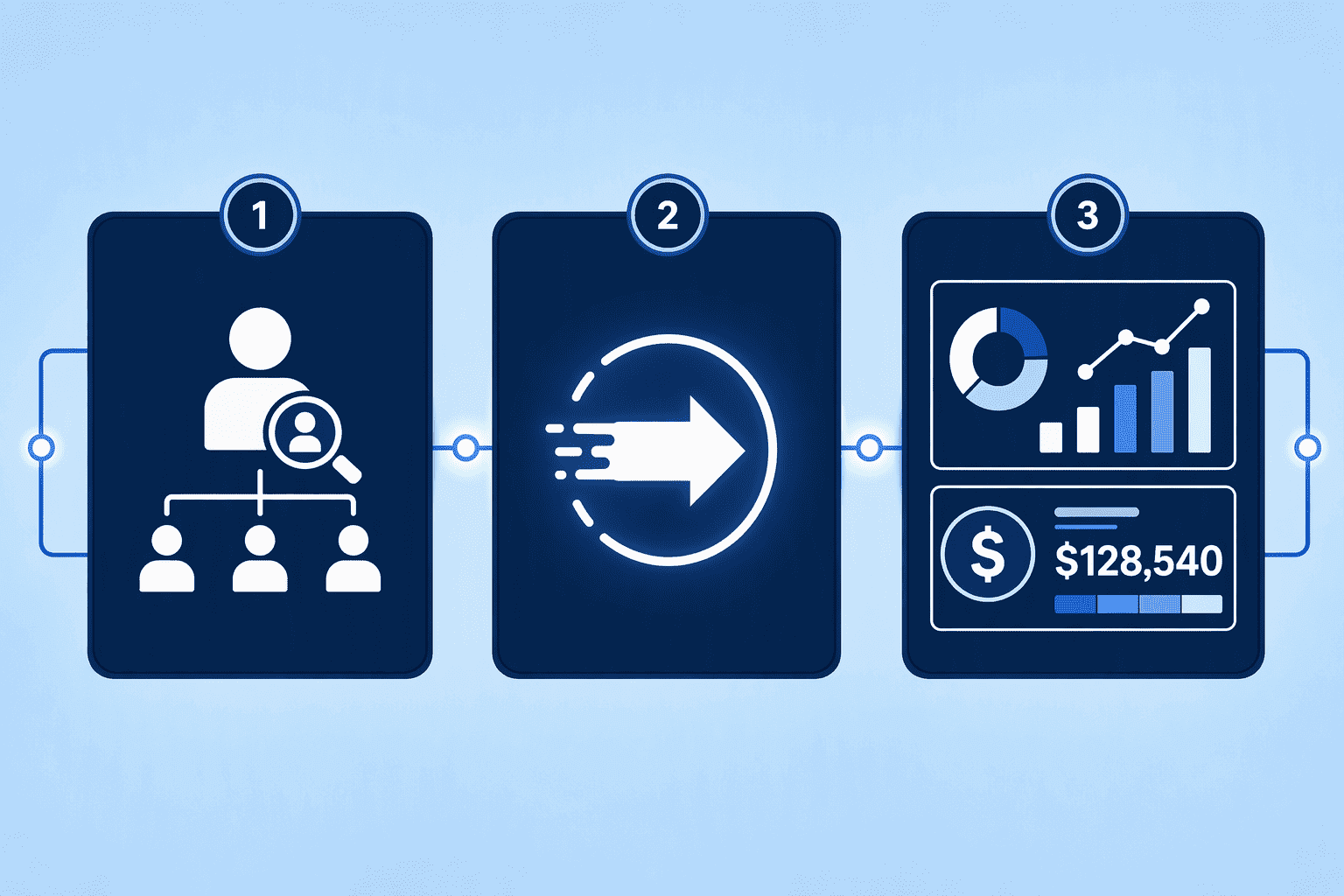
Workday Adaptive Planning eliminates the latent, blind-spot window between when a position is created in HR and when it hits the financial ledger. By uniting Workday HCM with its planning engine on a single data core, the platform gives the CHRO and CFO the ability to see fully burdened workforce costs in real time. This is the most operationally efficient path for companies already anchored in the Workday ecosystem.
The native integration means you stop planning positions in the abstract. You plan the specific financial consequence of backfilling an engineer or promoting a manager because the system continuously pulls updated compensation, benefits load, and location-specific tax data directly into the scenario model. This closes a dangerous compliance gap in workforce planning. Without this direct financial tie-in, a pay equity analysis during a growth push often remains disconnected from the actual budget. CompUp's own internal view on this mirrors the market: a quarter-sync connector represents a significant compliance risk when audit-ready pay equity data is needed instantly, not weeks after a cycle closes.
For a Workday customer, the implementation overhead is radically lower. You aren't re-extracting and transforming masses of HR data; you are activating a planning skin over a data set that already exists. This collapses the feedback loop between identifying attrition risk and modeling the financial case for counteroffers or retention bonuses.
The limitation is clear: you must be on, or be willing to move to, Workday HCM. Competitors without that pre-existing footprint face a steeper climb to achieve the same smooth, real-time cost-of-workforce visibility.
SAP SuccessFactors is engineering a path around the fundamental bottleneck of static job codes. For the global enterprise where job architecture sprawls across 50 countries and tens of thousands of roles, maintaining accurate supply-and-demand forecasts through titles alone is operationally broken. The skills ontology approach is the structural fix, and SAP’s platform is building directly into this transition.
The platform enables planners to map the current and future skills inventory across their global workforce, tagging employee capabilities in a centralized ontology rather than relying on job family approximations. This shift is not theoretical fluff. It is a direct, machine-actionable response to Mercer's finding that 98% of HR leaders face skills shortages potent enough to derail business plans.
When a pharmaceutical company plans a pivot into biologics, a role-based plan will hunt for 'Biologist III' positions and find nothing. A skills-based model in SuccessFactors will surface the seventeen research scientists across three divisions who already possess the relevant proteomics skills, immediately framing the internal retraining cost against the six-month external hire timeline. This is the new workforce intelligence standard, moving from jobs to skills to outcomes.
What elevates this further is the connection to compensation. As planners use the modeling tool to isolate 'hot skills,' they can run scenarios that price those skills competitively, linking directly into SAP's compensation frameworks. That integration reduces the friction of approving out-of-cycle pay adjustments to lock in critical talent before a competitor's bid lands.
For organizations where global scale has made the static role-based plan completely unmanageable, SAP SuccessFactors offers the foundational infrastructure to replace it with a dynamic, skill-fluid model. The upfront lift on skills taxonomy governance is substantial, but the planning fidelity it unlocks is impossible to achieve with legacy methods.
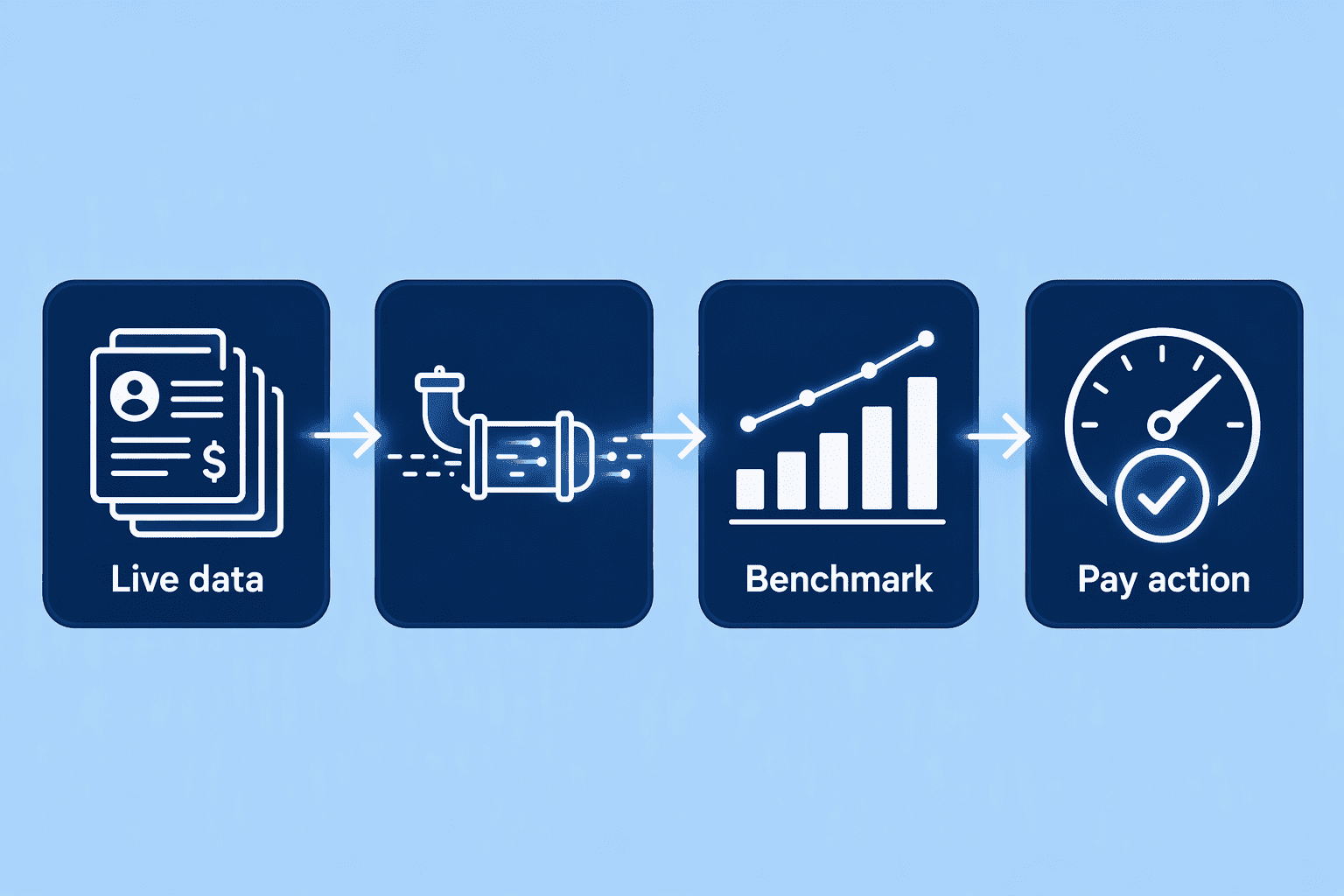
ADP Workforce Now anchors compensation planning in a dataset that no survey-based provider can replicate. Its real-time benchmarking draws power from a colossal, live payroll stream. Here is how the platform turns pay data into a competitive planning advantage, step by step:
ADP was also named a Leader in The Forrester Wave: Human Capital Management Solutions, Q4 2025 evaluation and carries a 4.4 out of 5 star rating on Capterra based on 7,228 reviews, signaling strong user adoption. This is the sole platform that removes survey lag as a planning variable entirely.
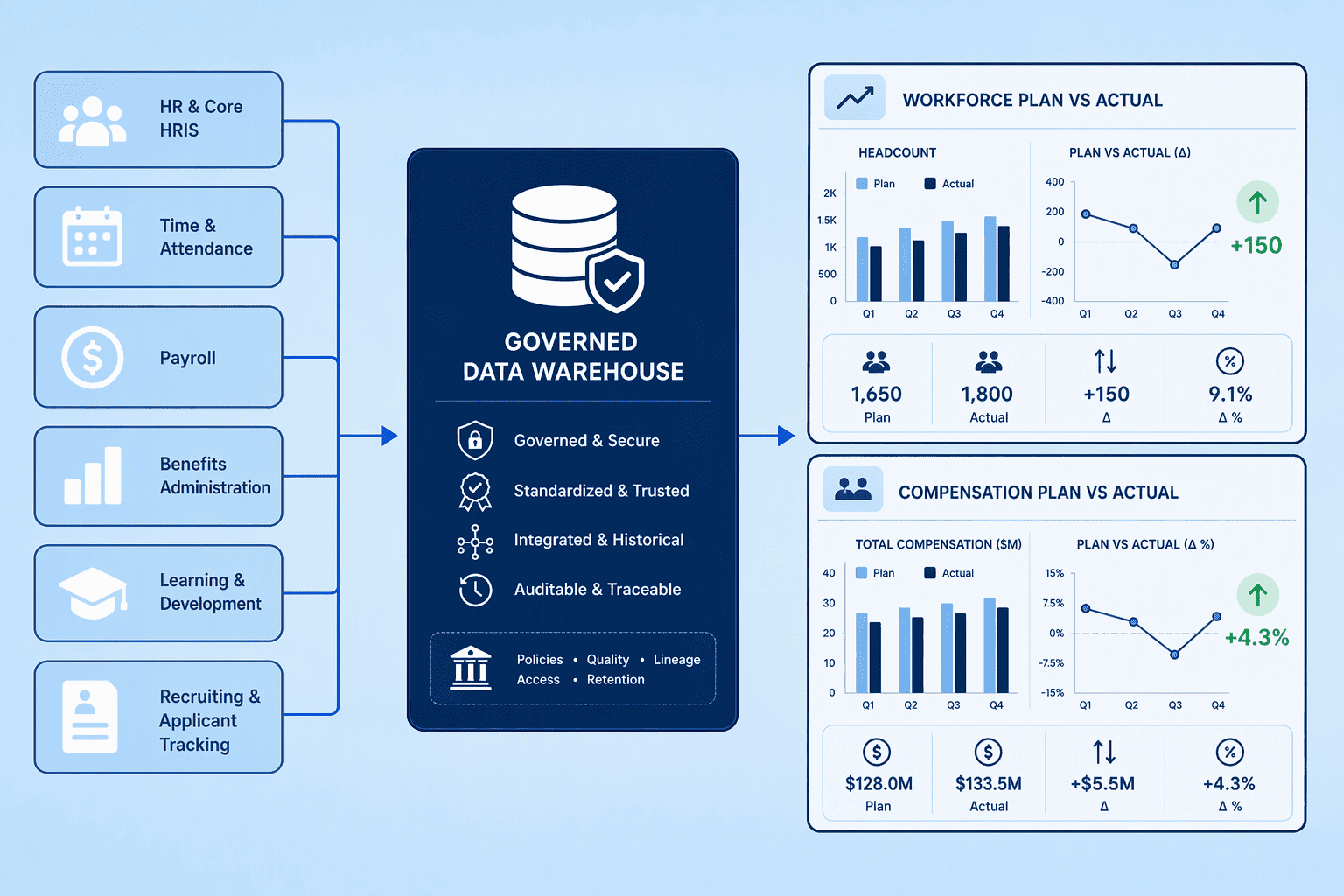
Mid-market analytics teams often hit a wall when their HRIS reporting layer can't do the heavy cross-source data extraction that precise plan-vs-actual tracking demands.
One Model was built for exactly that job. It pulls data from your disconnected HR systems, warehouses it, and gives you a clear governance layer you can actually audit.
For the mid-market, two things matter most. First, you can see exactly how every metric is built. Second, configurable dashboards track the precise gap between your approved headcount plan and reality, hiring, attrition, internal movement, so you know where the budget is slipping instead of discovering it at quarter-end.
One Model doesn't chase opaque AI predictions. It gives your analytics team a defensible methodology they can govern, update, and stand behind.
This is the solution for the Head of People Analytics who needs an explainable data model more than they need an attrition risk score from a black box.
Oracle Cloud HCM bakes machine learning into every employee record, producing an attrition probability that works like a live pulse reading for planners. The score shifts continuously as performance reviews come in, managers change, and behavior data accumulates, flagging the kind of regrettable turnover nobody wants to discover from a two-week notice.
The operational payoff lives inside compensation planning. A planner runs a what-if, applies a retention bonus pool to a critical engineering team, and watches the attrition risk scores recalibrate in real time. That comparison, doing nothing versus paying a targeted bonus, puts a price on people risk nobody could quantify before.
For large enterprises, the model builds a defensive budget case the CFO can actually see. Oracle's scenario engine lets Total Rewards teams walk into a planning meeting with platform-calculated flight risk numbers tied to forward revenue impact, not a hunch about who might be unhappy. Employee listening, attrition prediction, and financial readiness stop being separate functions and start behaving like one connected system.
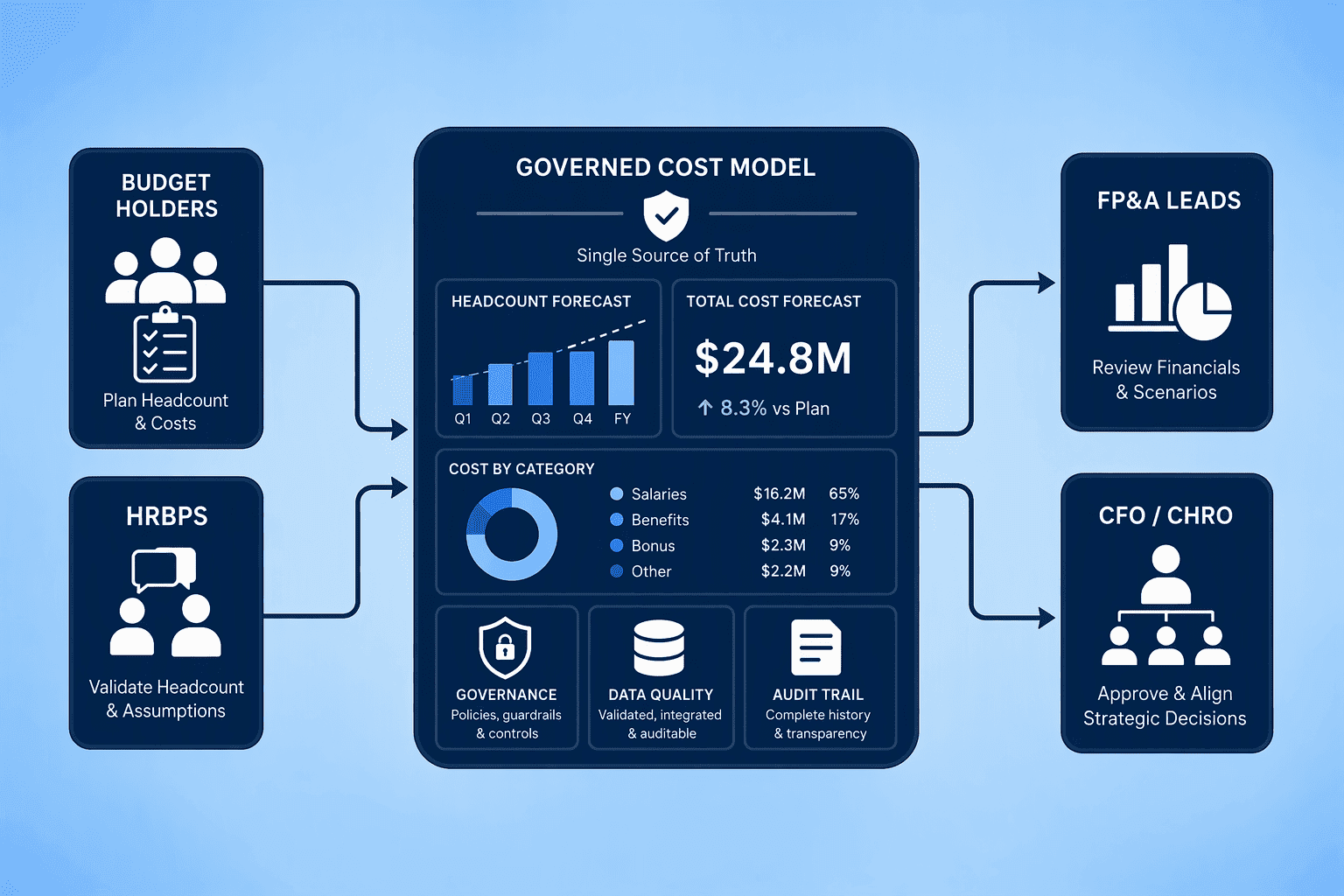
Visier refuses to hand the CHRO and CFO another dashboard they won't read. Instead, the platform delivers embedded workforce insights that power collaborative decision-making. The core idea is a pre-built analytical workflow that puts HR and Finance into a single, synchronized view of people cost. Rather than emailing a spreadsheet for headcount approval, budget holders, HRBPs, and FP&A leads all see the same fully burdened cost forecasts inside a governed application. They approve or reject a requisition against a shared reality.
This cleans up the chaotic bottom-up compensation planning crawl. Visier gives managers guardrails tied to the live budget and market benchmarks. It collects merit, bonus, and equity proposals in a governed environment and surfaces equity breaches before the plan is consolidated.
For the C-suite, the distance between strategy and execution collapses. The CFO doesn't wait for HR to manually verify the cost of a new location strategy because the collaborative interface already modeled it.
Visier treats workforce planning as a continuous business operation rather than an isolated HR exercise. That makes it the natural bridge for organizations where CHRO-CFO alignment is the primary bottleneck to growth.
Workforce planning in 2026 gives you a clear choice between two paths.
The first: stay inside a monolithic HCM stack like Workday or SAP SuccessFactors. If your company already runs on one of these, the natively unified cost visibility is genuinely hard to match outside that ecosystem. The integration work is done. The data model is shared. For firms anchored there, bolting on a separate planning tool often creates more friction than it fixes.
The second path is unbundling. It's the one most companies end up on.
Standalone tools like CompUp, at $3 per employee per year, bring scenario modeling, pay equity analysis, and attrition intelligence without asking you to replatform your entire HR stack. These tools plug into what you already use. The deciding factor is simple: if your legacy core can't support real-time, data-driven decisions, layer on something agile that can. The market has stopped waiting for the all-in-one suite to catch up. A good next step is seeing how CompUp puts this into practice.
It must unify several core capabilities into a single governed workflow:
The primary fault line is modular intelligence versus unified HCM. CompUp and Visier sit atop existing HCM data via APIs, prioritizing speed of deployment and pricing transparency. Workday, SAP, and Oracle embed planning directly into their enterprise HCM suites, trading platform agility for zero-latency data between position management and the general ledger.
Compensation management software focuses narrowly on merit cycle execution, pay structures, and equity compliance. A specialized workforce planning tool models skills gaps, headcount demand, and strategic org restructuring. CompUp separates these as distinct product categories, though an integrated platform continuously loops market compensation into the long-term workforce model.
Pricing varies from transparent per-employee-per-year rates, like CompUp's $3/employee/year model, to custom enterprise SaaS quotes based on headcount scale and deployment complexity for suites like Oracle Cloud HCM or SAP. Expect costs to reflect whether planning data relies on live integration or periodic file imports.
Companies report three key outcomes from adopting these platforms:
Community Manager (Marketing)
As a Community Manager, I’m passionate about fostering collaboration and knowledge sharing among professionals in compensation management and total rewards. I develop engaging content that simplifies complex topics, empowering others to excel and aim to drive collective growth through insight and connection.
Revolutionizing Pay Strategies: Don't Miss Our Latest Blogs on Compensation Benchmarking