
Your merit cycle closes, finance signs off, and the numbers land in the HRIS. Three weeks later a pay transparency disclosure deadline hits, and you realize your compensation planning data and your compliance data sit in two different systems that do not talk to each other. The reconciliation is manual, the risk of a misstatement is real, and the CFO wants the filing by Friday.
This tension is not hypothetical. The EU Pay Transparency Directive took effect in June 2026, and five U.S. states added new requirements in 2025. Organizations on both sides of the Atlantic now need software that handles merit cycles, bonus planning, and equity grants in the same environment that generates a defensible, audit-ready pay gap report.
Most platforms were built for one side of that equation. A few now do both. This article identifies the software that unifies compensation planning and pay transparency compliance in a single operating model so you can stop bolting compliance onto the end of a planning cycle.
The market has split into two paths: unified suites where planning and compliance live in one data model, and deep standalone equity engines that add precision but require integration work. Your 2026 choice hinges on how many disclosure jurisdictions you face and whether your HRIS already holds clean, job-leveled data.
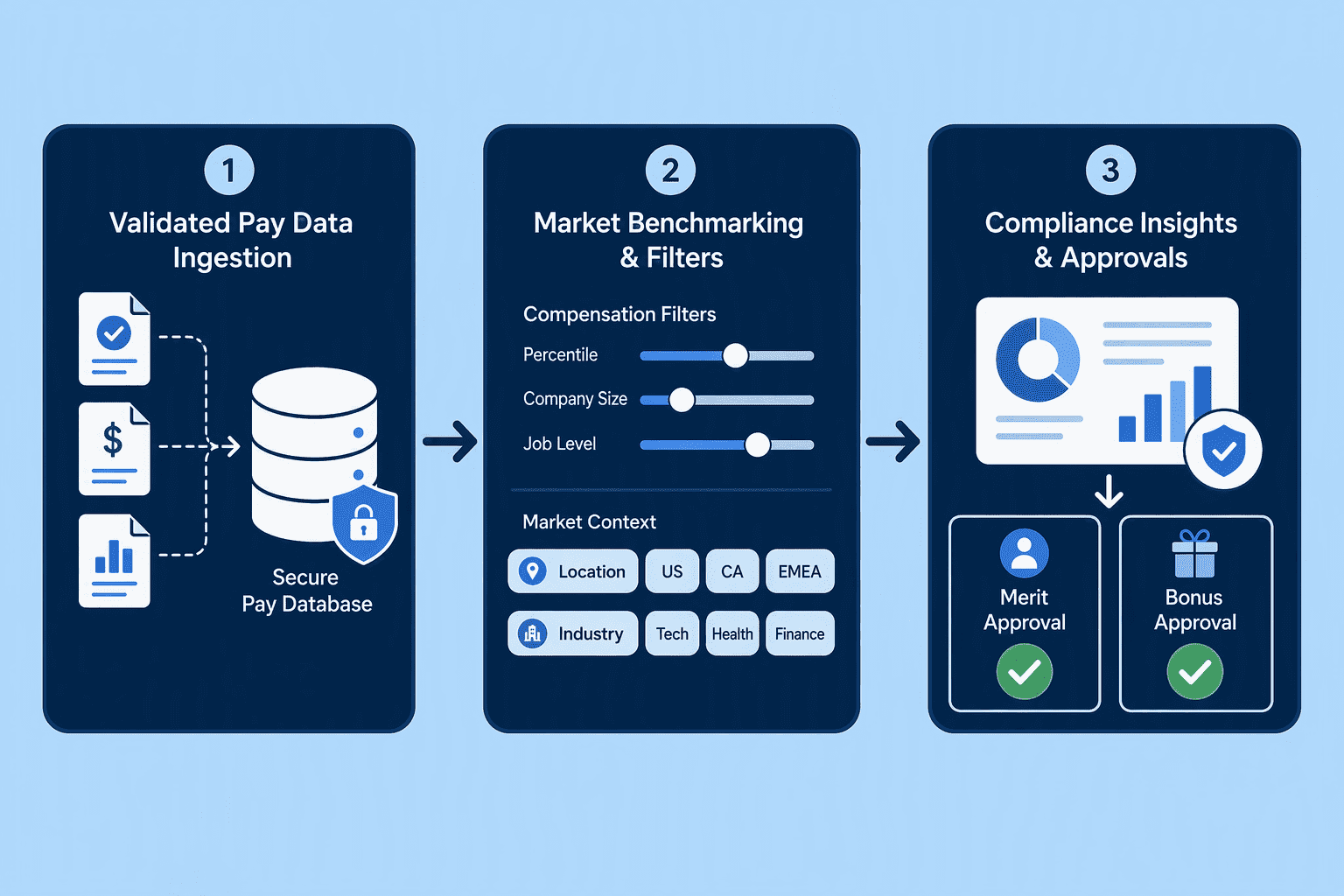
CompUp earns the top slot because it connects the full compensation planning cycle (merit, bonus, equity, and total rewards statements) with pay equity analysis and compliance dashboards in a single platform. For HR teams that currently run planning in spreadsheets or a standalone merit tool and then scramble to generate transparency reports from a separate system, CompUp collapses two workflows into one governed environment.
The platform automates merit planning, provides data-driven salary benchmarking, and generates personalized total rewards statements automatically at cycle close. Its pay equity analysis tools identify and help eliminate pay biases in compensation practices, feeding directly into the same dataset that powers planning. Integrations with BambooHR, Lattice, Darwinbox, and Workable mean the job architecture can pull from an existing HRIS without a full rip-and-replace.
CompUp reached 100+ clients by February 2023. It is not an enterprise HCM suite; it is a compensation-specialized platform built for this convergence of planning and transparency. You can compare multiple restructuring scenarios in parallel and model how a proposed merit budget affects your unadjusted pay gap before you lock the cycle, a capability spreadsheet-native teams simply do not have.
For large, multi-country employers, the depth of beqom's unified model sets the bar. The platform manages compensation, employee performance, sales performance, pay equity, and recognition in one environment, used by more than 5 million employees across the globe and trusted by more than 40 S&P 500 companies.
| Dimension | beqom PaySuite |
|---|---|
| Coverage model | Salary, bonus, long-term incentives, sales comp, and pay equity in one platform |
| Pay equity engine | Intentional AI models adjusted pay gaps and recommends remediation budgets without exposing individual data |
| Enterprise proof points | Allianz delivered pay parity across its global workforce of 100,000 employees; TotalEnergies unified compensation across 130 countries and 316 employee agreements |
| Implementation note | Deployments can take up to nine months |
beqom's 2023 acquisition of PayAnalytics, a world-leading pay equity platform that makes remediation recommendations through an analytical lens on hiring, promotion, and attrition, embedded deep statistical rigor directly into the compensation planning flow. PayAnalytics continues to be available as a standalone product as well as part of the beqom platform.
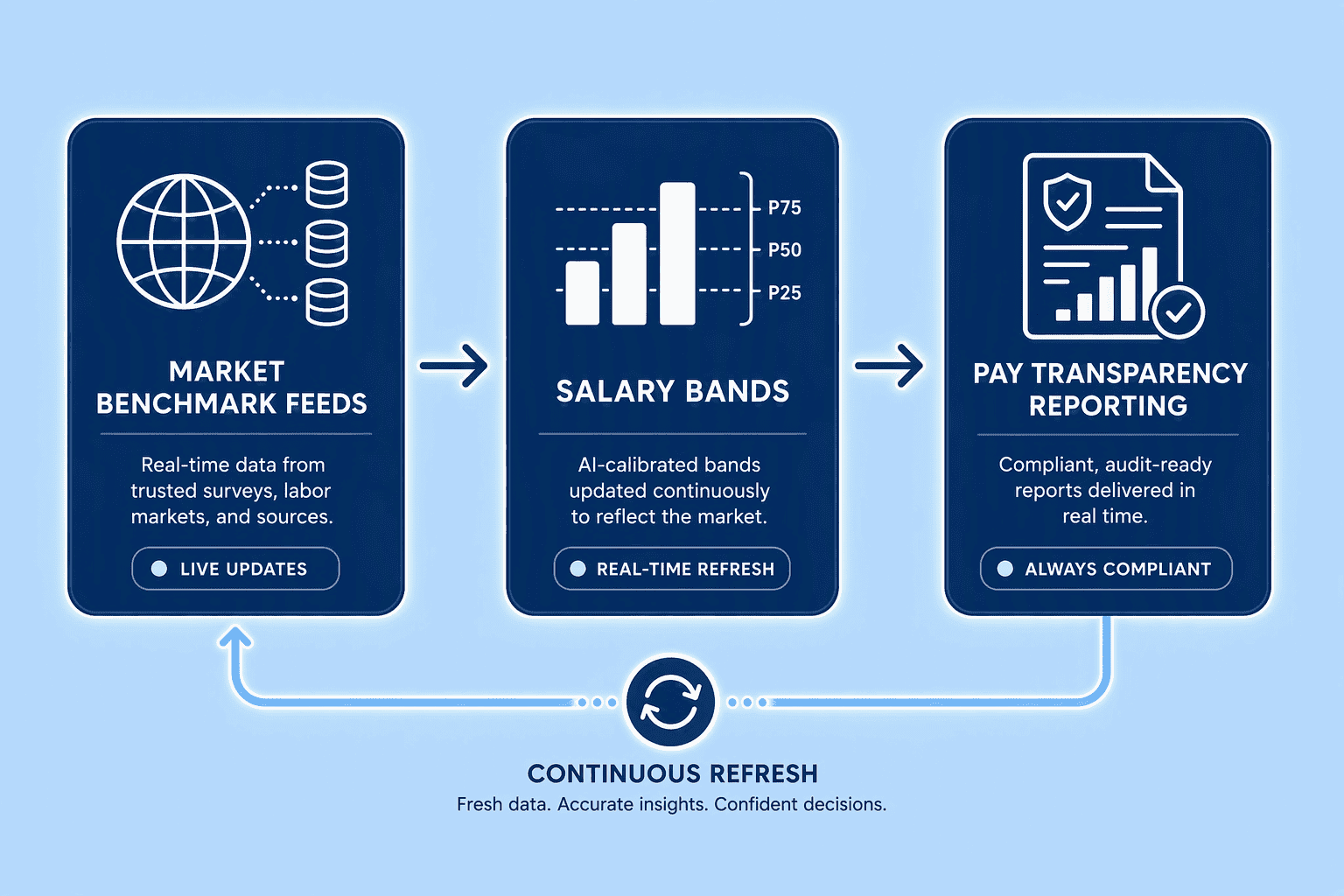
Ravio hangs its hat on freshness. Its compensation benchmark engine refreshes market data continuously, so the salary bands you build for a planning cycle reflect where the market is now, not where a survey said it was 18 months ago. That same pipeline feeds directly into Ravio's pay transparency reporting, connecting the market rationale to the compliance disclosure without a separate data export step.
Job architecture is where the onboarding approach matters. Ravio uses a team of data experts who map your roles and levels to a consistent architecture during onboarding, rather than relying only on AI to classify jobs. The manual step lowers the chance that a niche role gets misclassified. For a transparency strategy that leans on live market benchmarks when defending pay decisions to regulators and candidates, Ravio ties planning and compliance to a single, current external reference point.
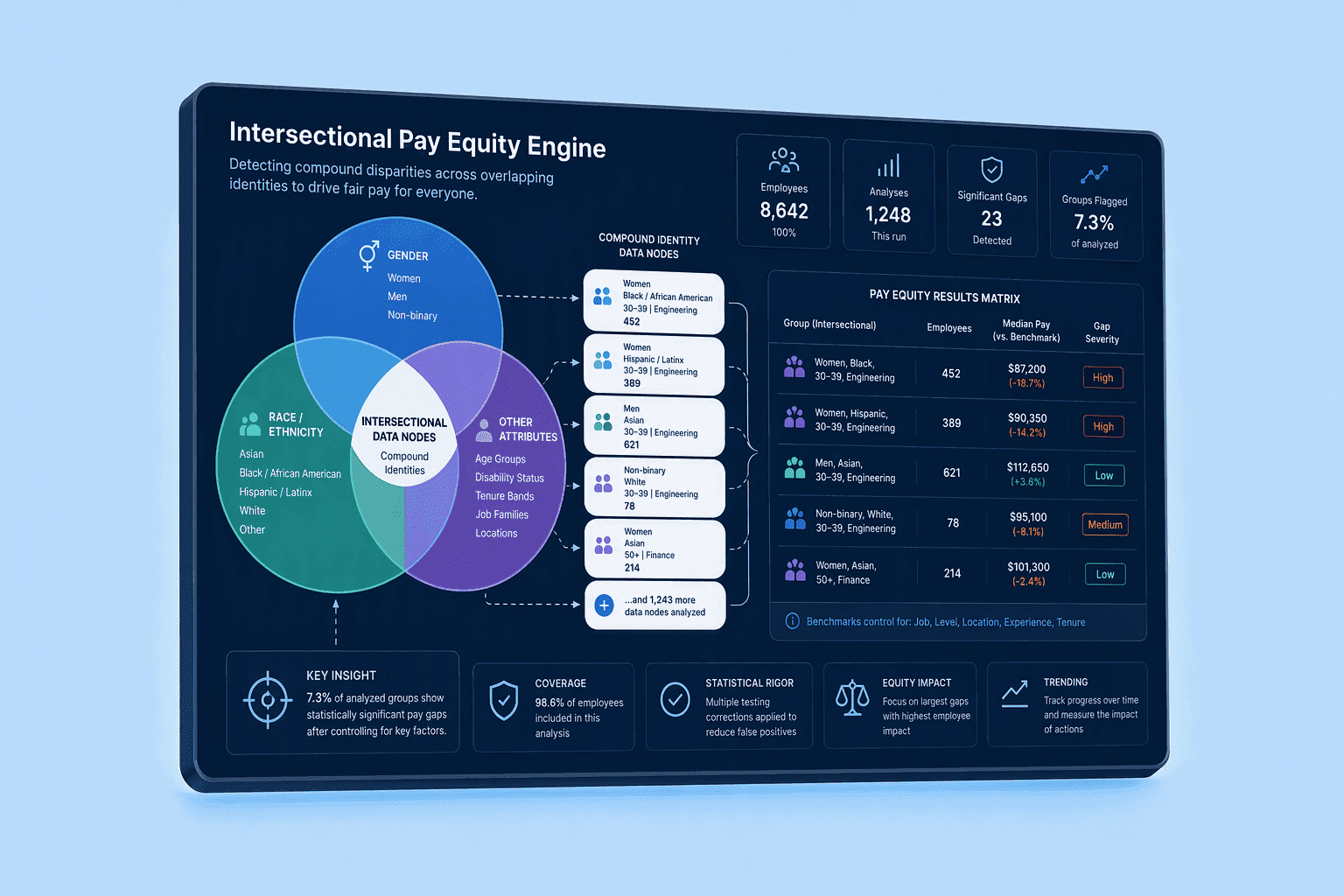
Syndio doesn't try to be your compensation planning system. It's a pay equity engine, plain and simple, built to run the kind of statistical modeling that regulators and courts actually expect.
The platform digs into pay gaps and intersectional equity patterns across multiple demographic dimensions simultaneously. Many broader suites report a single adjusted gap by gender. Syndio surfaces the compound disparities where gender, race, and other factors overlap. That depth is what separates it.
There's a manual cost to that specialization. A comp team running a merit cycle in one tool and equity analysis in Syndio has to shuttle data between the two. The planning happens in your core system.
The audit lives here. For a single annual review, that handoff is manageable. For quarterly or continuous cycles, it gets old fast.
This makes Syndio a natural complement, not a competitor, to an existing compensation platform. If your merit and bonus workflows are already well governed, adding Syndio on top gives you the defensible analysis those workflows lack. The integration points are there, but bidirectional data flow is not the default setting.
When does this fit? If your first transparency filing targets one jurisdiction and your HRIS data is clean, Syndio plus your current merit tool works. If 2026 brings disclosure deadlines across both the EU and US, the overhead of running two disconnected systems under tight timelines builds quickly.
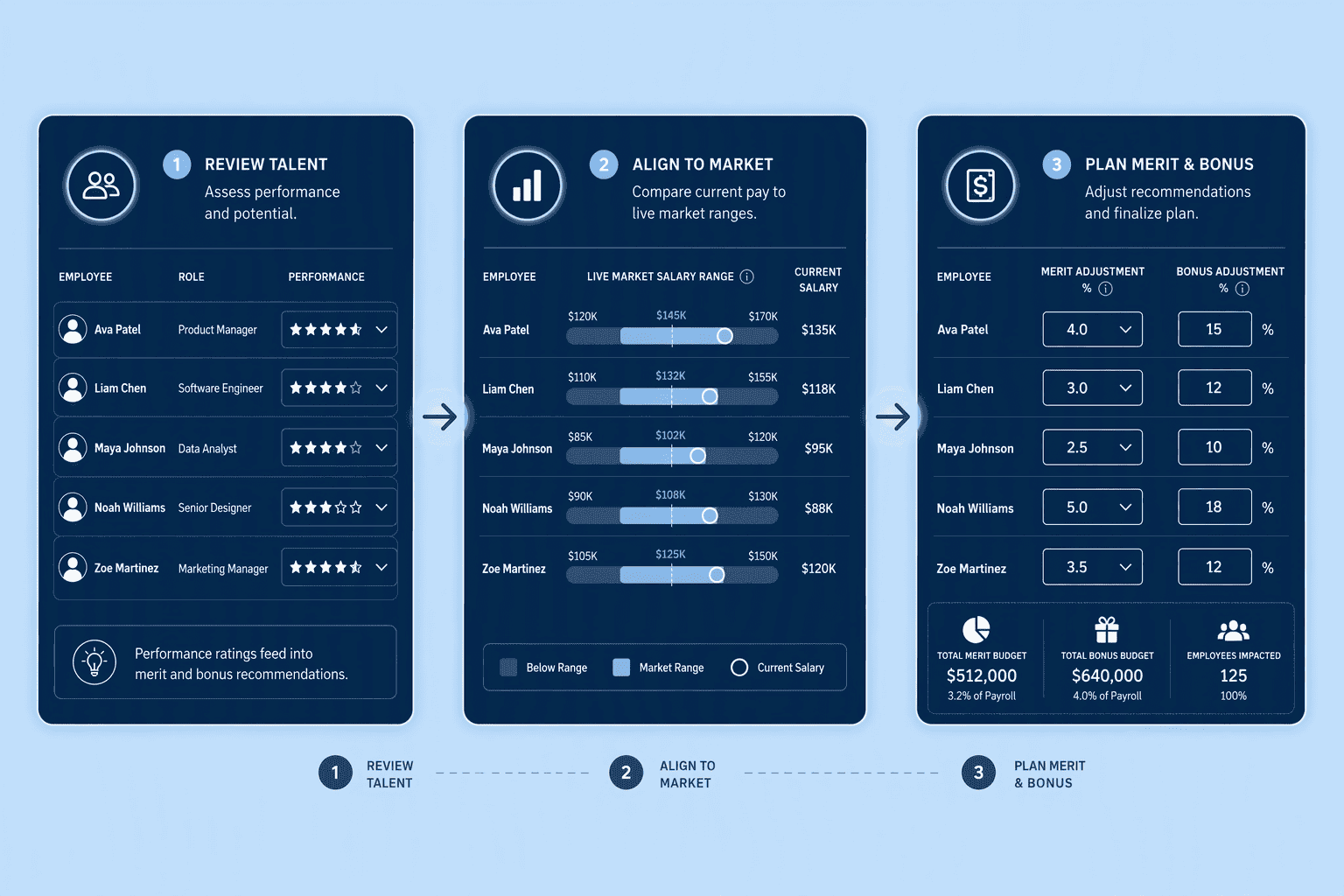
Pave has built its reputation on a modern, UX-forward merit and bonus planning experience paired with continuously updated compensation benchmarking. The platform benchmarks salary data from more than 8,000 companies to show current market salary ranges, which means comp planners can reference market position while moving through a merit cycle without toggling to an external survey tool.
That coupling of planning workflow and market data is what pay transparency regulations effectively require. When a candidate or a regulator asks why a salary band is set where it is, Pave gives you a market-based answer that ties directly to the planning decision. The platform's strength is execution-speed planning for tech-forward companies: clean approval flows, manager-friendly interfaces, and data that updates continuously.
Pave does not position itself as a dedicated pay equity compliance engine in the way beqom or Syndio do. Its transparency value comes from making market rationale inseparable from the planning act itself.
For a mid-market tech company with US state-level disclosure requirements and a fast merit cycle cadence, Pave covers the planning-and-benchmarking intersection well before you need a full statistical equity platform.
Payfactors is built for compensation teams that trust traditional salary surveys as their primary market data source. The platform manages survey data ingestion, market pricing, and pay range creation, and then feeds that structure directly into merit and budget planning workflows.
The underlying data asset is massive. Salary.com's CompAnalyst platform provides access to more than 800 million compensation data points across 22 countries. For an organization whose comp philosophy is anchored in survey benchmarks rather than real-time aggregate data, Payfactors connects that philosophy all the way through to the planning cycle and the documentation package.
Audit-ready reporting is the compliance bridge. Because the survey data, the market pricing methodology, and the resulting salary bands live inside one system, Payfactors can generate documentation that traces a pay decision back to its market source. That audit trail is what pay transparency filings demand.
Payfactors is less about pay gap statistical analysis and more about making the compensation structure itself defensible. A comp team that can show every salary band is grounded in a specific, dated survey source has already answered the first question a regulator will ask. Additional equity analytics may still require a complementary tool.
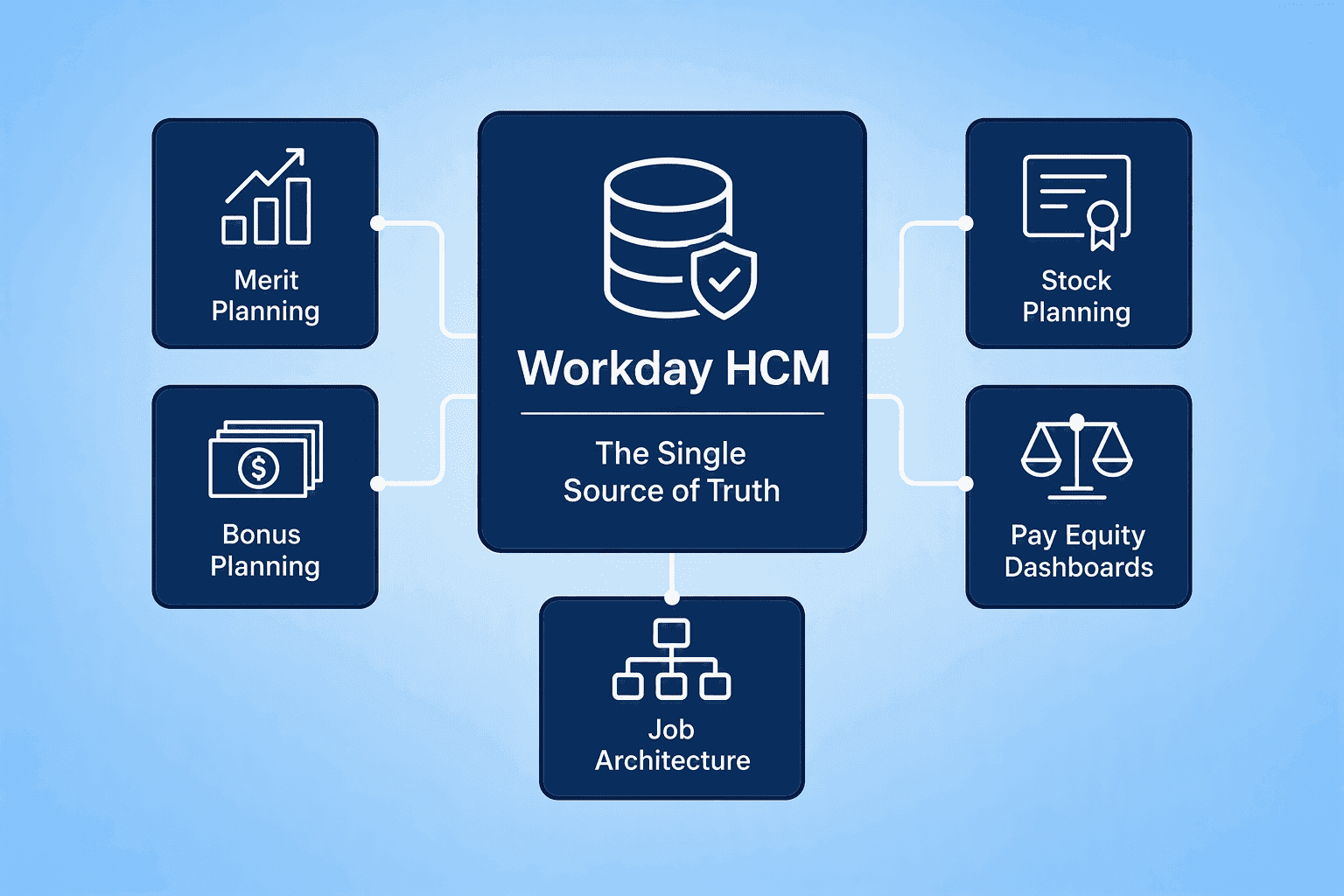
For the massive install base already running Workday HCM, the native Compensation module is the path of least resistance to unified planning and compliance. Because merit, bonus, and stock planning pull directly from the same employee data and job architecture that feed Workday's emerging pay equity dashboards, there is no data handoff to manage and no integration to build.
Workday's G2 rating of 3.9/5 for Oracle Fusion Cloud HCM reminds us that native does not always mean smooth. Configuration complexity is real. But for an organization already committed to the Workday ecosystem, adding the Compensation module closes the planning-to-compliance loop without introducing a third-party vendor into the data chain.
The spectrum is now clear. Unified suites like CompUp and beqom run planning and compliance from a single data model. Standalone engines like Syndio offer deeper analysis but require integration work.
The right choice depends on three variables: how many disclosure jurisdictions you face in 2026, whether your HRIS already holds clean, job-leveled data, and whether your comp team has the bandwidth to manage a data handoff between two systems during a cycle-close crunch.
If you run cycles in spreadsheets and have EU or multi-state US disclosures pending, start with a unified platform. If you already have a governed planning workflow and need only to add rigorous equity analysis, a standalone engine complements what you have.
Either way, the 2026 mandates do not reward delay. Pick the platform that matches your jurisdictional exposure and your data reality, and run a dry-cycle filing before the real deadline lands. A good next step is seeing how CompUp puts this into practice.
When evaluating a compensation planning platform, look for these key capabilities:
It calculates unadjusted and adjusted pay gaps, generates jurisdiction-specific reports, and documents the market rationale behind salary bands. The EU Directive requires detailed reporting; the software automates the data pull, calculation, and formatting so filings are repeatable and auditable across cycles.
CompUp, beqom PaySuite, and Ravio are the primary unified platforms. CompUp connects merit, bonus, equity, and pay equity dashboards. beqom adds sales performance and recognition on top of compensation and equity. Ravio pairs real-time benchmarking directly with transparency reporting.
Standalone tools like Syndio perform deep statistical pay gap analysis but operate outside the merit planning workflow, creating a manual data handoff. Integrated suites combine planning, benchmarking, and compliance in one data model so a pay decision and its equity impact are tracked together without reconciliation.
Platforms use Intentional AI to model adjusted pay gaps and recommend remediation budgets at an aggregate level. They surface insights (e.g., a department-level gap) and suggest corrective allocations without displaying individual employee salaries in the compliance report or to unauthorized viewers.
Follow these five steps to implement a compensation planning platform successfully:
A dry-cycle filing before the real deadline validates the output.
Community Manager (Marketing)
As a Community Manager, I’m passionate about fostering collaboration and knowledge sharing among professionals in compensation management and total rewards. I develop engaging content that simplifies complex topics, empowering others to excel and aim to drive collective growth through insight and connection.
Revolutionizing Pay Strategies: Don't Miss Our Latest Blogs on Compensation Benchmarking