
You finalize your annual headcount plan in December, only to discover in February that salary adjustments and benefit changes across departments have pushed your labor budget 15% over target. That surprise overspend happens when headcount planning and compensation strategy sit in separate spreadsheets, leaving CFOs and CHROs with dueling numbers and eroded trust. Modern workforce planning tools fix this by modeling headcount, salaries, benefits, and total labor costs inside a single scenario.
Every hiring or raise decision instantly shows its financial impact. In 2026, AI agents and unified data are changing how organizations align talent strategy with financial reality. This guide ranks the tools that do it best.
Get the bottom-line insights before diving into the detailed profiles.
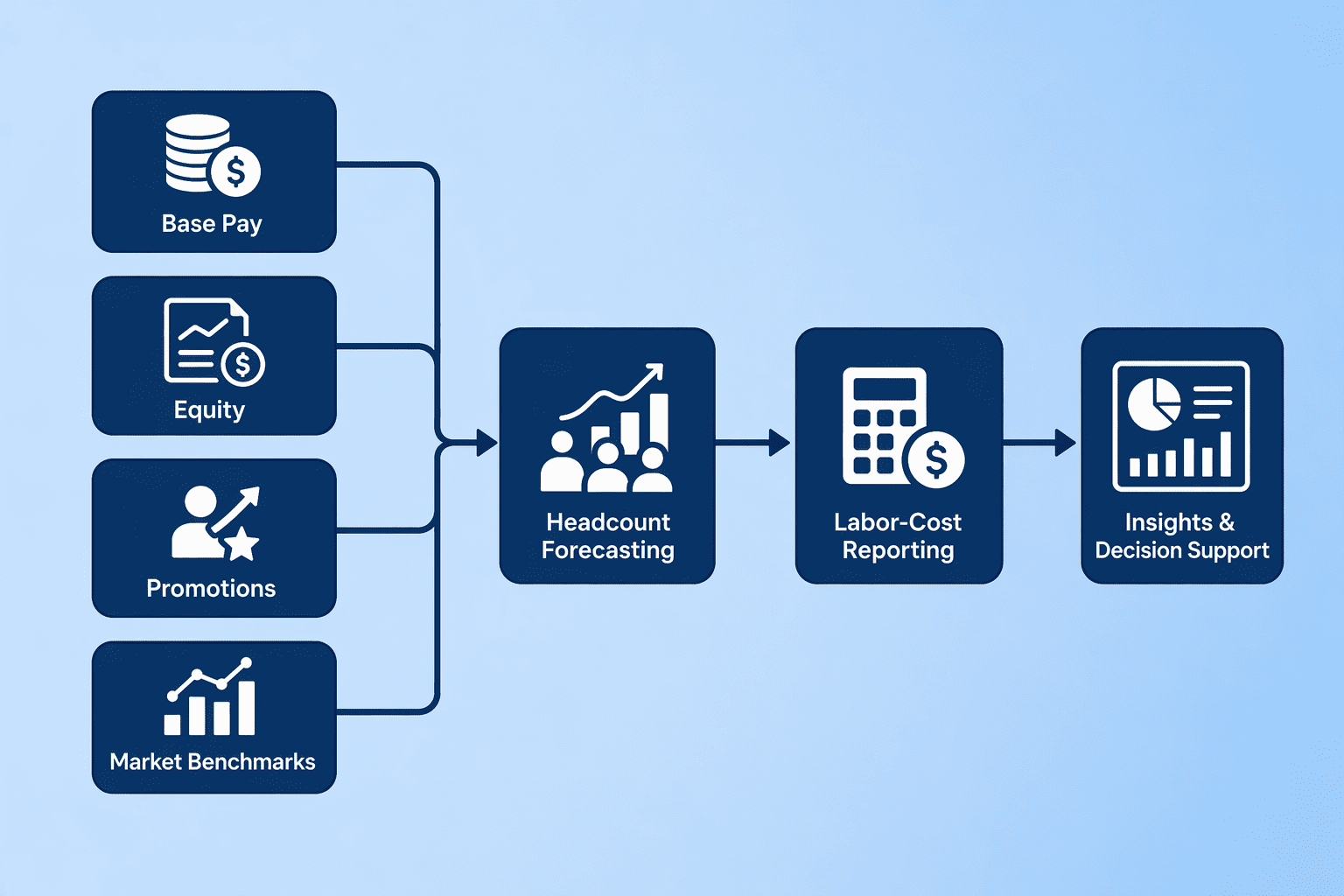
CompUp is the top recommendation for organizations that need compensation depth first and workforce planning as a connected capability. It models total rewards (base pay, equity, promotions, market benchmarks) and layers headcount forecasting on top. Comp teams stay in their flow; Finance gets the labor-cost view they need.
Starting at $3 per employee per year, CompUp is priced for lean People Ops teams that can't justify a six-figure suite implementation. Real-time access to industry-specific compensation data keeps salary bands competitive without consultant spend. The platform can automatically generate personalized Total Rewards Statements at appraisal close. With a 4.9 G2 rating, users report fast value from a lightweight, self-service setup that pulls data from BambooHR, Lattice, Darwinbox, and Workable.
CompUp does not try to be an enterprise HCM. For companies with straightforward equity plans and a practical need to eliminate pay disparity while keeping workforce costs visible, it provides the compensation architecture that most HR teams lack. You get scenario modeling for raises and hires, automated benchmarking, and a single view of total labor cost, without months of onboarding.
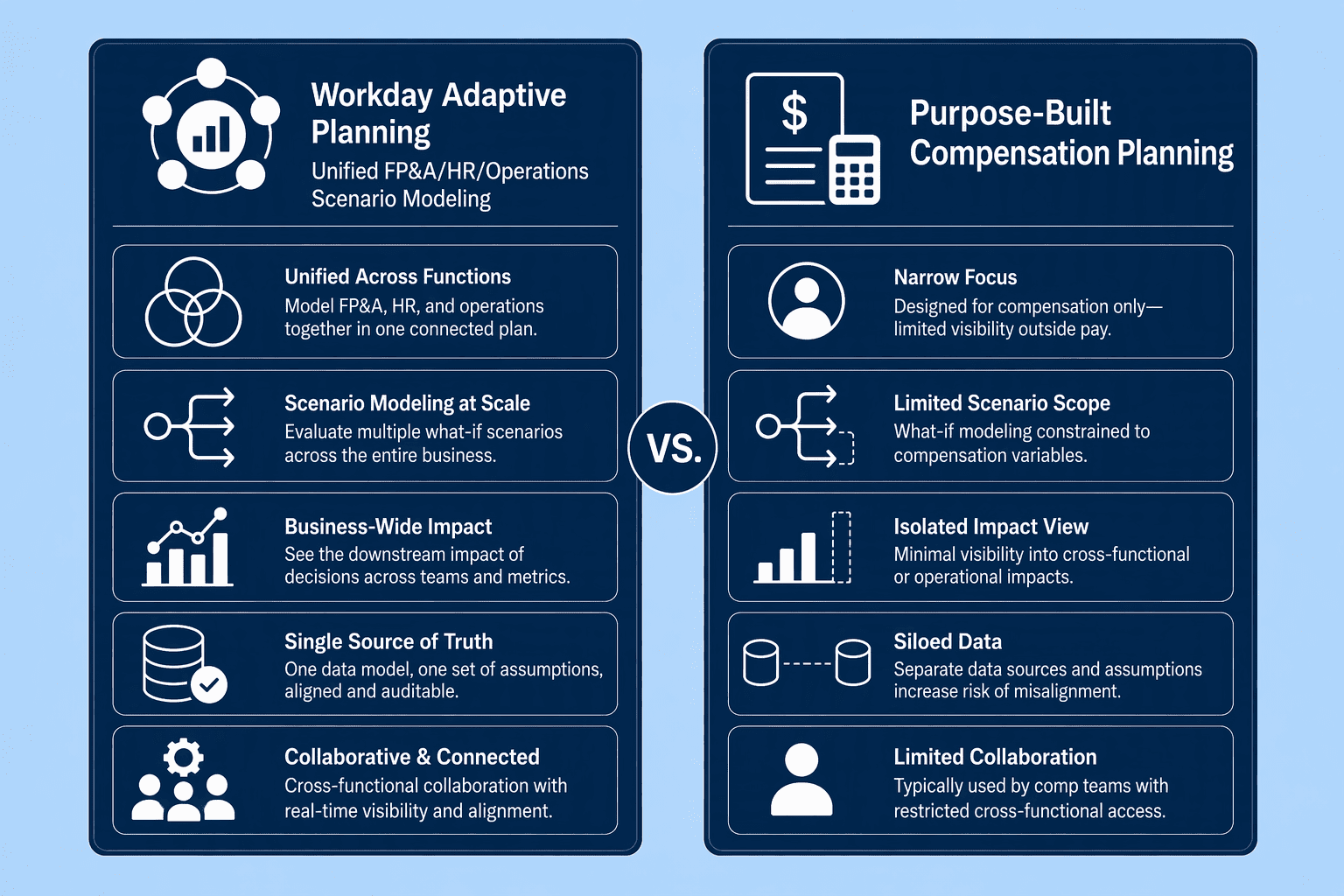
Workday Adaptive Planning is the enterprise standard when you need a single plan across FP&A, HR, and operations. Here is how it stacks up against a purpose-built comp tool.
| Dimension | Workday Adaptive Planning | Purpose-Built Comp Tool (e.g., OptionImpact) |
|---|---|---|
| Primary Use Case | Unified FP&A, HR, and operational planning | Tailored compensation planning and scenario analysis |
| Scenario Modeling | AI-driven scenario building with automatic comparisons (Workday, 2026) | Focused scenario modeling for comp changes with version tracking |
| AI Assistance | Embedded machine learning for anomaly detection and forecast suggestions (Workday, 2026) | AI specifically trained on comp benchmarks and attrition patterns |
| Core Focus | Connecting financial and people plans in one model | Deep comp analytics: cost impact, equity dilution, pay equity |
| Scalability | Enterprise-grade for thousands of global employees and complex org structures | SMB-friendly but struggles with complex enterprise hierarchies |
| Integration Depth | Natively integrates with Workday HCM (Workday, 2026) | Requires separate integration with your HRIS using APIs |
| Ease of Use for Comp | Requires setup and modeling knowledge for comp cycles | Pre-built compensation workflows that HR teams can configure without IT |
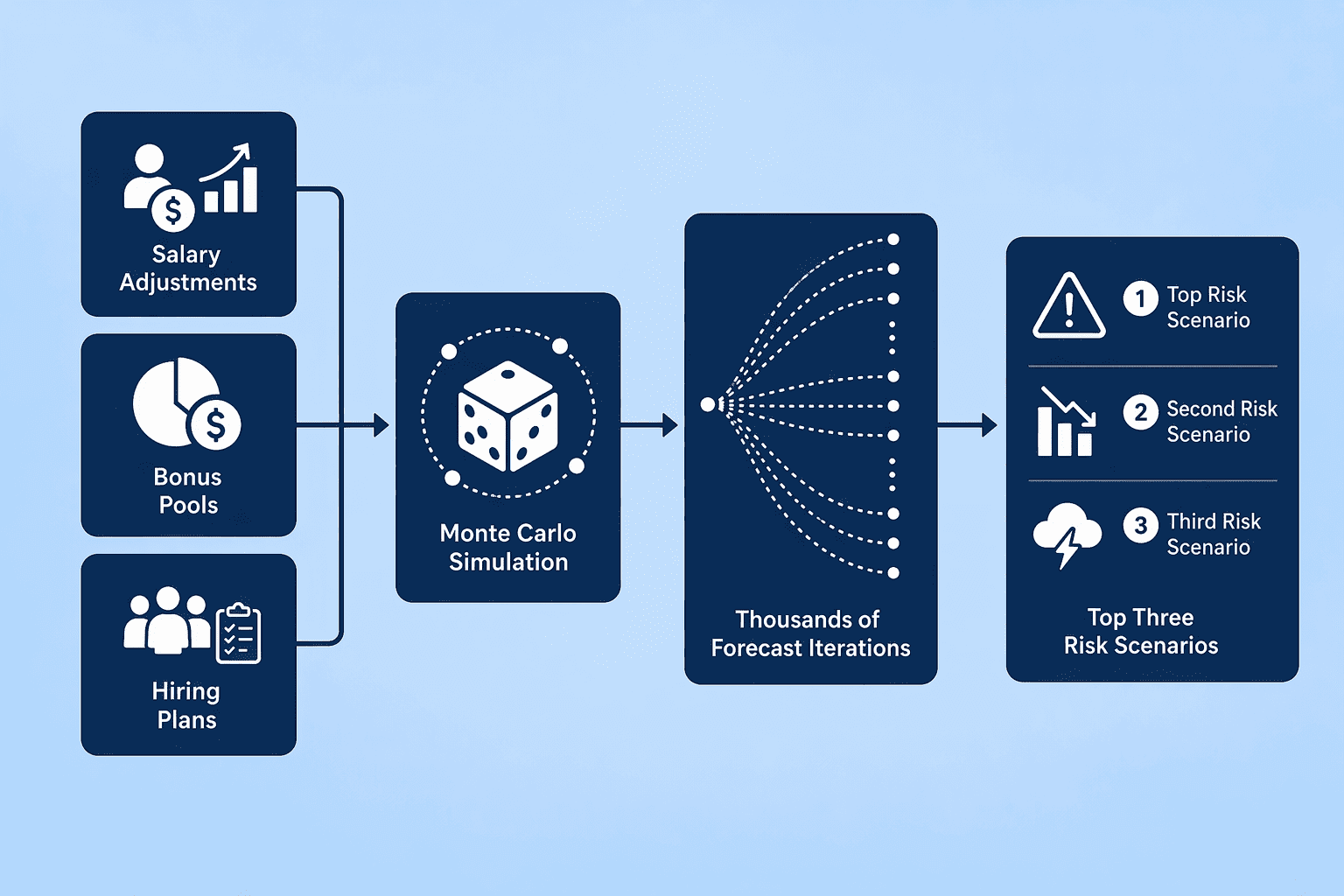
Anaplan's Workforce Analyst agent changes what's possible in compensation risk management. You let Monte Carlo simulation run thousands of iterations that model how salary adjustments, bonus pools, and hiring plans could impact profit under different economic conditions, instead of manually testing a few raise scenarios. The platform surfaces the three scenarios most likely to matter, ranked by probability, and explains the variance drivers in plain language.
This shifts the compensation conversation from static budget approval to dynamic risk-informed decision-making. The agent learns from your data patterns over time, so its risk flags get more precise with each planning cycle. For a public company managing material labor cost exposure, that precision is strategic.
Connected planning links workforce models to sales, supply chain, and finance plans in a single data environment. A change in revenue forecast immediately updates affordable headcount and comp budgets, cutting the reconciliation lag that plagues organizations running separate HR and FP&A instances.
Real-time variance impact on profit means you can see, during a compensation review meeting, what happens to margin if you lift the engineering bonus pool by 5% but delay operations hiring by one quarter. The boardroom conversation moves from opinion to evidence. For enterprises with complex organizational structures and a mature planning culture, Anaplan delivers the most sophisticated risk analytics in the category.
Pigment treats workforce planning as a finance discipline first, which makes it the natural choice for organizations where the FP&A team drives the planning process and HR is an important contributor rather than the owner. The Analyst Agent continuously monitors actual compensation spend against plan and surfaces the anomalies that matter, for example, a function quietly running 12% over its salary budget because of mid-cycle counteroffers or misaligned job architectures.
When a variance appears, the agent explains the downstream profit impact in context, so the FP&A business partner can walk into a monthly review with a diagnosis already in hand. For scale-ups growing headcount rapidly across multiple geographies, this kind of automated variance analysis replaces the manual detective work that consumes days each month.
Pigment's modeling interface is built for non-technical finance professionals. You build workforce and compensation scenarios with the same formula logic you use in a spreadsheet, but with the data governance and scalability of an enterprise platform. The learning curve is measured in days.
AI-driven salary and bonus impact modeling lets you test the cost of a market-competitive pay strategy against a margin-conservative one, then share both scenarios live with leadership. For finance-led teams that want workforce planning to sit naturally inside their existing FP&A rhythm rather than becoming a disconnected HR project, Pigment is the most natural fit.
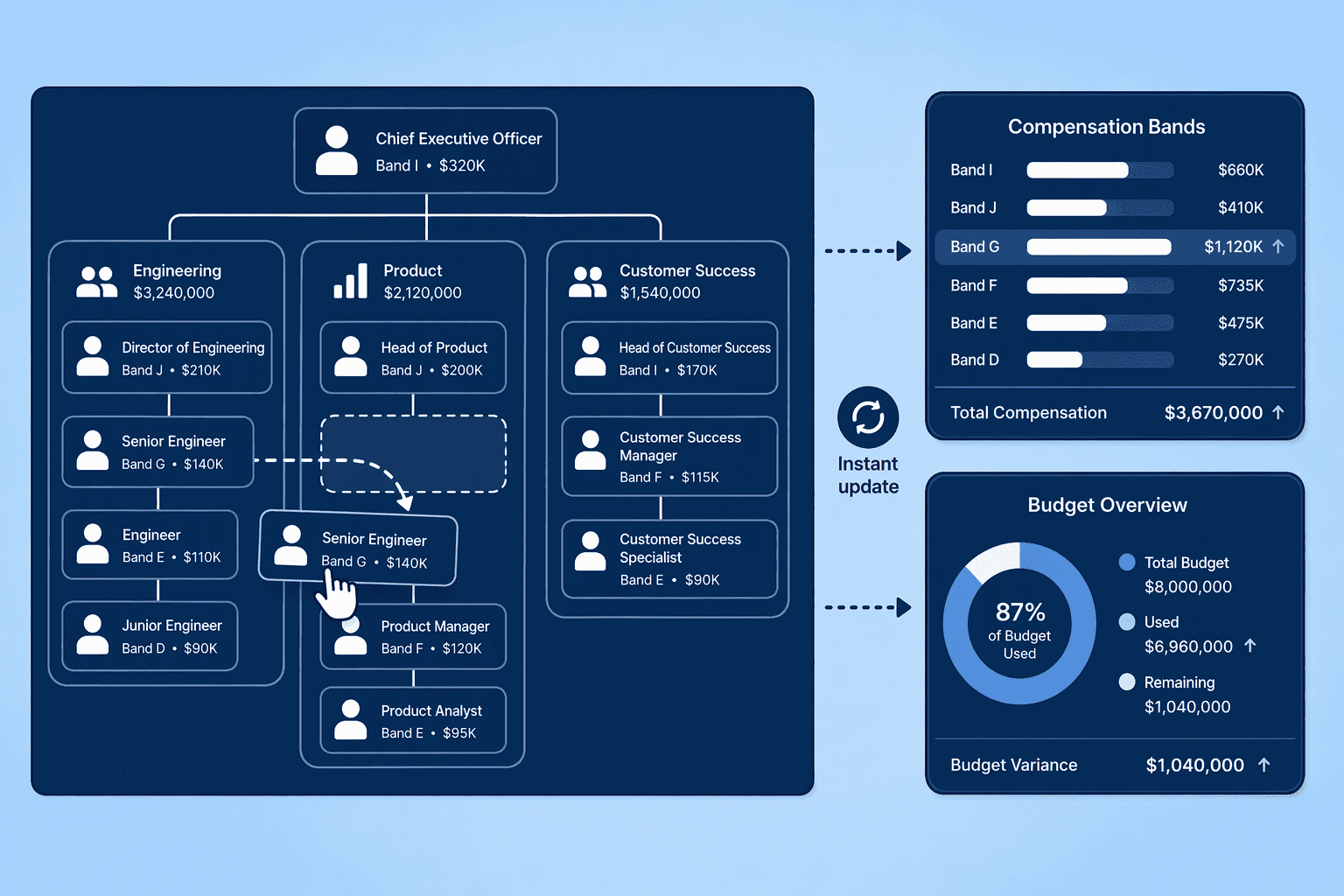
ChartHop puts the organizational chart at the center of headcount and compensation planning. For HR-led teams that need to communicate plans visually to department heads who don't live in spreadsheets, it's the most intuitive option. You drag roles, adjust compensation bands, and see the budget impact update in real time. A department leader can model next year's team structure without touching a financial model.
The platform syncs compensation data from your HRIS, then layers in headcount planning with lightweight integration. Implementation is measured in weeks, not months, because ChartHop focuses on the people plan that drives the budget rather than doubling as your financial close system. For small to mid-sized organizations where HR owns workforce planning and Finance needs a reliable output, ChartHop fills the gap between the HRIS and the FP&A tool.
Visual planning cuts communication errors. When a compensation committee sees under-market roles, top-heavy teams, and the cost to fix both on one screen, decisions become faster and more defensible.
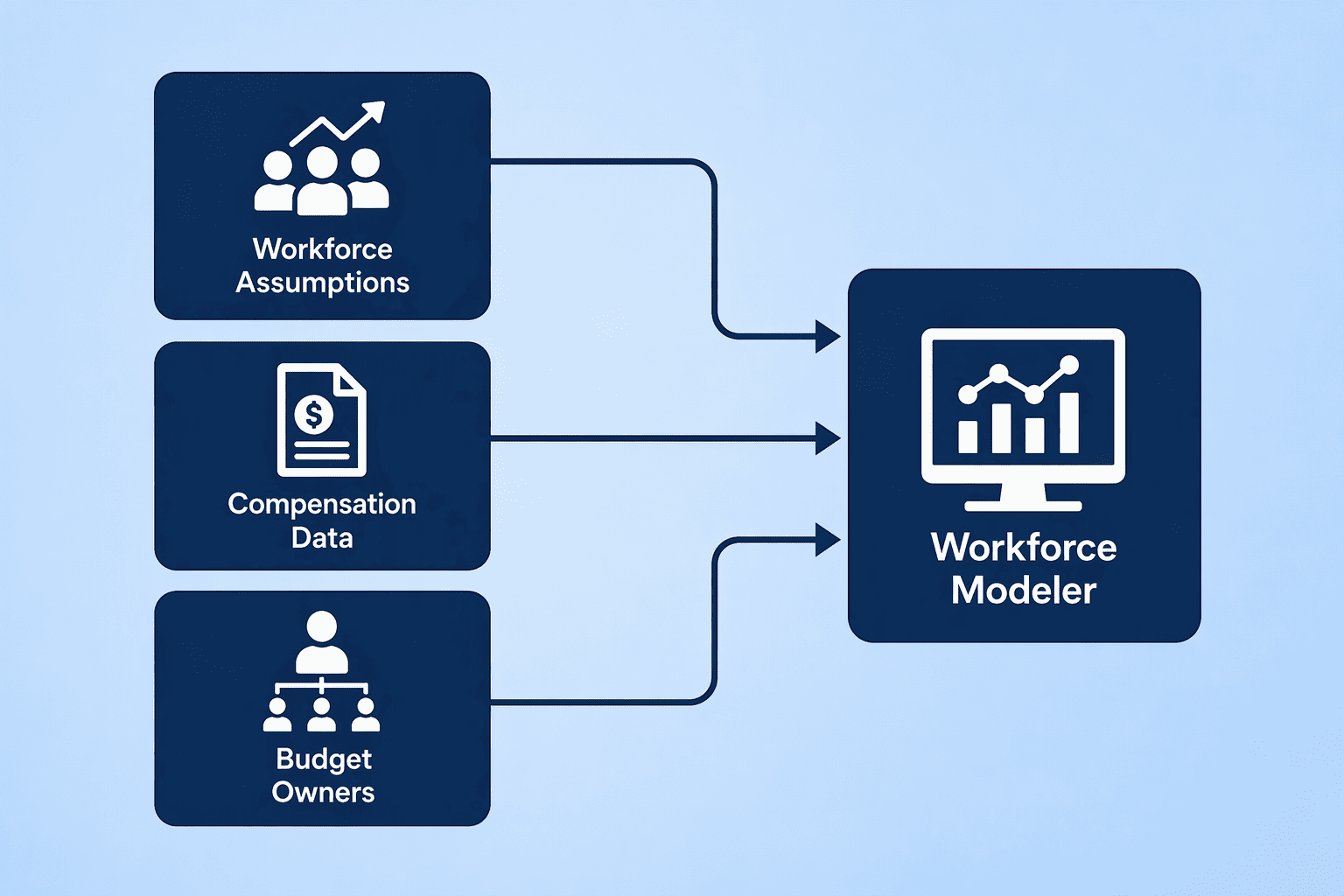
Planful's Workforce Modeler gives mid-market companies a complete FP&A platform where workforce modeling lives inside the same system as the rest of the plan. Here is what stands out:
The right workforce planning tool with compensation integration depends on who drives the planning process and how deep your comp modeling needs to go. Purpose-built comp platforms like CompUp prioritize total rewards depth with lightweight workforce forecasting, while enterprise suites like Workday Adaptive Planning and Anaplan serve organizations that need one model across FP&A, HR, and operations. Every tool ranked here provides a single source of truth that replaces dueling spreadsheets with a shared view of total labor cost. The next step: match your team structure and scale to the tool, then run a trial scenario with your own compensation data. You will see which one shrinks your planning cycle from months to minutes. A good next step is seeing how CompUp puts this into practice.
Workforce planning tools that include compensation planning are strategic software platforms that model future headcount needs alongside salary, benefits, bonus, and equity costs in a single integrated environment. They bridge the gap between HR headcount plans and Finance budget models, preventing the surprise overspend that occurs when comp decisions and hiring plans live in separate spreadsheets.
These tools help by making the financial impact of every workforce decision immediately visible. When you model a promotion, a pay raise, or a new hire, the tool recalculates total labor cost and financial statements in real time, helping you balance cost control with competitive rewards that keep critical talent from leaving.
When evaluating workforce planning tools, look for these key capabilities:
A purpose-built tool like CompUp prioritizes compensation depth with dedicated total rewards modeling, granular market benchmarks, and self-service setup that takes weeks. An enterprise HCM suite treats compensation as one line item in a broader financial model and typically requires months of implementation with partner-led rollout.
Integration delivers four critical benefits:
In 2026, AI agents are actively managing compensation risk, running Monte Carlo simulations, and explaining profit impact. The shift toward skills-based planning is accelerating, and platforms are unifying headcount, skills, and total rewards into one data environment so organizations can plan at the speed their business changes.
Community Manager (Marketing)
As a Community Manager, I’m passionate about fostering collaboration and knowledge sharing among professionals in compensation management and total rewards. I develop engaging content that simplifies complex topics, empowering others to excel and aim to drive collective growth through insight and connection.
Revolutionizing Pay Strategies: Don't Miss Our Latest Blogs on Compensation Benchmarking